 Back
BackRotational Motion and Energy: Step-by-Step Physics Study Guide
Study Guide - Smart Notes
 Tailored notes based on your materials, expanded with key definitions, examples, and context.
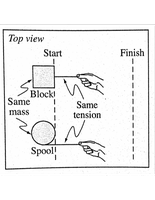
Q1. Will the spool cross the finish line before the block, after the block, or is it a tie?
Background
Topic: Rotational Motion and Translational Motion
This question tests your understanding of how rotational inertia affects the motion of objects when pulled by a string, specifically comparing a block (which only translates) and a spool (which both translates and rotates).
Key Terms and Formulas:
Translational kinetic energy:
Rotational kinetic energy:
Moment of inertia (): Resistance to rotational acceleration
Newton's Second Law for rotation:
Step-by-Step Guidance
Consider the forces acting on both the block and the spool. Both are pulled by a string with the same tension and have the same mass.
For the block, all the energy from the tension goes into translational motion ().
For the spool, the energy from the tension is split between translational motion () and rotational motion (), since the spool rotates as it moves.
Think about how this division of energy affects the acceleration and speed of the spool compared to the block.
Set up the equations for energy and acceleration for both objects, but stop before calculating the final velocities or times.
Try solving on your own before revealing the answer!
Final Answer: The block crosses the finish line before the spool.
The block accelerates faster because all the tension energy goes into its translational motion, while the spool must also rotate, dividing the energy between translation and rotation.
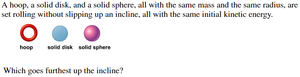
Q2. A hoop, a solid disk, and a solid sphere, all with the same mass and radius, are set rolling without slipping up an incline, all with the same initial kinetic energy. Which goes furthest up the incline?
Background
Topic: Rotational Kinetic Energy and Conservation of Energy
This question tests your understanding of how the distribution of mass (moment of inertia) affects how far different objects roll up an incline when they start with the same kinetic energy.
Key Terms and Formulas:
Moment of inertia (): , ,
Total kinetic energy:
Conservation of energy:
Step-by-Step Guidance
Recall that all objects start with the same total kinetic energy, which is split between translational and rotational components.
Write the expressions for rotational kinetic energy for each object using their respective moments of inertia.
Set up the conservation of energy equation: the initial kinetic energy is converted into gravitational potential energy as the object rolls up the incline.
Compare how the different moments of inertia affect the conversion of kinetic energy to height.
Stop before calculating the exact maximum height for each object.
Try solving on your own before revealing the answer!
Final Answer: The solid sphere goes furthest up the incline.
The sphere has the smallest moment of inertia relative to its mass, so more of its kinetic energy is available for translation, allowing it to reach a greater height.
