 Back
BackRotational Motion: Concepts and Applications
Study Guide - Smart Notes
 Tailored notes based on your materials, expanded with key definitions, examples, and context.
Rotational Motion
Circular Motion
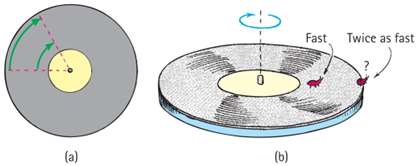
Circular motion occurs when an object turns about an axis that passes through it. This type of motion is fundamental in physics and is characterized by two distinct types of speed: tangential (linear) speed and rotational (angular) speed.
Tangential Speed: The distance traveled by a point on a rotating object divided by the time taken to travel that distance. Points closer to the circumference have higher tangential speed than those near the center.
Rotational Speed: The number of rotations or revolutions per unit time. All points on a rigid rotating object have the same rotational speed.
Relationship: Tangential speed is given by , where is the radial distance and is the rotational speed.
Example: On a spinning disk, points at the edge move faster than those near the center.
Rotational Inertia
Definition and Dependence
Rotational inertia (symbol I) is the property of an object to resist changes in its rotational state of motion. It depends on the mass of the object and the distribution of mass relative to the axis of rotation.
Mass and Distribution: The greater the distance between an object's mass concentration and the axis, the greater the rotational inertia.
Axis of Rotation: Rotational inertia varies depending on the axis about which the object rotates.
Shape and Axis: Different shapes and axes yield different rotational inertia values.
Example: A tightrope walker uses a long pole with high rotational inertia for stability.



Torque
Definition and Calculation
Torque is the influence that changes the rotational speed of an object, established by a force acting at a point not on the rotational axis. It depends on the magnitude of the force, the direction of the force, and the point of application.
Formula:
Lever Arm: The lever arm depends on where the force is applied, the axis of rotation, and the direction of the force.
Example: Using a wrench, the torque increases as the lever arm increases or the force is applied more perpendicularly.

Center of Mass and Center of Gravity
Definitions and Determination
The center of mass (CM) is the average position of all the mass in an object, while the center of gravity (CG) is the average position of weight distribution. For most objects, these points coincide.
Determining CG: Suspend the object from two different points and draw vertical lines; the intersection is the CG.
Stability: If the line from the CG falls within the base, the object is stable; if outside, it is unstable.
Example: The Leaning Tower of Pisa remains stable because its CG falls within its base.


Centripetal Force
Definition and Equation
A centripetal force is directed toward the center of a rotational motion, keeping an object moving in a circle. It depends on the mass, tangential speed, and radius of the circle.
Formula:
Example: Friction between tires and road provides centripetal force for a car rounding a curve.


Centrifugal Force
Apparent Force and Misconceptions
Inside a rotating system, an occupant seems to experience an outward force called centrifugal force. This is an apparent force, not a real one, and is often misunderstood.
Misconception: If the string breaks, the object moves tangentially, not outward, due to Newton's first law.
Rotating Reference Frames: Centrifugal force feels real in a rotating frame, such as a bug in a spinning can.


Simulated Gravity
Application in Space Stations
Centrifugal force can be used to simulate gravity in space stations by spinning them. Occupants experience a force similar to gravity, which can be adjusted by changing the radius and rotational speed.
Example: To simulate Earth's gravity (), a space station could have a radius of about 1 km and rotate at 1 revolution per minute.

Angular Momentum
Definition and Conservation
Angular momentum is the "inertia of rotation" and is analogous to linear momentum. It is given by the product of rotational inertia and angular velocity.
Formula:
For small objects:
Conservation: If no external net torque acts, angular momentum remains constant.
Example: A spinning person increases rotational speed by pulling weights inward.

Summary Table: Rotational Inertia for Common Shapes
The rotational inertia depends on the shape and axis of rotation. Below is a summary table for common objects:
Object | Axis | Rotational Inertia (I) |
|---|---|---|
Simple pendulum | About pivot | |
Hoop | Normal axis | |
Hoop | Diameter | |
Stick | About end | |
Stick | About center of gravity | |
Solid cylinder | About CG | |
Solid sphere | About CG |
