 Back
BackRotational Motion: Concepts, Equations, and Applications
Study Guide - Smart Notes
 Tailored notes based on your materials, expanded with key definitions, examples, and context.
Rotational Motion
Introduction to Rotational Motion
Rotational motion is a fundamental topic in physics, describing how objects rotate about a fixed axis. Understanding rotational motion is essential for analyzing the behavior of rigid bodies in various physical systems, from everyday objects to celestial bodies. - Rigid Body: An object whose size and shape do not change as it moves. - Rotational Velocity: The rate at which an object rotates about an axis. - Rotational Acceleration: The rate of change of rotational velocity. 
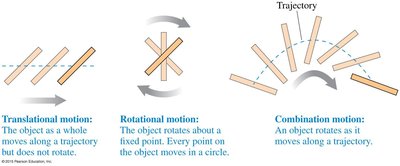
Kinematics of Rotational Motion
Rotational kinematics describes the motion of objects using quantities analogous to those in linear motion. - Rotational Position (θ): Measured in radians, it specifies the angular location of a point. - Rotational Velocity (ω): Measured in radians per second (rad/s), it describes how fast an object rotates. - Rotational Acceleration (α): Measured in radians per second squared (rad/s²), it describes how quickly the rotational velocity changes. Key Equations: 
Comparing Linear and Rotational Motion
Many physical quantities in rotational motion have direct analogs in linear motion. - Position: Linear (x), Rotational (θ) - Velocity: Linear (v), Rotational (ω) - Acceleration: Linear (a), Rotational (α) Example: A spinning wheel's angular velocity is analogous to a car's speed along a road.
Moment of Inertia (Rotational Inertia)
The moment of inertia (MOI) is the rotational equivalent of mass in linear motion. It quantifies an object's resistance to changes in rotational motion and depends on both the mass and its distribution relative to the axis of rotation. - Definition: where is the mass of each particle and is its distance from the axis of rotation. - Physical Meaning: Objects with mass farther from the axis have larger moments of inertia and are harder to rotate. 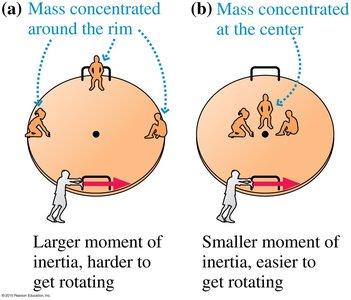


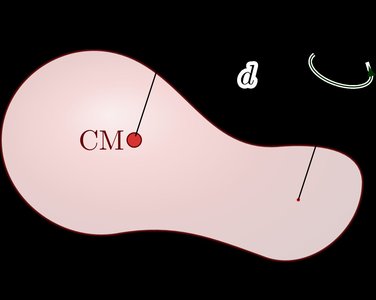

Parallel Axis Theorem
The parallel axis theorem allows calculation of the moment of inertia about any axis parallel to one passing through the center of mass (CoM). - Equation: where is the moment of inertia through the CoM, is the total mass, and is the distance between axes. 
Rotational Dynamics: Newton's Second Law for Rotation
Rotational dynamics relates the net torque exerted on a body to its rotational acceleration and moment of inertia. - Torque (τ): The rotational equivalent of force, causing angular acceleration. - Newton's Second Law for Rotation: where is the net torque, is the moment of inertia, and is the angular acceleration. 
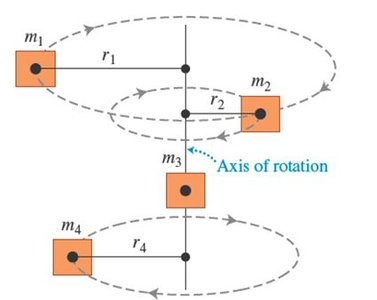

Rotational Momentum (Angular Momentum)
Rotational momentum, or angular momentum (), is the product of an object's moment of inertia and its rotational velocity. - Equation: - Conservation: For an isolated system (zero net torque), angular momentum is conserved. - Direction: Positive for counterclockwise, negative for clockwise rotation. 
Rotational Kinetic Energy
Rotational kinetic energy is the energy due to the rotation of a rigid body about a particular axis. It is included in the work-energy principle. - Equation: - Translational Equivalent: 
Applications and Everyday Examples
Rotational motion concepts are applied in various real-world scenarios, such as: - Bicycle wheels: Understanding why it is easier to balance a moving bike than a stationary one. - Celestial bodies: Explaining how stars can rotate rapidly and how the Moon affects Earth's rotation. - Playground equipment: Analyzing the effect of mass distribution on the ease of rotation. 
Summary Table: Rotational vs. Translational Quantities
Translational Quantity | Rotational Quantity |
|---|---|
Position (x) | Angle (θ) |
Velocity (v) | Angular velocity (ω) |
Acceleration (a) | Angular acceleration (α) |
Mass (m) | Moment of inertia (I) |
Force (F) | Torque (τ) |
Linear momentum (p) | Angular momentum (L) |
Kinetic energy () | Rotational kinetic energy () |
Key Takeaways
- Rotational motion is described using angular position, velocity, and acceleration. - Moment of inertia quantifies resistance to rotational acceleration and depends on mass distribution. - Newton's second law for rotation relates torque, moment of inertia, and angular acceleration. - Angular momentum is conserved in isolated systems. - Rotational kinetic energy is a form of energy due to rotation. Additional info: Academic context and equations have been expanded for clarity and completeness. Images included are directly relevant to the explanation of each paragraph.
