 Back
BackRotational Motion: Concepts, Equations, and Applications
Study Guide - Smart Notes
 Tailored notes based on your materials, expanded with key definitions, examples, and context.
Rotational Motion
Introduction to Rotational Motion
Rotational motion describes the movement of objects around a fixed axis. Unlike linear motion, rotational motion involves angular quantities such as angular position, velocity, and acceleration. Understanding rotational motion is essential for analyzing the behavior of rigid bodies in physics.
Rigid body: An object that does not deform during motion.
Deformable body: An object that can change shape during motion.
Rotational coordinate system: The reference for measuring angular position, typically with θ = 0 at a chosen reference line and counterclockwise (CCW) as positive.
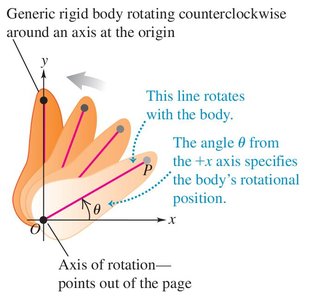
Angular Quantities
Angular quantities are used to describe rotational motion, analogous to linear quantities in straight-line motion.
Angular position (θ): The angle that specifies the orientation of a line with the body relative to a reference axis.
Angular velocity (ω): The rate of change of angular position with respect to time.
Angular acceleration (α): The rate of change of angular velocity with respect to time.
Greek letters: θ (theta), ω (omega), α (alpha) are commonly used to represent these quantities.
The Radian and Angular Measurement
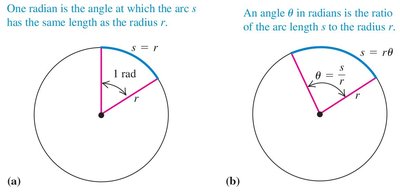
The radian is the standard unit for measuring angles in physics. It relates the arc length of a circle to its radius.
Definition: One radian is the angle at which the arc length s equals the radius r.
General formula:
Comparison of Linear and Angular Kinematics
Rotational motion equations closely parallel those of linear motion, with angular quantities replacing linear ones. The following table summarizes the analogies between linear and angular kinematic equations for constant acceleration:
Linear Motion | Rotational Motion |
|---|---|
Relating Linear and Rotational Quantities
Linear and angular quantities are related through the radius of rotation. These relationships are crucial for analyzing rolling and rotating objects.
Tangential velocity:
Tangential acceleration:
Radial (centripetal) acceleration:
The total acceleration is the vector sum:

Kinetic Energy in Rotational Motion
Rotating objects possess rotational kinetic energy, which depends on their moment of inertia and angular velocity.
Rotational kinetic energy:
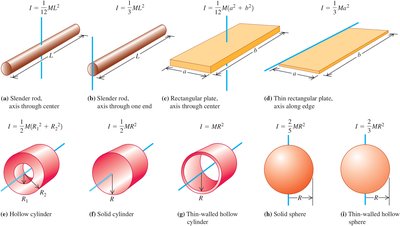
Moment of inertia (I): A measure of how mass is distributed relative to the axis of rotation. For a point mass, .
For extended objects, depends on the shape and axis of rotation.
Combined Translational and Rotational Motion
Objects can have both translational and rotational kinetic energy. The total kinetic energy is the sum of both contributions.
Translational kinetic energy:
Rotational kinetic energy about the center of mass:
Gravitational potential energy:
Rolling Without Slipping
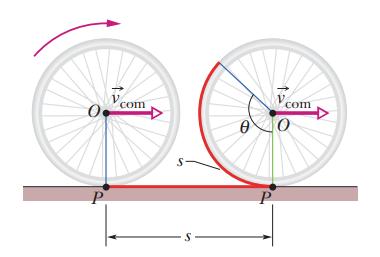
When an object rolls without slipping, there is a fixed relationship between its translational velocity and angular velocity.
Condition for rolling without slipping:

Applications: Race of Rolling Objects
When different objects roll down an incline, their moments of inertia affect their acceleration and final speed. For objects with the same mass and radius, the one with the smallest moment of inertia reaches the bottom first.
Example Problem: Rotational Kinematics
Example: A wheel turns with a constant angular acceleration of . How much time does it take to reach an angular velocity of from rest? Through how many revolutions does it turn in this interval?
Solution: (a) , (b) revolutions
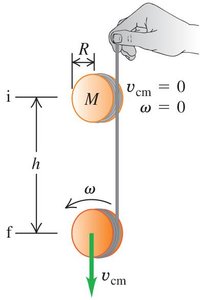
Example Problem: Rotation While the Axis Moves
Example: Find the center-of-mass speed and angular speed of a yo-yo after it has descended a height , given , , .
Solution: ,
Summary Table: Moments of Inertia for Common Shapes
Shape | Axis | Moment of Inertia (I) |
|---|---|---|
Slender rod | Center | |
Slender rod | End | |
Rectangular plate | Center | |
Thin rectangular plate | Edge | |
Hollow cylinder | Center | |
Solid cylinder | Center | |
Thin-walled hollow cylinder | Center | |
Solid sphere | Center | |
Thin-walled hollow sphere | Center |
Additional info: Some images and memes in the source material were omitted as they do not directly reinforce the academic content. The summary table above is inferred from standard physics references for completeness.
