 Back
BackRotational Motion: Concepts, Equations, and Applications
Study Guide - Smart Notes
 Tailored notes based on your materials, expanded with key definitions, examples, and context.
Rotational Motion of Rigid Bodies
Introduction to Rotational Motion
Rotational motion describes the movement of objects around a fixed axis. Unlike point particles, rigid bodies have a definite size and shape that do not deform during rotation. Examples include spinning wheels, rotating discs, and wind turbines.
Rigid Body: An object with fixed size and shape that cannot be stretched, twisted, or squeezed.
Axis of Rotation: The straight line around which the body rotates.

Measuring Angles in Rotational Motion
Radians and Angular Position
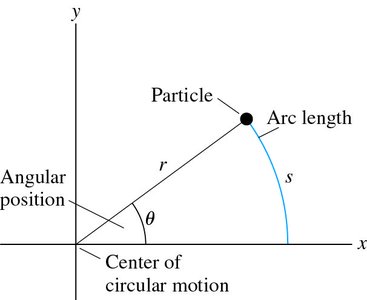
The angle of rotation is measured in radians, which is the ratio of the arc length s to the radius r of the circle.
Radian: The SI unit for measuring angles in rotational motion.
Conversion:
Angular Position (\(\theta\)): The angle measured counterclockwise from the positive x-axis is considered positive.
Angular Displacement
Definition and Calculation
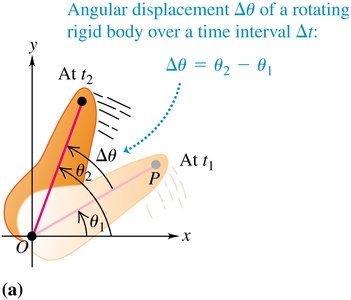
Angular displacement (\(\Delta \theta\)) is the change in angular position as a rigid body rotates about an axis.
Formula:
Measured in radians (rad).
Angular Velocity
Average and Instantaneous Angular Velocity
Angular velocity (\(\omega\)) describes the rate of change of angular displacement with respect to time.
Average Angular Velocity:
Instantaneous Angular Velocity:
Unit: rad/s
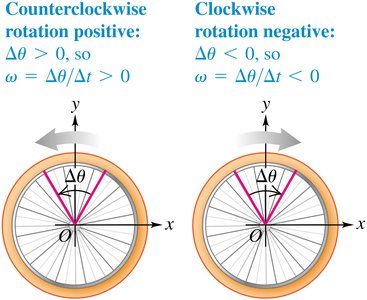
Counterclockwise rotation is positive by convention.
Comparison of Angular Velocities
All points on a rigid body rotating about a fixed axis have the same angular velocity, regardless of their distance from the axis. 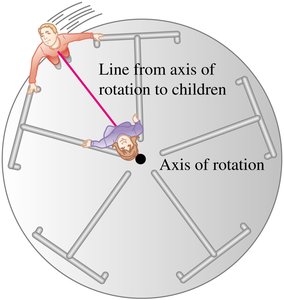
Angular Acceleration
Definition and Calculation
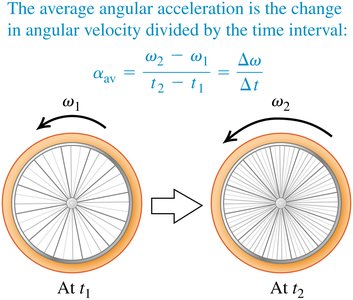
Angular acceleration (\(\alpha\)) is the rate at which angular velocity changes with time.
Average Angular Acceleration:
Instantaneous Angular Acceleration:
Unit: rad/s2
Sign of Angular Acceleration
The sign of angular acceleration depends on whether the angular velocity is increasing or decreasing. If an object is slowing down, \(\omega\) and \(\alpha\) have opposite signs. 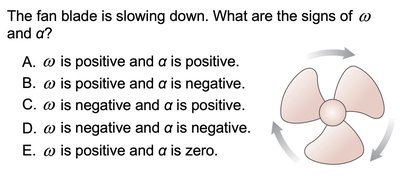
Equations of Rotational Motion with Constant Angular Acceleration
Key Equations
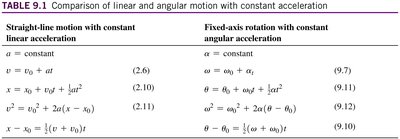
The equations for rotational motion with constant angular acceleration are analogous to those for linear motion:
Worked Example: Rotation of a Compact Disc
Problem Statement
A CD with radius 6.0 cm spins at 7200 rev/min.
Find the angular velocity in rad/s.
Calculate the time to rotate through 90°.
If starting from rest and reaching full speed in 4.0 s, find the average angular acceleration.
Solution Steps:
Convert rev/min to rad/s:
Time for 90°: ,
Average angular acceleration:

Quick Concept Checks
Sample Questions and Answers
When a wheel with constant angular acceleration turns through 25 rad in time t, after time 2t it will have turned through 100 rad. (\(\Delta \theta \propto (\Delta t)^2\))
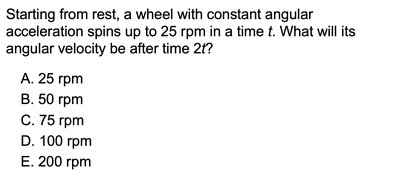
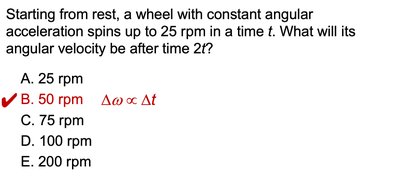
If a wheel spins up to 25 rpm in time t, after time 2t its angular velocity will be 50 rpm. (\(\Delta \omega \propto \Delta t\))
Summary Table: Linear vs. Angular Motion
Comparison of Equations
Straight-line motion with constant linear acceleration | Fixed-axis rotation with constant angular acceleration |
|---|---|
Applications of Rotational Motion
Everyday Examples
Rotational motion is observed in many real-world systems, such as wind turbines, gyroscopes, playground merry-go-rounds, and rotating machinery.
Wind Turbines: Convert wind energy into rotational energy to generate electricity.
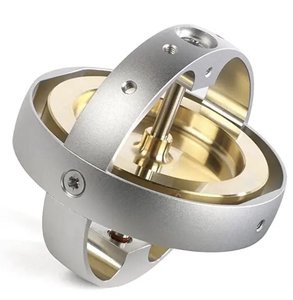
Gyroscopes: Used for navigation and stability in vehicles and spacecraft.
Merry-Go-Rounds: Demonstrate equal angular velocity for all riders, regardless of their distance from the axis.



Key Takeaways
Rotational motion is described using angular displacement, velocity, and acceleration.
Equations for rotational motion closely parallel those for linear motion.
Understanding sign conventions and units is crucial for solving problems in rotational dynamics.
