 Back
BackRotational Motion: Concepts, Formulas, and Applications
Study Guide - Smart Notes
 Tailored notes based on your materials, expanded with key definitions, examples, and context.
Rotational Motion
Types of Circular Motion
Rotational motion involves objects moving in a circular path. There are two main types of circular motion:
Rotation: An object spins around an internal axis (an axis located within the object itself).
Revolution: An object moves around an external axis (an axis located outside the object).
Examples:
Rotation: The Earth spinning on its axis.
Revolution: The Earth orbiting around the Sun.
Describing Circular Speeds
Circular motion can be described using two types of speeds:
Rotational (Angular) Speed: The rate at which something spins, measured in revolutions per minute (RPM) or radians per second (rad/s).
Linear (Tangential) Speed: The distance traveled around the circle divided by the time taken, measured in meters per second (m/s).
Example: If a merry-go-round makes 1 complete rotation in 1.25 seconds, its rotational speed is:
Number of rotations per second: rotations/second
To convert to RPM: RPM
Period (T): The time it takes to complete one full revolution.
For a wheel with diameter 39 m making one revolution in 8 seconds, the linear speed is:
where is the radius and is the period.
Centripetal Acceleration
Centripetal acceleration is the rate at which the direction of velocity changes for an object moving in a circle. It always points toward the center of the circle.
Formula:
Units: m/s2
Example: For a rider on a wheel with linear speed and radius , plug values into the formula above to find .
Accelerations are often described in terms of "g's":
1 g = 9.8 m/s2
The more "g's" you experience, the heavier you feel.
At 3g's, you feel three times as heavy as normal.
Many people pass out at around 5g's.
Astronauts on the ISS feel weightless (0g).
Centripetal Force
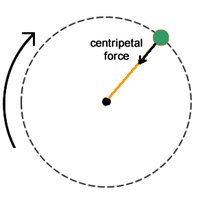
Centripetal force is the net force required to keep an object moving in a circular path, always directed toward the center of the circle. It is not a new type of force; rather, it can be provided by tension, gravity, friction, or other forces.
Formula:
Depends on the object's mass (), speed (), and radius of the circle ().
Example: For a 920 kg car traveling at 68 m/s on a curve of radius 75 m:
To find how many g's the rider feels:
Moving objects tend to go in a straight line (inertia). If centripetal force is removed, the object moves tangentially to the circle.
Centrifugal Force
Centrifugal force is a perceived force that seems to push objects away from the center of a circle. In reality, it is not a true force but the result of inertia—the tendency of an object to move in a straight line.
What feels like a force is actually your body wanting to continue in a straight line while the path curves.
Sample Problems: The Rotor Ride
A carnival ride called the Rotor has a radius of 3.00 m and takes 2.20 seconds to complete one revolution. For a person of mass 75 kg:
Linear speed:
Centripetal acceleration:
Centripetal force:
Additional info: These calculations illustrate the relationships between speed, acceleration, and force in rotational motion, and how they apply to real-world amusement park rides.
