 Back
BackRotational Motion: Concepts, Kinematics, and Energy
Study Guide - Smart Notes
 Tailored notes based on your materials, expanded with key definitions, examples, and context.
Rotational Motion
Introduction to Rotational Motion
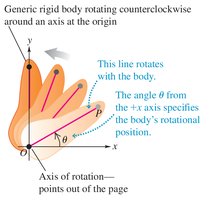
Rotational motion describes the movement of rigid bodies around a fixed axis. Unlike linear motion, where objects move along a straight path, rotational motion involves objects spinning or rotating about an axis. This chapter introduces the fundamental quantities and equations that govern rotational dynamics.
Rigid Body: An object with a fixed shape that does not deform during motion.
Axis of Rotation: The straight line about which the body rotates.
Angular Quantities
Measuring Angles: The Radian
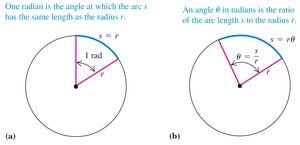
Angles in rotational motion are measured in radians, which relate the arc length of a circle to its radius. This unit is essential for connecting angular and linear quantities.
Radian (rad): The angle subtended at the center of a circle by an arc whose length equals the radius of the circle.
Conversion: radians = 360°, so 1 radian ≈ 57.3°.
Formula: , where is in radians, is arc length, and is radius.
Angular Displacement
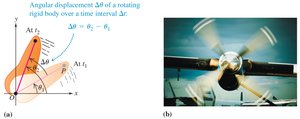
Angular displacement () measures the change in the rotational position of a body over a time interval. It is analogous to linear displacement in translational motion.
Units: Radians (rad)
Formula:
Direction: Counterclockwise is usually taken as positive, clockwise as negative.
Angular Velocity ()
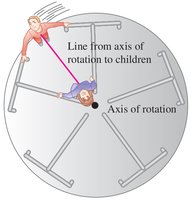
Angular velocity describes how quickly an object rotates, defined as the rate of change of angular displacement with respect to time.
Units: Radians per second (rad/s)
Formula:
Average Angular Velocity:
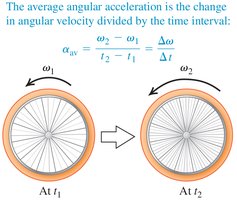
Angular Acceleration ()
Angular acceleration is the rate at which angular velocity changes with time. It is a vector quantity and can be positive or negative depending on the direction of rotation.
Units: Radians per second squared (rad/s²)
Formula:
Average Angular Acceleration:
Sign Conventions in Rotation
Positive and Negative Rotation
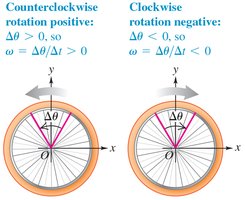
In rotational motion, the direction of rotation is important. By convention, counterclockwise rotation is considered positive, while clockwise rotation is negative. This affects the sign of angular displacement, velocity, and acceleration.
Counterclockwise: ,
Clockwise: ,
Relating Linear and Angular Quantities
Linear and Angular Variables
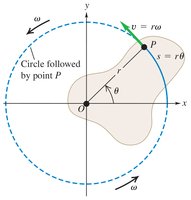
There is a direct relationship between linear and angular variables for points at a distance from the axis of rotation. These relationships allow us to translate between rotational and translational motion.
Arc Length:
Linear Velocity:
Linear Acceleration:
Tangential and Radial Acceleration
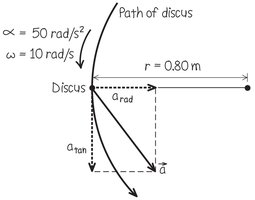
When an object rotates, it can experience both tangential and radial (centripetal) acceleration. Tangential acceleration is due to the change in the magnitude of velocity, while radial acceleration is due to the change in direction.
Tangential Acceleration:
Radial (Centripetal) Acceleration:
Kinematics of Rotational Motion
Equations for Constant Angular Acceleration
For rotational motion with constant angular acceleration, the following kinematic equations apply (analogous to linear kinematics):
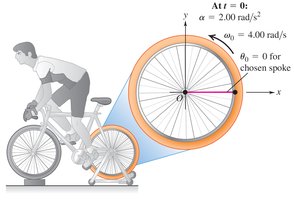
Example: A bicycle wheel starts from rest and accelerates at for 3 seconds. Find its angular velocity and angular displacement.
Kinetic Energy of Rotation and Moment of Inertia
Rotational Kinetic Energy
Rotational kinetic energy is the energy due to the rotation of a body and depends on its moment of inertia and angular velocity.
Formula:
Moment of Inertia (I): A measure of an object's resistance to changes in its rotation, depending on mass distribution relative to the axis.
Moment of Inertia
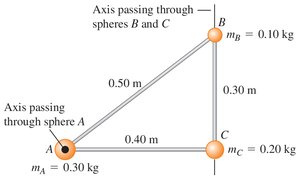
The moment of inertia quantifies how mass is distributed with respect to the axis of rotation. It plays a similar role in rotational motion as mass does in linear motion.
Formula: (for discrete masses)
For continuous bodies, integrate:
Different shapes have different moments of inertia (see Table 9.2 in your text).
Rotation About a Moving Axis
Rotational Motion with Translating Axis
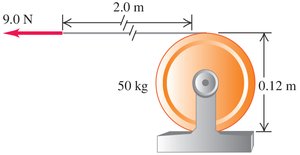
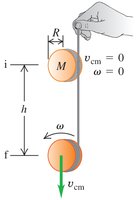
Some objects rotate while their axis of rotation itself moves, such as a rolling wheel or a yo-yo. In these cases, both rotational and translational motion must be considered.
Example: A yo-yo descending while spinning combines rotational and linear kinetic energy.
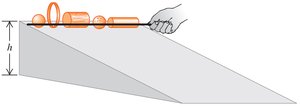
Race of Rolling Objects
Comparing Rotational Inertia in Rolling Motion
When objects of different shapes roll down an incline, their moments of inertia affect their acceleration and final speed. Objects with smaller moments of inertia relative to their mass reach the bottom faster.
Key Point: For the same mass and radius, a solid sphere will reach the bottom before a hollow cylinder.
Summary Table: Linear vs. Angular Motion
Comparison of Variables and Equations
The following table summarizes the analogies between linear and angular motion for constant acceleration:
Linear Quantity | Angular Quantity | Relationship |
|---|---|---|
Displacement () | Angular Displacement () | |
Velocity () | Angular Velocity () | |
Acceleration () | Angular Acceleration () | |
Mass () | Moment of Inertia () | |
Kinetic Energy () | Rotational Kinetic Energy () | — |
Additional info: For more details on moments of inertia for various shapes, refer to Table 9.2 in your textbook. The examples referenced in the notes (e.g., Examples 9.1–9.10) provide practical applications of these concepts.
