 Back
BackRotational Motion: Dynamics, Energy, and Applications
Study Guide - Smart Notes
 Tailored notes based on your materials, expanded with key definitions, examples, and context.
Rotational Motion
Angular Position, Velocity, and Acceleration
Rotational motion describes the movement of objects around a fixed axis. The key quantities are angular position (θ), angular velocity (ω), and angular acceleration (α).
Angular Position (θ): The angle an object has rotated, measured in radians (rad).
Angular Displacement (Δθ): The change in angular position.
Angular Velocity (ω): The rate of change of angular position, (unit: rad/s).
Angular Acceleration (α): The rate of change of angular velocity, (unit: rad/s2).
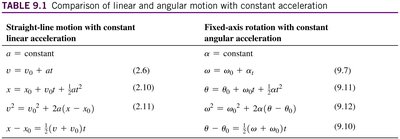
For constant angular acceleration, the equations of motion are analogous to those for linear motion:
Linear and Angular Quantities
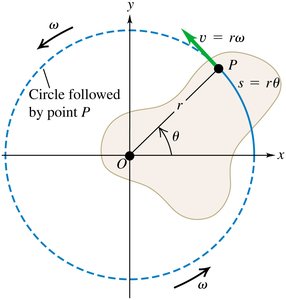
There is a direct relationship between linear and angular quantities for a point at a distance r from the axis of rotation:
Linear velocity:
Linear acceleration:
Moment of Inertia
The moment of inertia (I) quantifies how mass is distributed relative to the axis of rotation and determines the resistance to angular acceleration. It depends on both the mass and the geometry of the object.
For a point mass:
For continuous bodies,
Moment of inertia must always specify the axis of rotation.
Kinetic Energy of Rotation
A rotating rigid body possesses rotational kinetic energy:
For objects that both translate and rotate (e.g., rolling), the total kinetic energy is the sum of translational and rotational parts:
Work-Energy Theorem for Rotation
The work done by torques on a rotating object changes its rotational kinetic energy, analogous to the linear work-energy theorem.
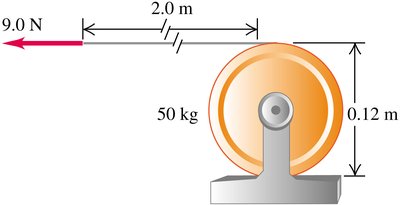
Example: A cable unwinds from a winch drum (solid cylinder) as a force is applied. The final angular velocity and speed of the cable can be found using energy methods.
Rotation About a Moving Axis
When the axis of rotation itself moves (e.g., rolling objects), the motion can be decomposed into:
Translational motion of the center of mass
Rotation about the center of mass
The total kinetic energy is always the sum of these two contributions.
Rolling Motion Without Slipping
For an object rolling without slipping, the point of contact with the surface is instantaneously at rest. The condition for rolling without slipping is:
During one revolution, the distance traveled is equal to the circumference:
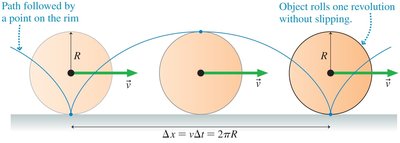
Energy in Rolling Motion
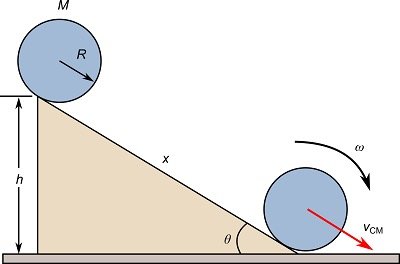
For a rolling object, the total kinetic energy is:
When rolling down an incline, gravitational potential energy is converted into both translational and rotational kinetic energy.
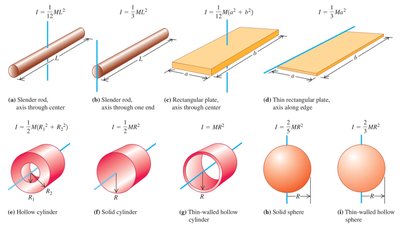
Moment of Inertia for Common Shapes
The moment of inertia depends on the mass distribution. For example:
Solid cylinder or disk:
Hollow cylinder:
Solid sphere:
Thin-walled hollow sphere:
Comparing Rolling Objects
When different objects roll down an incline, their acceleration and final speed depend on their moment of inertia. For objects of equal mass and radius, the one with the smaller moment of inertia reaches the bottom first.
Object | Moment of Inertia (I) | Relative Speed at Bottom |
|---|---|---|
Solid Cylinder | Fastest | |
Hollow Cylinder | Slowest | |
Solid Sphere | Faster than solid cylinder |
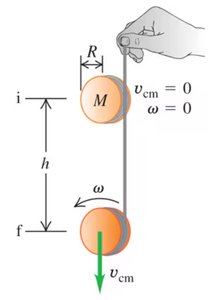
Sample Problem: Yo-Yo Dropping Down
For a yo-yo (solid disk) released from rest, the speed of the center of mass after dropping a height h can be found using energy conservation:
Potential energy lost = Total kinetic energy gained
For a solid disk, and
Solve for :
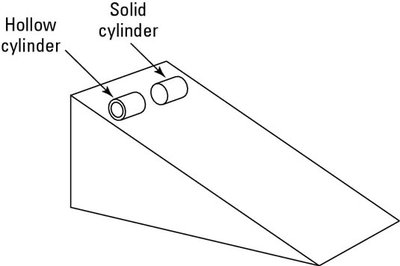
Quick Check: Solid vs Hollow Cylinder
When a solid cylinder and a hollow cylinder of equal mass and radius roll down an incline, the solid cylinder reaches the bottom first because it has a smaller moment of inertia, so more energy goes into translational motion.
Summary Table: Linear vs Angular Motion
Straight-line motion with constant linear acceleration | Fixed-axis rotation with constant angular acceleration |
|---|---|
Additional info: The above notes synthesize the provided slides and images, expanding on definitions, equations, and applications relevant to college-level physics on rotational motion. All equations are provided in LaTeX format as required.
