 Back
BackRotational Motion: Equations, Linear-Angular Relationships, and Moment of Inertia
Study Guide - Smart Notes
 Tailored notes based on your materials, expanded with key definitions, examples, and context.
Rotational Motion
Equations of Rotational Motion with Constant Angular Acceleration
Rotational motion about a fixed axis with constant angular acceleration is governed by equations analogous to those for linear motion. These equations describe how angular position, velocity, and acceleration are related over time.
Angular velocity:
Angular displacement:
Relationship between angular velocities and displacement:
Example: If a bicycle wheel increases its speed from 2 rad/s to 10 rad/s in 3 s, to find the number of revolutions, use the above equations in sequence: first solve for angular acceleration , then use it to find angular displacement .
Relationship Between Linear and Angular Quantities
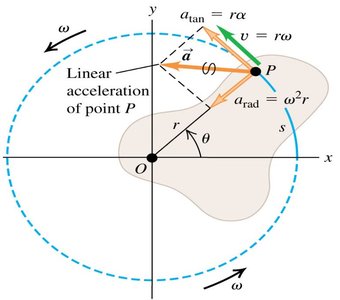
For a rigid body rotating about a fixed axis, the linear motion of a point at a distance r from the axis is related to the angular motion of the body. These relationships are fundamental for connecting rotational and translational dynamics.
Linear velocity:
Tangential acceleration:
Radial (centripetal) acceleration:
Arc length:
All points on a rigid object share the same angular speed and angular acceleration, but their linear speeds and accelerations depend on their distance from the axis of rotation.
Moment of Inertia
Definition and Physical Meaning
The moment of inertia (I) quantifies an object's resistance to changes in its rotational motion, analogous to mass in linear motion. It depends on both the mass of the object and how that mass is distributed relative to the axis of rotation.
Discrete mass distribution:
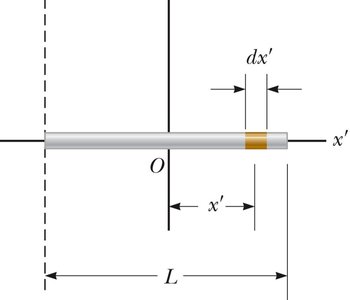
Continuous mass distribution:
Dependence: The value of I changes with the axis chosen and the mass distribution.
Example: For a system of point masses, sum for each mass at distance from the axis.
Rotational Kinetic Energy
An object rotating with angular speed possesses rotational kinetic energy, which is the sum of the kinetic energies of all its particles.
Rotational kinetic energy:
This energy is analogous to the translational kinetic energy .
Common Moments of Inertia
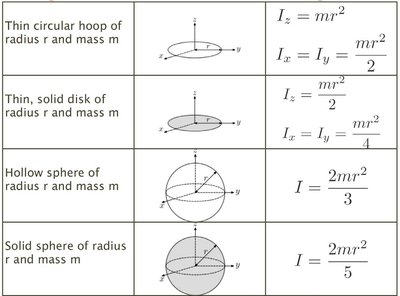
Different shapes have characteristic moments of inertia, depending on their geometry and axis of rotation. The following table summarizes moments of inertia for several common objects:
Object | Moment of Inertia |
|---|---|
Thin circular hoop (radius r, mass m) |
|
Thin, solid disk (radius r, mass m) |
|
Hollow sphere (radius r, mass m) | |
Solid sphere (radius r, mass m) |
Calculating Moment of Inertia: Examples
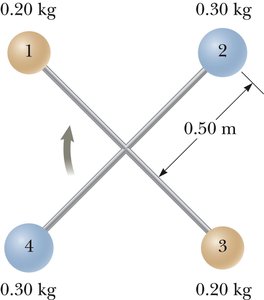
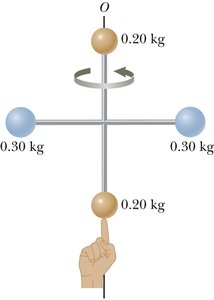
For systems of discrete masses, sum the products of each mass and the square of its distance from the axis. For continuous bodies, integrate over the mass distribution.
Example (discrete): For four masses at the ends of rods, .
Example (continuous): For a uniform thin rod of mass M and length L about its center, .
Additional info: The parallel axis theorem and perpendicular axis theorem are also useful for finding moments of inertia about axes not passing through the center of mass or for planar objects, respectively.
