 Back
BackRotational Motion: Moments of Inertia and Exam Preparation
Study Guide - Smart Notes
 Tailored notes based on your materials, expanded with key definitions, examples, and context.
Rotational Motion and Moments of Inertia
Exam Preparation and Key Chapters
This section provides guidance for preparing for an upcoming physics exam, with a focus on rotational motion and related chapters. The exam will cover Chapters 6, 7, 8, 9, and 10, which include topics such as work and kinetic energy, potential energy and conservation, momentum and collisions, rotation of rigid bodies, and dynamics of rotational motion. Students are reminded to review Newton's Laws and related concepts from earlier chapters as well.
Review Materials: Watch the recommended recordings and review the lecture notes and quizzes.
Practice Problems: Pay special attention to review problems and ensure proficiency in both symbolic and numerical solutions.
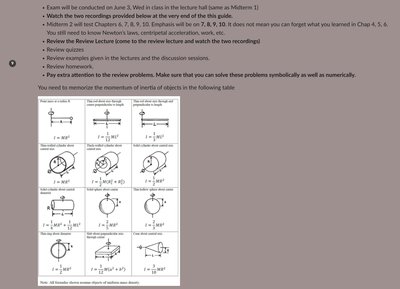
Key Focus: Memorize the moments of inertia for various objects, as summarized in the provided table.
Moments of Inertia: Definitions and Key Objects
The moment of inertia (I) quantifies an object's resistance to changes in its rotational motion about a specific axis. It depends on the mass distribution relative to the axis of rotation. The following table summarizes the moments of inertia for common shapes, which are essential for solving rotational dynamics problems.
Object | Axis | Moment of Inertia (I) |
|---|---|---|
Thin rod | Center, perpendicular to length | |
Thin rod | End, perpendicular to length | |
Solid cylinder or disk | Central axis | |
Solid sphere | Diameter | |
Thin spherical shell | Diameter | |
Hollow cylinder (thin hoop) | Central axis | |
Rectangular plate | Center, perpendicular to plane | |
Solid sphere | Tangent | |
Solid disk | Diameter | |
Solid disk | Edge | |
Solid cylinder | Edge |
Key Concepts and Applications
Moment of Inertia (I): For a point mass, , where m is the mass and r is the distance from the axis of rotation.
Parallel Axis Theorem: If the axis is shifted parallel to one passing through the center of mass, , where d is the distance between axes.
Rotational Kinetic Energy: , where \omega is the angular velocity.
Application: Calculating the moment of inertia is essential for analyzing rotational dynamics, such as in rolling motion, angular acceleration, and torque problems.
Study Tips
Memorize the standard moments of inertia for common shapes.
Practice applying the parallel axis theorem for composite objects.
Work through both symbolic and numerical problems to ensure deep understanding.
