 Back
BackRotational Motion: Physics with Calculus Study Notes
Study Guide - Smart Notes
 Tailored notes based on your materials, expanded with key definitions, examples, and context.
Rotational Motion
Introduction to Rotational Motion
Rotational motion refers to the movement of objects that spin about an axis. Unlike linear motion, where objects move along a straight path, rotational motion involves objects turning around a fixed line or point. This chapter explores the fundamental concepts, equations, and applications of rotational motion in physics.
Describing Circular and Rotational Motion
Angular Position
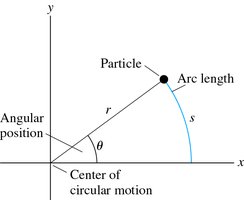
Angular position, denoted by θ, describes the location of a particle on a circular path relative to a reference axis (usually the positive x-axis). It is measured in radians (rad), where one radian is the angle subtended by an arc length equal to the radius of the circle.
Arc length (s): The distance traveled along the circular path.
Relationship: , where r is the radius.
One revolution: radians = 360° = 1 revolution.
Angular Displacement and Angular Velocity
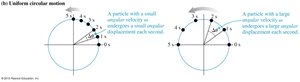
Angular displacement is the change in angular position over time. Angular velocity (ω) is the rate of change of angular displacement, measured in radians per second (rad/s).
Angular velocity:
For uniform circular motion, angular velocity is constant.
Angular speed: The magnitude of angular velocity, ignoring direction.
Relationship to period (T):
Relationship to frequency (f):
Relating Linear and Angular Quantities
Linear speed (v) at a point on a rotating object is related to angular speed by:
Points farther from the axis move faster.

Angular Acceleration
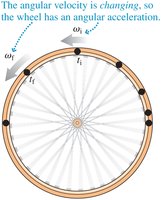
Angular acceleration (α) is the rate of change of angular velocity:
Units: rad/s2
Tangential Acceleration
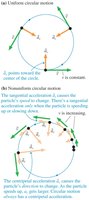
Tangential acceleration (at) is the component of acceleration tangent to the circle, measuring the rate at which the speed around the circle increases:
Comparison of Linear and Circular Motion
Linear Motion | Circular Motion |
|---|---|
Position (x) | Angle (θ) |
Velocity (v) | Angular velocity (ω) |
Acceleration (a) | Angular acceleration (α) |
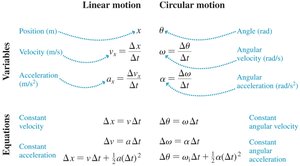
The Rotation of a Rigid Body
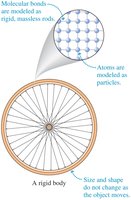
Rigid Body Model
A rigid body is an object whose size and shape do not change as it moves. Every point on a rotating rigid body has the same angular velocity, but points at different distances from the axis have different linear speeds.
Torque
Definition and Calculation
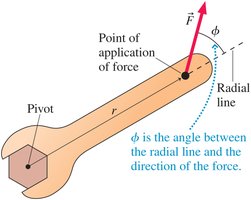
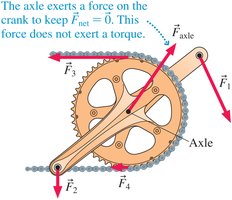
Torque (τ) is the rotational equivalent of force. It measures the ability of a force to cause rotation about an axis. The magnitude of torque depends on:
The magnitude of the force (F)
The distance (r) from the pivot to the point of application
The angle (φ) between the force and the radial line
Torque is calculated as:
Alternatively, using the moment arm (lever arm):
Direction of Torque
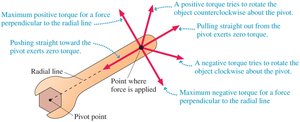
By convention, counterclockwise torques are positive, and clockwise torques are negative.
Net Torque
The net torque on an object is the sum of all individual torques:
Gravitational Torque and Center of Gravity
Center of Gravity
The center of gravity is the point at which the entire weight of an object can be considered to act for the purpose of analyzing torque due to gravity. The gravitational torque can be calculated as if all the mass were concentrated at this point.
For a system of particles:
Rotational Dynamics and Moment of Inertia
Moment of Inertia
The moment of inertia (I) is the rotational equivalent of mass. It quantifies how difficult it is to change the rotational motion of an object. The moment of inertia depends on both the mass and its distribution relative to the axis of rotation.
For point masses:
Units: kg·m2
Newton’s Second Law for Rotation
Newton’s second law for rotational motion states that the net torque on an object is equal to the product of its moment of inertia and its angular acceleration:
Moments of Inertia for Common Shapes
Shape | Moment of Inertia (I) |
|---|---|
Thin rod (axis through center) | |
Thin rod (axis through end) | |
Solid cylinder or disk (axis through center) | |
Solid sphere | |
Hollow cylinder (thin-walled) |
*Additional info: Table entries inferred from standard physics tables for clarity.*
Rolling Motion
Rolling Without Slipping
Rolling motion is a combination of rotational and translational motion. For an object rolling without slipping, the velocity of the center of mass is related to the angular velocity by:
Summary of Key Equations
Angular position:
Angular velocity:
Angular acceleration:
Linear and angular speed:
Tangential acceleration:
Torque:
Moment of inertia (point masses):
Newton’s second law for rotation:
Rolling constraint:
