 Back
BackRotational Motion: Study Notes for General Physics I
Study Guide - Smart Notes
 Tailored notes based on your materials, expanded with key definitions, examples, and context.
Rotational Motion
Introduction to Rotational Motion
Rotational motion describes the movement of a rigid object about a fixed axis. Unlike translational motion, where all points move in the same direction, rotational motion involves all points rotating around a central axis. This chapter introduces the fundamental quantities and laws governing rotational motion, including angular position, velocity, acceleration, torque, and rotational inertia.
Rigid Body: An object that does not deform during rotation; all points move in circles about the axis.
Fixed Axis: The axis about which the object rotates remains stationary.
Examples: Ferris wheels, carousels, rotating rods.

Rotational Variables
Angular Position
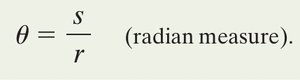
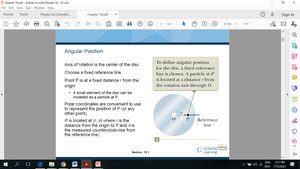
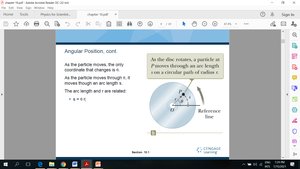
The angular position of a point on a rotating object is defined by the angle θ, measured in radians, from a fixed reference line. The position of a particle P at a distance r from the axis is conveniently described using polar coordinates (r, θ).
Arc Length (s): The distance along the circular path, related to θ by .
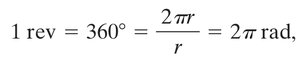
Radians: The standard unit for measuring angles in rotational motion; 1 revolution = radians.
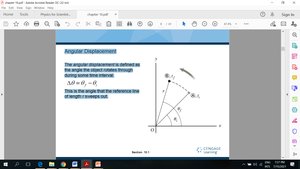
Angular Displacement
Angular displacement (Δθ) is the change in angular position as an object rotates. It is given by .
Direction: Counterclockwise is positive, clockwise is negative.
Physical Meaning: The angle swept out by the reference line from the initial to the final position.
Angular Velocity
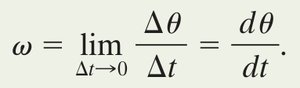
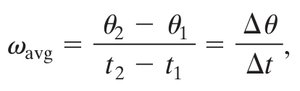
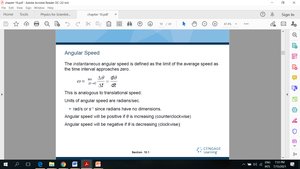
Angular velocity (ω) describes how fast the angular position changes with time. It can be average or instantaneous:
Average Angular Velocity:
Instantaneous Angular Velocity:
Units: Radians per second (rad/s)
Sign: Positive for counterclockwise, negative for clockwise rotation
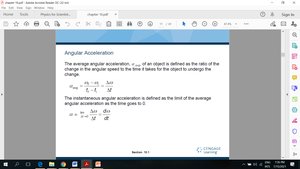
Angular Acceleration
Angular acceleration (α) is the rate of change of angular velocity. It can also be average or instantaneous:
Average Angular Acceleration:
Instantaneous Angular Acceleration:
Units: Radians per second squared (rad/s²)
Sign: Positive if speeding up counterclockwise or slowing down clockwise
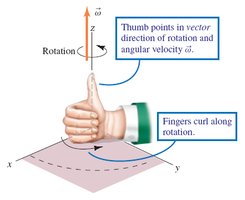
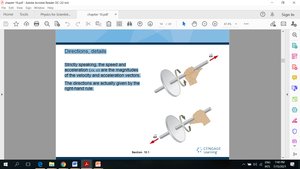
Direction of Angular Quantities: The Right-Hand Rule
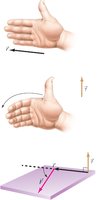
The direction of angular velocity and acceleration vectors is determined by the right-hand rule: curl the fingers of your right hand in the direction of rotation; your thumb points in the direction of the vector.
Application: Used to assign vector directions to rotational quantities in three dimensions.
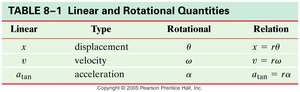
Comparison of Linear and Rotational Quantities
There is a direct analogy between linear and rotational motion. The following table summarizes the correspondence:
Linear | Type | Rotational | Relation |
|---|---|---|---|
x | displacement | θ | |
v | velocity | ω | |
a_{tan} | acceleration | α |
Rigid Object under Constant Angular Acceleration
Kinematic Equations for Rotational Motion
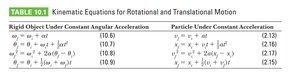
For a rigid object rotating with constant angular acceleration, the equations of motion mirror those of linear kinematics, with angular variables replacing linear ones:
Example: Rotational Kinematics
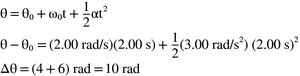
Problem: A wheel rotates with a constant angular acceleration of 3.00 rad/s². If the angular speed is 2.00 rad/s at t = 0, what is the angular displacement in 2.00 s?
Solution: Use
Calculation:
Torque and Rigid Objects Under a Net Torque
Definition of Torque
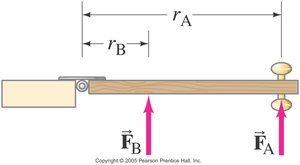
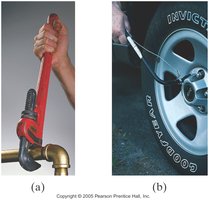
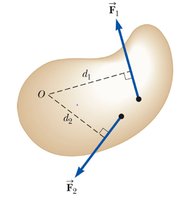
Torque (τ) is the rotational equivalent of force. It measures the tendency of a force to rotate an object about an axis. The magnitude of torque depends on the force, the lever arm (distance from axis), and the angle between them:
Formula:
Lever Arm: The perpendicular distance from the axis of rotation to the line of action of the force.
Units: Newton-meter (N·m)
Direction of Torque: Right-Hand Rule
The direction of the torque vector is given by the right-hand rule, similar to angular velocity and acceleration.
Rotational Inertia (Moment of Inertia)
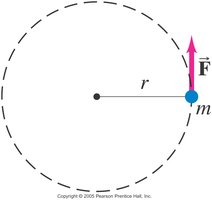
Rotational inertia (I) quantifies an object's resistance to changes in its rotational motion. It depends on the mass distribution relative to the axis of rotation.
Formula for Point Mass:
Extended Objects: (sum over all mass elements)
Role in Dynamics:
Torque and Angular Acceleration
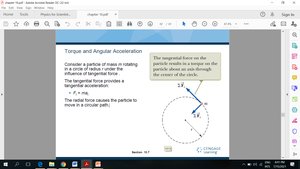
Newton's second law for rotation states that the net torque on an object is equal to the product of its moment of inertia and its angular acceleration:
Analogous to in linear motion.
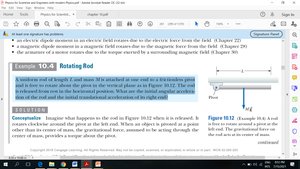
Example: Rotating Rod
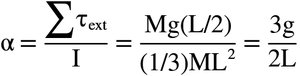
Problem: A uniform rod of length L and mass M is attached at one end and released from rest. Find the initial angular acceleration and the initial translational acceleration of the free end.
Solution:
Translational acceleration at the end:
Summary Table: Linear vs. Rotational Motion
Linear Quantity | Rotational Quantity | Relation |
|---|---|---|
Displacement (x) | Angular Displacement (θ) | |
Velocity (v) | Angular Velocity (ω) | |
Acceleration (a) | Angular Acceleration (α) | |
Force (F) | Torque (τ) | |
Mass (m) | Moment of Inertia (I) |
Additional info: The notes above are based on standard introductory physics textbooks and lecture slides, with added context for clarity and completeness. All equations are provided in LaTeX format as required for physics study guides.
