 Back
BackRotational Vectors and the Cross Product in Physics
Study Guide - Smart Notes
 Tailored notes based on your materials, expanded with key definitions, examples, and context.
Rotational Vectors and the Right-Hand Rule
Understanding Rotational Vectors
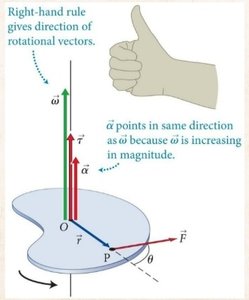
Rotational vectors, such as angular velocity (\( \vec{\omega} \)) and angular acceleration (\( \vec{\alpha} \)), are essential in describing the motion of objects in circular or rotational motion. The direction of these vectors is determined by the right-hand rule, which is a standard convention in physics for vector cross products and rotational directions.
Angular Velocity (\( \vec{\omega} \)): Represents the rate of change of angular displacement. Its direction is perpendicular to the plane of rotation, given by the right-hand rule.
Angular Acceleration (\( \vec{\alpha} \)): Represents the rate of change of angular velocity. If the magnitude of \( \vec{\omega} \) increases, \( \vec{\alpha} \) points in the same direction as \( \vec{\omega} \).
Right-Hand Rule: Point your right thumb in the direction of the rotational vector (e.g., angular velocity), and your fingers curl in the direction of rotation.
Example: For a rotating disk, if the rotation is counterclockwise when viewed from above, the angular velocity vector points upward, perpendicular to the disk.
The Vector Cross Product and Its Magnitude
Definition and Geometric Interpretation
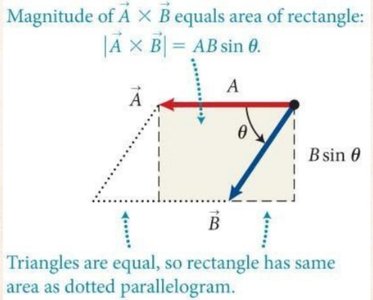
The cross product of two vectors \( \vec{A} \) and \( \vec{B} \) is a vector perpendicular to both \( \vec{A} \) and \( \vec{B} \), with a magnitude equal to the area of the parallelogram formed by the two vectors. The direction is given by the right-hand rule.
Magnitude Formula: The magnitude of the cross product is given by: where \( \theta \) is the angle between \( \vec{A} \) and \( \vec{B} \).
Geometric Meaning: The area of the parallelogram (or rectangle, if vectors are perpendicular) formed by \( \vec{A} \) and \( \vec{B} \) is equal to the magnitude of their cross product.
Applications: The cross product is used to calculate torque, angular momentum, and magnetic force in physics.
Example: If \( \vec{A} \) and \( \vec{B} \) are perpendicular, \( \sin \theta = 1 \), so .
Summary Table: Properties of the Cross Product
Property | Description |
|---|---|
Direction | Perpendicular to both \( \vec{A} \) and \( \vec{B} \) (right-hand rule) |
Magnitude | |
Zero Value | If \( \vec{A} \) and \( \vec{B} \) are parallel or anti-parallel (\( \theta = 0 \) or \( \pi \)), the cross product is zero |
Physical Examples | Torque, angular momentum, magnetic force |
Additional info: The third image provided does not directly relate to the topics of rotational vectors or the cross product and is therefore not included.
