Back
BackScaling Laws, Models, and Quantitative Reasoning in Physics for the Life Sciences
Study Guide - Smart Notes
 Tailored notes based on your materials, expanded with key definitions, examples, and context.
Introduction to Physics in the Life Sciences
Physics as a Foundational Science
Physics provides the fundamental principles that underlie biology, chemistry, earth science, and other natural sciences. By applying a relatively small number of key concepts, physics helps explain a vast array of natural phenomena, including those relevant to living systems.
Unifying Principles: Concepts such as energy conservation and fluid dynamics constrain what is possible for life.
Application to Biology: Physics explains processes from the flow of blood in the circulatory system to the transmission of nerve impulses and the mechanics of animal locomotion.
Describing and Explaining Motion
Key Concepts in Motion
Understanding motion involves both describing how objects move and explaining why they move as they do. This is foundational for analyzing biological systems, from running athletes to cellular processes.
Force: The cause of motion changes.
Acceleration: The effect of applied forces.
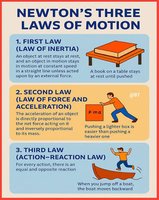
Newton's Laws of Motion: Three laws that explain how forces cause motion and how objects respond to forces.
Models in Physics and Biology
Types of Models
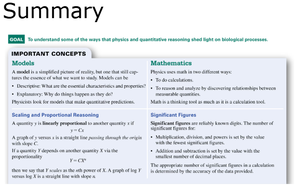
Models are simplified descriptions of reality that help reduce complexity and allow for quantitative analysis. They are essential for understanding both physical and biological systems.
Descriptive Models: Capture essential characteristics and properties of a phenomenon (e.g., modeling a cell as a sphere).
Explanatory Models: Explain why things happen and have predictive power (e.g., spring-like models for molecular bonds).
Importance: Models allow us to make sense of complex situations and provide frameworks for quantitative reasoning.
Scaling Laws in Biology
Proportionality and Scaling
Scaling laws describe how physical characteristics of organisms, such as bone size or metabolic rate, depend on organism size. These relationships are often expressed as power laws.
General Form:
Proportionality: means y scales with the nth power of x.
Linear Proportionality: (straight line through the origin).
Example: Mass of an object is proportional to its volume: .
Ratio Reasoning
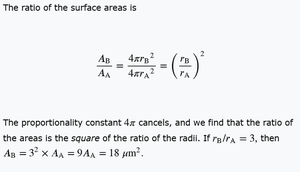
Proportionality allows us to use ratios to solve problems without knowing the proportionality constant, as the constant cancels out.
Example: If the radius of a cell triples, its surface area increases by a factor of .
Allometry and Biological Scaling
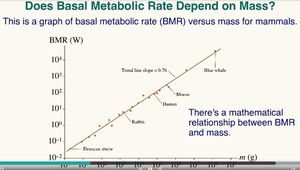
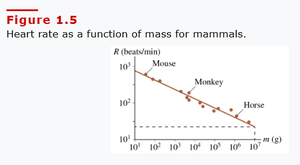
Allometry is the study of how physiological processes scale with body size. For example, basal metabolic rate (BMR) in mammals scales as the 3/4 power of body mass:
Log-log graphs are used to analyze these relationships:
Examples of Scaling Laws
Surface Area: (area scales with the square of the radius).
Volume: (volume scales with the cube of a linear dimension).
Bone Strength: Scales with cross-sectional area (), while mass scales with —explaining why larger animals need disproportionately thicker bones.
Logarithms and Log-Log Graphs
Using Logarithms in Scaling Laws
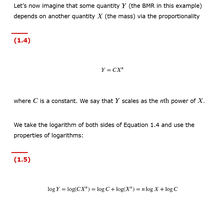
Logarithms are used to linearize power-law relationships for easier analysis. For a scaling law , taking the logarithm of both sides gives:
Graphing Relationships
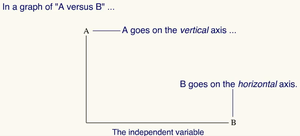
In a graph of "A versus B," A is plotted on the vertical axis and B on the horizontal axis. Log-log graphs are especially useful for identifying power-law relationships.
Applications and Example Problems
Ratio Reasoning in Practice
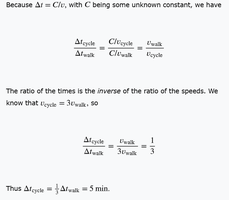
For steady speed, the time to travel a distance is inversely proportional to speed: .
Example: If Angela cycles three times as fast as she walks, her travel time is one-third as long.
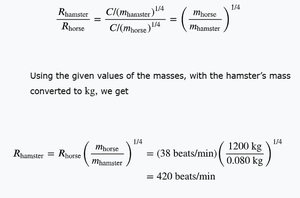
Scaling Heart Rate with Mass
Heart rate scales inversely with the 1/4 power of body mass :
For a horse and a hamster:
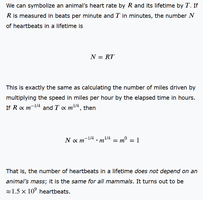
Number of Heartbeats in a Lifetime
The number of heartbeats in a mammal's lifetime is approximately constant across species, as heart rate and lifetime scale with mass in inverse ways:
If and , then
Inverse Square Law Example
The electric force between two ions scales inversely with the square of the distance between them. If the distance doubles, the force becomes one-fourth as large.
Units, Significant Figures, and Conversions
Physical Quantities and Units
Physical Quantities: Include distance, mass, time, temperature, electric current, amount of substance, and luminous intensity.
Units: SI units are standard; conversions may be necessary for practical calculations.
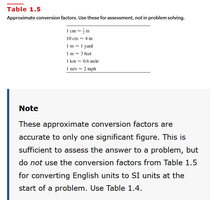
Significant Figures
Significant figures reflect the precision of measurements and calculations.
Multiplication/division: result has as many significant figures as the least precise measurement.
Addition/subtraction: result has as many decimal places as the least precise measurement.
Summary Table: Key Concepts
Concept | Description |
|---|---|
Model | Simplified picture of reality capturing essential features for analysis. |
Scaling Law | Relationship where one quantity scales as a power of another: . |
Ratio Reasoning | Using proportionality to solve problems without knowing constants. |
Significant Figures | Reflect the precision of measurements and calculations. |
Additional Notes
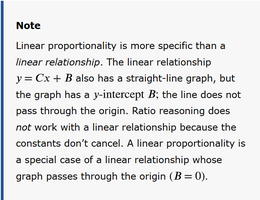
Linear proportionality is a special case of a linear relationship where the graph passes through the origin ( in ).
Physical reasoning and quantitative analysis provide deep insight into biological systems, especially when using models and scaling laws.