 Back
BackSimple Harmonic Motion and Damped Oscillations: Study Notes
Study Guide - Smart Notes
 Tailored notes based on your materials, expanded with key definitions, examples, and context.
Simple Harmonic Motion (SHM)
Definition and Characteristics
Simple Harmonic Motion (SHM) is a type of periodic motion where the restoring force is directly proportional to the displacement and acts in the direction opposite to that displacement. SHM is fundamental in physics, describing systems such as springs and pendulums.
Restoring Force: For a spring, the restoring force is given by , where k is the spring constant and s is the displacement.
Natural Frequency: The frequency at which a system oscillates when not subjected to a continuous or repeated external force.
Period: The time taken for one complete cycle of oscillation.
Example: A 132 kg mass oscillates with an amplitude of 5.00 cm and a spring constant of kg/s2. The natural frequency is calculated as:
The Simple Pendulum
Restoring Force and Small Angle Approximation
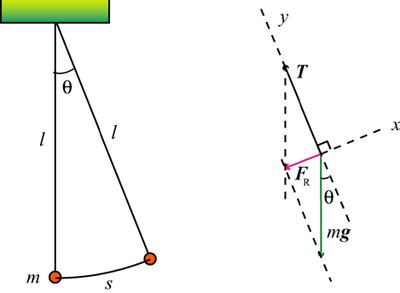
A simple pendulum consists of a mass m attached to a string of length l. The restoring force is due to gravity and is given by . For small angles (), (in radians), simplifying the analysis.
Angular Displacement: , where s is the arc length.
Restoring Force:
Spring Analogy: The pendulum behaves like a spring with an effective spring constant .
Natural Frequency:
Example: An astronaut's 1.00 m pendulum completes 100 cycles in 496 s. The acceleration due to gravity is:
This value is approximately 1/6 of Earth's gravity, indicating the location is the Moon.
Damped Oscillations
Definition and Mathematical Description
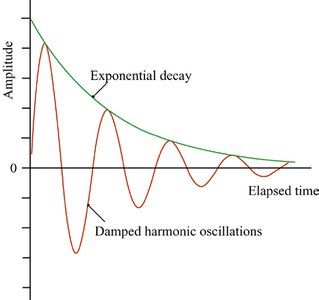
Damped oscillations occur when the amplitude of oscillation decreases over time due to energy loss (e.g., friction or drag). The damping force is often proportional to velocity: , where b is the damping constant.
Equation of Motion:
Solution: , where and
Exponential Decay: The amplitude decreases as
Example: The displacement of a load is given by . The initial amplitude is 5.45 cm, frequency is 1.50 Hz, amplitude after 0.25 s is 2.00 cm, and displacement after 0.25 s is -1.41 cm.
Calculating Damping and Amplitude Decay
Examples and Applications
To determine the damping constant and amplitude at a given time, use the relationship and solve for using known amplitude reductions over a set number of oscillations.
Example: A spring vibrates at 2.00 Hz with an initial amplitude of 15.0 cm. After 20 oscillations, amplitude is 1/3 original. Time for 20 oscillations: .
Solving for :
Amplitude at 5.00 s:
Important Equations
(Taylor series expansion)
(Pendulum frequency)
(Damped oscillation)
(Damping constant)
(Angular frequency with damping)
