 Back
BackSimple Harmonic Motion and the Simple Pendulum
Study Guide - Smart Notes
 Tailored notes based on your materials, expanded with key definitions, examples, and context.
Chapter 14: Periodic Motion
Introduction to Periodic Motion
Periodic motion refers to any motion that repeats itself at regular time intervals. This type of motion is fundamental in physics and is observed in systems such as springs, pendulums, and waves.
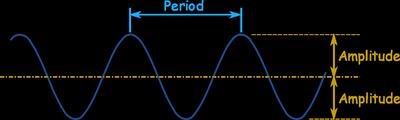
Amplitude (A): The maximum displacement from the equilibrium position.
Period (T): The time required to complete one full cycle of motion.
Frequency (f): The number of cycles per unit time. $f = \frac{1}{T}$
Angular Frequency (\omega): $\omega = 2\pi f$
Simple Harmonic Motion (SHM)
Definition and Characteristics
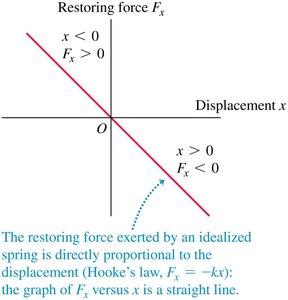
Simple Harmonic Motion occurs when the restoring force acting on an object is directly proportional to its displacement from equilibrium and is directed toward the equilibrium position. This is mathematically described by Hooke's Law:
Restoring Force: $F_x = -kx$
Displacement as a Function of Time: $x(t) = A \cos(\omega t + \phi)$
Angular Frequency: $\omega = \sqrt{\frac{k}{m}}$

Graphical Representation of SHM
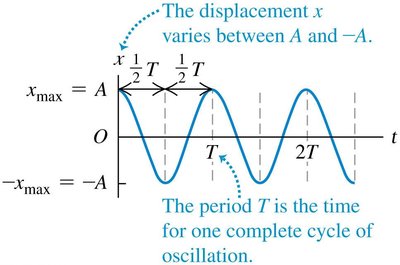
The displacement in SHM varies sinusoidally with time, oscillating between +A and -A. The period T is the time for one complete oscillation.
Phase and Phase Angle
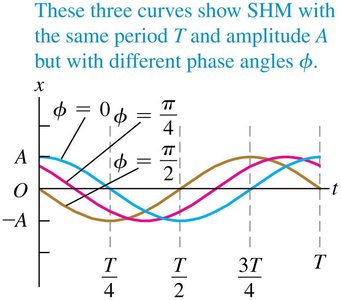
The phase angle (\phi) determines the initial position of the oscillating object at t = 0. Changing \phi shifts the displacement-time graph horizontally.
Key Equations for SHM
Angular Frequency: $\omega = \sqrt{\frac{k}{m}}$
Frequency: $f = \frac{\omega}{2\pi} = \frac{1}{2\pi} \sqrt{\frac{k}{m}}$
Period: $T = \frac{1}{f} = 2\pi \sqrt{\frac{m}{k}}$



Displacement, Velocity, and Acceleration in SHM
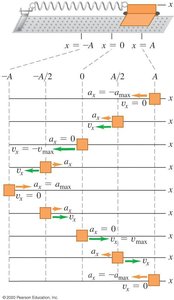
In SHM, the displacement, velocity, and acceleration are all sinusoidal functions of time, but with different phases:
Displacement: $x(t) = A \cos(\omega t + \phi)$
Velocity: $v(t) = -A\omega \sin(\omega t + \phi)$
Acceleration: $a(t) = -A\omega^2 \cos(\omega t + \phi) = -\omega^2 x(t)$
Energy in Simple Harmonic Motion
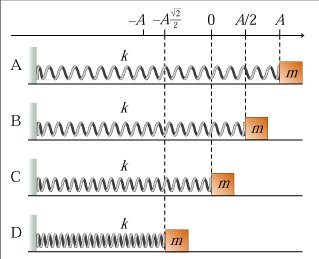
In SHM, only conservative forces act, so the total mechanical energy is conserved. The energy oscillates between kinetic and potential forms:
Kinetic Energy: $K = \frac{1}{2} m v^2$
Potential Energy (Spring): $U = \frac{1}{2} k x^2$
Total Mechanical Energy: $E = \frac{1}{2} k A^2$
Example Problems in SHM
Finding the Spring Constant: If a mass m stretches a spring by distance d, $k = \frac{mg}{d}$.
Finding the Frequency: $f = \frac{1}{2\pi} \sqrt{\frac{k}{m}}$
Finding the Total Mechanical Energy: $E = \frac{1}{2} k A^2$
The Simple Pendulum
Definition and Physical Model
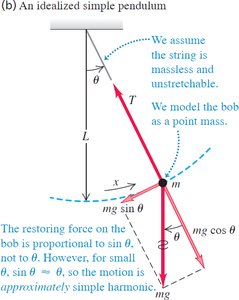
A simple pendulum consists of a mass (bob) attached to a string of length L, swinging under the influence of gravity. For small angles (\theta), the motion approximates SHM.
Restoring Force: $F_\theta = -mg \sin \theta$
For small \theta, $\sin \theta \approx \theta$ (in radians), so $F_\theta \approx -mg \theta$



Equations for the Simple Pendulum (Small Amplitude)
Angular Frequency: $\omega = \sqrt{\frac{g}{L}}$
Frequency: $f = \frac{1}{2\pi} \sqrt{\frac{g}{L}}$
Period: $T = 2\pi \sqrt{\frac{L}{g}}$


Applications and Examples
Grandfather Clocks: Use the principle of the simple pendulum to keep time accurately.
Swings: A real-life example of a pendulum, though not ideal due to air resistance and large amplitudes.

Effect of Gravity on Pendulum Period
The period of a pendulum depends on the local acceleration due to gravity (g). If the period changes on another planet, the value of g can be determined using the period equation.
Example: If a pendulum has period T on Earth and T' on another planet, $\frac{T'}{T} = \sqrt{\frac{g_{Earth}}{g_{Planet}}}$
Additional info: The notes above expand on the provided slides by including definitions, equations, and examples for clarity and completeness. All images included are directly relevant to the adjacent explanations and reinforce the concepts discussed.
