 Back
BackSimple Harmonic Motion and the Simple Pendulum
Study Guide - Smart Notes
 Tailored notes based on your materials, expanded with key definitions, examples, and context.
Chapter 14: Periodic Motion
Introduction to Periodic Motion
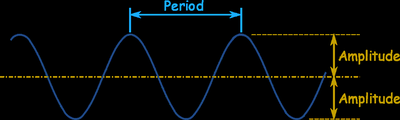
Periodic motion refers to any motion that repeats itself at regular time intervals. This type of motion is fundamental in physics and is observed in systems such as springs, pendulums, and waves.
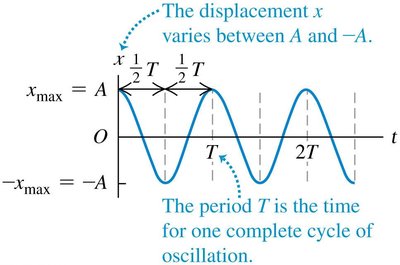
Amplitude (A): The maximum displacement from the equilibrium position.
Period (T): The time required to complete one full cycle of motion.
Frequency (f): The number of cycles per unit time.
Angular Frequency (\omega):
Simple Harmonic Motion (SHM)
Definition and Characteristics
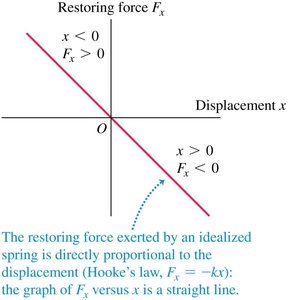
Simple harmonic motion occurs when the restoring force acting on an object is directly proportional to its displacement from equilibrium and is directed toward the equilibrium position. This is mathematically described by Hooke's Law:
Restoring Force:
Displacement: is measured from the equilibrium position.
Equation of Motion
The displacement of an object in SHM as a function of time is given by:
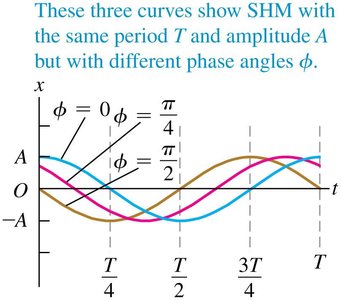
Phase Angle (\phi): Determines the initial position at .
Angular Frequency:

Graphical Representation of SHM
The displacement in SHM varies sinusoidally with time, oscillating between and .
Effect of Phase Angle
Changing the phase angle shifts the displacement-time graph horizontally. Different phase angles result in different starting positions for the oscillation.
Frequency, Angular Frequency, and Period in SHM
The relationships between frequency, angular frequency, and period for a mass-spring system are:



Displacement, Velocity, and Acceleration in SHM
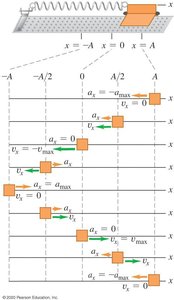
In SHM, the displacement, velocity, and acceleration are all sinusoidal functions of time, but with different phases:
Displacement:
Velocity:
Acceleration:
Energy in Simple Harmonic Motion
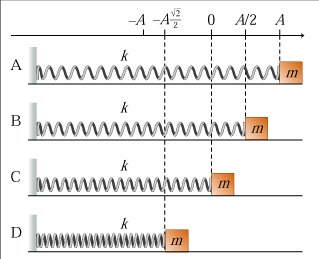
In SHM, only conservative forces act, so the total mechanical energy is conserved. The energy alternates between kinetic and potential forms:
Kinetic Energy:
Potential Energy (Spring):
Total Mechanical Energy: (constant)
Vertical SHM
Vertical Mass-Spring System
When a mass is attached to a vertical spring, the equilibrium position is shifted due to gravity, but the oscillatory motion remains simple harmonic. The effective force constant and period are calculated as in the horizontal case.
Spring Constant: , where is the stretch from the spring's natural length.
Frequency:
The Simple Pendulum
Physical Description
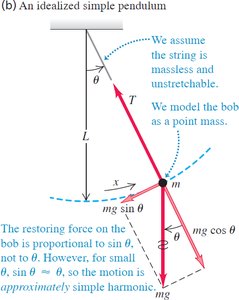
A simple pendulum consists of a mass (bob) attached to a string of length , swinging under the influence of gravity. For small angles ( rad), the motion approximates SHM.

Restoring Force and Small Angle Approximation
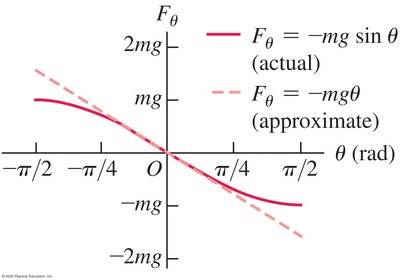
The restoring force for a pendulum is . For small angles, (in radians), so the force becomes proportional to displacement, satisfying the condition for SHM.


Equations for the Simple Pendulum
Angular Frequency:
Frequency:
Period:


Applications and Examples
Grandfather clocks use pendulums to keep time due to the period's dependence on length and gravity.
Swings act as real-world pendulums, though air resistance and large angles introduce deviations from ideal SHM.
Summary Table: Key Equations for SHM and the Simple Pendulum
System | Angular Frequency (\omega) | Frequency (f) | Period (T) |
|---|---|---|---|
Mass-Spring (SHM) | |||
Simple Pendulum (small angle) |
Additional info: For larger angles in a pendulum, the approximation becomes less accurate, and the period increases slightly. Energy methods and phase diagrams are also useful for analyzing SHM but are not covered in detail here.
