 Back
BackSimple Harmonic Motion, Damped Oscillations, and Resonance
Study Guide - Smart Notes
 Tailored notes based on your materials, expanded with key definitions, examples, and context.
Simple Harmonic Motion (SHM)
Definition and Characteristics
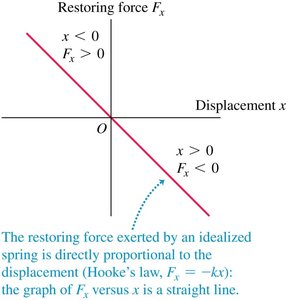
Simple Harmonic Motion (SHM) describes the motion of an object when the restoring force is directly proportional to its displacement from equilibrium and acts in the opposite direction. This type of motion is fundamental in physics and appears in many systems, such as springs and pendulums.
Restoring Force: The force that brings the system back toward equilibrium is given by Hooke's Law: , where is the force constant and is the displacement.
Equilibrium Position: The point where the net force on the object is zero.
Oscillation: The object moves back and forth about the equilibrium position in a regular, repeating pattern.
Mathematical Description of SHM
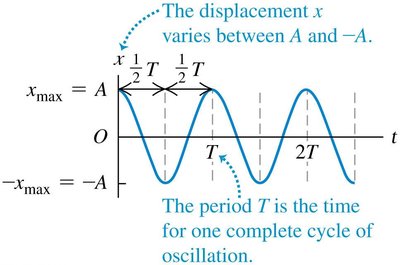
The displacement of an object in SHM as a function of time is given by:
Displacement Equation:
Amplitude (A): Maximum displacement from equilibrium.
Angular Frequency (\omega):
Phase Angle (\phi): Determines the initial position at .

Period, Frequency, and Angular Frequency
The period, frequency, and angular frequency are key quantities describing SHM:
Period (T): Time for one complete cycle.
Frequency (f): Number of cycles per second.
Angular Frequency (\omega):



Displacement, Velocity, and Acceleration in SHM
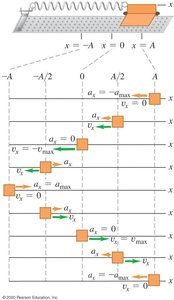
In SHM, the displacement, velocity, and acceleration vary sinusoidally with time. The velocity is maximum at the equilibrium position, while the acceleration is maximum at the turning points (maximum displacement).
Displacement (x):
Velocity (v):
Acceleration (a):
Energy in Simple Harmonic Motion
In SHM, only conservative forces act, so the total mechanical energy is conserved. The energy oscillates between kinetic and potential forms:
Kinetic Energy (KE):
Potential Energy (PE):
Total Mechanical Energy (E): (constant)
Examples of SHM: Mass-Spring System
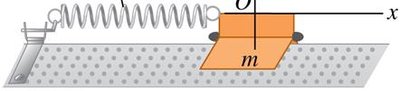
A classic example of SHM is a mass attached to a spring oscillating on a frictionless surface. The force constant and the mass determine the frequency and period of oscillation.
The Simple Pendulum
Definition and Small-Angle Approximation
A simple pendulum consists of a mass (bob) attached to a string of length that swings under the influence of gravity. For small angles ( rad), , and the motion can be approximated as SHM.
Restoring Force:
Small-Angle Approximation:
Period (T):


Damped Oscillations
Definition and Equation of Motion
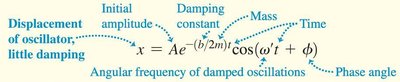
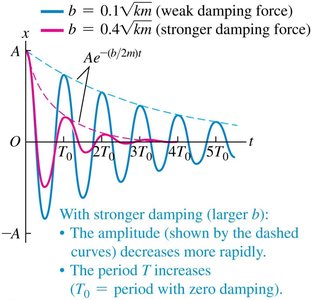
Damped oscillations occur when a resistive force (such as friction or air resistance) acts on the system, causing the amplitude to decrease over time. The damping force is often proportional to velocity: .
Equation of Motion:
Displacement (with little damping):
Angular Frequency (damped):

Forced Oscillations and Resonance
Definition and Effects
When an external periodic force drives an oscillator, the system undergoes forced oscillations. If the driving frequency matches the system's natural frequency, resonance occurs, leading to large amplitude oscillations.
Driving Force: An external force that varies periodically with time.
Resonance: Occurs when the driving frequency is close to the natural frequency , causing the amplitude to increase dramatically.
Application: In engineering, structures are designed so their natural frequencies differ from common driving frequencies (e.g., earthquakes) to avoid resonance.
Summary Table: Key Equations in SHM and Damped Oscillations
Quantity | Equation | Description |
|---|---|---|
Restoring Force (spring) | Hooke's Law | |
Displacement (SHM) | General solution for SHM | |
Angular Frequency (SHM) | Depends on and | |
Period (SHM) | Time for one cycle | |
Frequency (SHM) | Cycles per second | |
Displacement (damped) | With damping | |
Angular Frequency (damped) | With damping |
