 Back
BackSimple Harmonic Motion: Mass-Spring Systems and Pendulums
Study Guide - Smart Notes
 Tailored notes based on your materials, expanded with key definitions, examples, and context.
Simple Harmonic Motion (SHM)
Introduction to SHM
Simple Harmonic Motion (SHM) describes the periodic oscillatory motion of an object where the restoring force is proportional to and opposite its displacement from equilibrium. SHM is foundational in physics, underlying many mechanical and wave phenomena.
Restoring Force: The force that brings the object back to equilibrium, described by Hooke's Law: .
Periodic Motion: The motion repeats in a regular cycle, characterized by period (T) and frequency (f).
Energy Exchange: Energy oscillates between kinetic and potential forms, but the total mechanical energy remains constant.

Connection to Uniform Circular Motion (UCM)
SHM can be visualized as the one-dimensional projection of uniform circular motion (UCM). The mathematical relationships for period and frequency in UCM directly apply to SHM.
Period (T): Time for one complete cycle. , where t is total time and n is number of cycles.
Frequency (f): Number of cycles per second. , measured in Hertz (Hz).
Relationship: and .

Mass-Spring System
Horizontal and Vertical Mass-Spring Systems
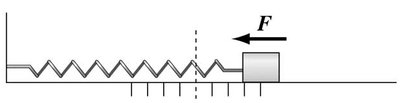
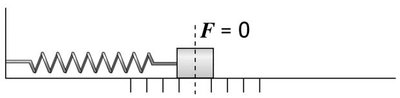
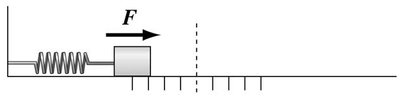
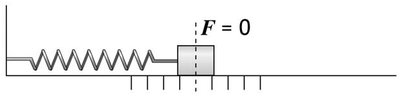
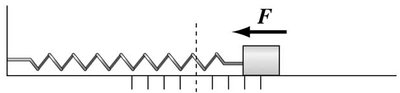
A mass attached to a spring oscillates about an equilibrium position. The system can be oriented horizontally or vertically, with the equilibrium position adjusted for gravity in the vertical case.
Displacement (x): Measured from equilibrium ().
Amplitude (A): Maximum displacement from equilibrium.
Hooke's Law: , where k is the spring constant.
Restoring Force: Always directed toward equilibrium.
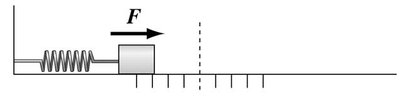
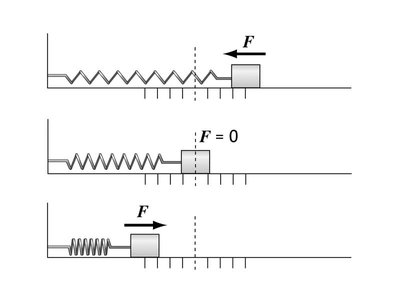
Key Locations in Mass-Spring Motion
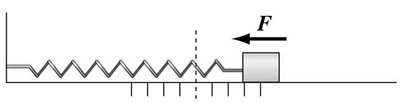
At (maximum displacement): , and are maximum and directed toward equilibrium.
At (equilibrium): , , .
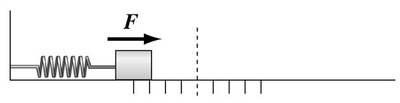
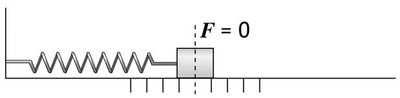
Vertical Mass-Spring System
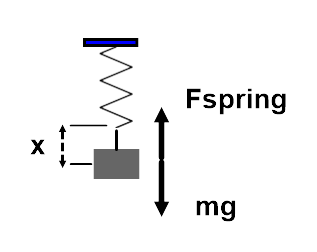
When the spring is vertical, the equilibrium position is where the spring force balances gravity ().
Formulas for Mass-Spring Systems
Hooke's Law:
Period:
Frequency:
Maximum Speed:
Energy in Simple Harmonic Motion
Energy in the Mass-Spring System
Energy in SHM oscillates between kinetic energy (KE) and elastic potential energy (EPE), but the total mechanical energy remains constant.
Elastic Potential Energy:
Kinetic Energy:
Total Energy: (constant for a given amplitude)
Simple Pendulum
Simple Pendulum Motion
A simple pendulum consists of a mass (bob) at the end of a lightweight, inextensible string. For small angles (), the restoring force is proportional to displacement, and the motion approximates SHM.
Restoring Force: for small angles.
Displacement:
Period:
Frequency:
Mass Independence: The period does not depend on the mass of the bob.
Energy in the Simple Pendulum
Gravitational Potential Energy:
Kinetic Energy:
Total Mechanical Energy: (conserved)
Graphical Analysis of SHM
Energy vs. Position Graphs
Energy graphs for oscillating masses show how kinetic and potential energies vary with position. The total energy remains constant, while KE and EPE are complementary parabolic curves.
At maximum displacement (): All energy is EPE.
At equilibrium (): All energy is KE.
Bullet-Block Oscillating System
Conservation of Momentum and Energy
When a bullet embeds in a block attached to a spring, the system's motion can be analyzed using conservation of momentum (for the collision) and conservation of energy (for the subsequent oscillation).
Initial Kinetic Energy:
Final Velocity (after collision): Use
Maximum Compression: Set to solve for maximum spring compression.
Period of Oscillation: Use total mass in
Summary Table: Key Equations in SHM
Quantity | Mass-Spring System | Pendulum |
|---|---|---|
Restoring Force | ||
Period (T) | ||
Frequency (f) | ||
Max KE | ||
Max EPE/GPE |
Additional info:
For all SHM systems, the acceleration is not constant; it varies with displacement.
Energy methods are powerful for finding velocities and positions at any point in the cycle.
For pendulums, the small-angle approximation ( in radians) is essential for SHM analysis.
