 Back
BackSimple Harmonic Motion: Pendulums, Damping, and Resonance- lecture 24
Study Guide - Smart Notes
 Tailored notes based on your materials, expanded with key definitions, examples, and context.
Simple Harmonic Motion
Pendulums
Pendulums are a classic example of simple harmonic motion (SHM), where the restoring force is provided by gravity rather than a spring. When displaced from equilibrium, the pendulum bob experiences a gravitational force that pulls it back toward the lowest point, but due to angular momentum, it overshoots and oscillates about the equilibrium position.
Restoring Torque: The restoring force in a pendulum is a torque given by , where is the mass, is the acceleration due to gravity, and is the perpendicular distance from the pivot to the center of mass.
Small Angle Approximation: For small angles (), (in radians), simplifying the analysis. The arc length relates to the angle by , and for small , .
Equation of Motion: Substituting the small angle approximation, the torque becomes . Defining , the equation takes the SHM form: .
Angular Frequency: The angular frequency for a simple pendulum is , where is the moment of inertia. For a simple pendulum, , so .
Example: A pendulum of length m has an angular frequency rad/s.
Other Types of Harmonic Motions
Real-world oscillatory systems often experience forces that cause energy dissipation or addition, leading to more complex behaviors than ideal SHM.
Damped Harmonic Motion
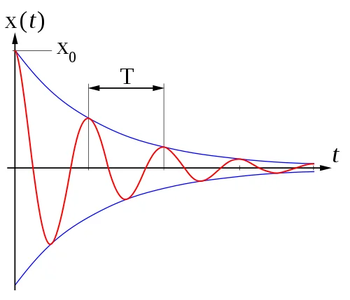
Damped harmonic motion occurs when frictional forces (such as air resistance or viscous drag) cause the amplitude of oscillations to decrease over time. The system loses energy, and the motion gradually ceases.
Damping: The process by which amplitude decreases due to energy loss.
Sources of Damping: Air drag, friction, and viscous fluids are common sources.
Types of Damping
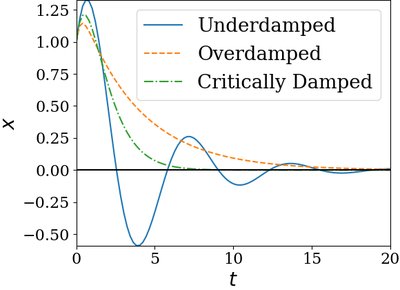
There are three main types of damping, classified by how quickly the system returns to equilibrium:
Critical Damping: The minimum amount of damping needed to prevent oscillations; the system returns to equilibrium as quickly as possible without overshooting.
Overdamped: Damping exceeds the critical value; the system returns to equilibrium slowly without oscillating.
Underdamped: Damping is less than critical; the system oscillates with gradually decreasing amplitude.
Driven Harmonic Motion
In driven harmonic motion, an external force adds energy to the system, causing the amplitude of oscillations to increase. The driving force is typically periodic and can sustain or amplify the motion.
Driving Force: An external force that supplies energy to the oscillator (e.g., pushing a swing in rhythm with its motion).
Example: A child pumping their legs to swing higher on a playground swing.
Resonance
Resonance occurs when the frequency of the driving force matches the natural frequency of the system, resulting in a large increase in amplitude. If there is no energy dissipation, the amplitude can grow without bound.
Natural Frequency: for a mass-spring system.
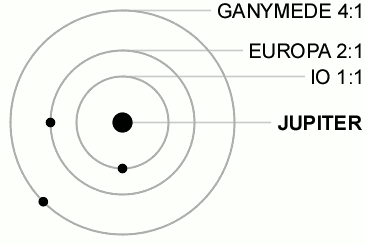
Applications: Resonance is observed in musical instruments, playground swings, and orbital resonances in planetary systems. It can be beneficial (amplifying sound in instruments) or destructive (as in the Tacoma Narrows Bridge collapse).
Type of Harmonic Motion | Energy Source | Amplitude Behavior | Example |
|---|---|---|---|
Simple Harmonic Motion | Conservative (no loss/gain) | Constant | Ideal pendulum, mass-spring system |
Damped Harmonic Motion | Energy lost (friction, drag) | Decreases over time | Car shock absorbers |
Driven Harmonic Motion | Energy added (driving force) | Can increase (if in resonance) | Playground swing, musical instruments |
