 Back
BackSimple Harmonic Motion: Springs, Kinematics, and Energy- lecture 23
Study Guide - Smart Notes
 Tailored notes based on your materials, expanded with key definitions, examples, and context.
Simple Harmonic Motion (SHM)
Introduction to Springs and SHM
Simple harmonic motion (SHM) is a type of periodic motion where an object oscillates about an equilibrium position under a restoring force proportional to its displacement. Springs are a fundamental model for understanding SHM in physics.
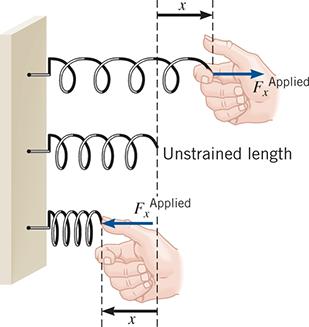
Spring Model: When a spring is stretched or compressed, it exerts a force to return to its original length.
Restoring Force: The force increases with the amount of stretch or compression.
Ideal Spring: Follows Hooke's Law perfectly, with no energy loss.

Springs and Hooke's Law
Applied and Restoring Forces
The force required to stretch or compress a spring is described by Hooke's Law. Newton's Third Law states that the spring exerts an equal and opposite restoring force.
Applied Force:
Restoring Force:
Spring Constant (k): Measures the stiffness of the spring (units: N/m).
Equilibrium: The position where the net force on the spring is zero.
Oscillations and Sinusoidal Motion
Spring Oscillations and Sine Waves
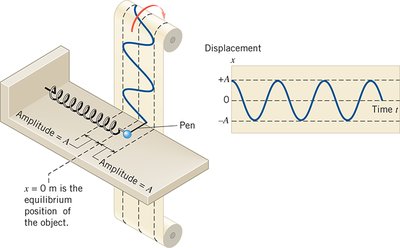
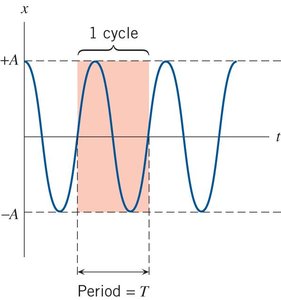
When an object attached to a spring is displaced and released, it oscillates about the equilibrium position. The displacement over time forms a sinusoidal (sine or cosine) wave.
Oscillation: The object moves back and forth, overshooting the equilibrium due to inertia.
Sinusoidal Graph: The displacement as a function of time is a sine or cosine wave.
Undamped Motion: In the absence of friction, oscillations continue indefinitely.
SHM Kinematics
Unit Circle and Projection
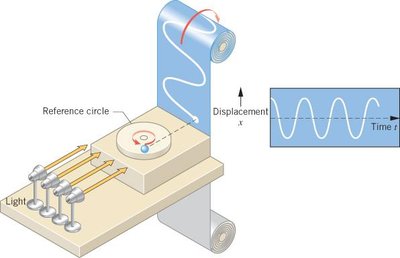
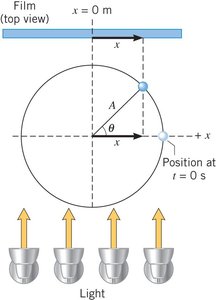
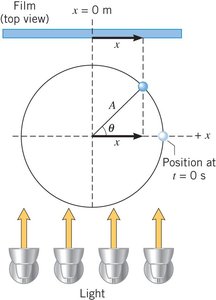
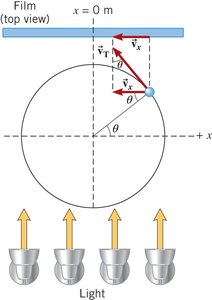
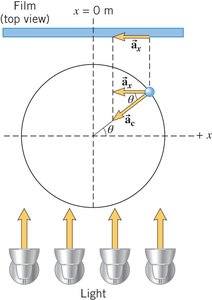
The motion of SHM can be visualized as the projection of uniform circular motion onto one axis. This analogy helps relate angular quantities to linear SHM variables.
Reference Circle: The position on the circle corresponds to the phase of oscillation.
Projection: The x-component of the circular motion gives the SHM displacement.
Frequency, Period, and Angular Frequency
SHM is characterized by its frequency (f), period (T), and angular frequency (ω). These quantities describe how fast the oscillations occur.
Frequency (f): Number of cycles per second (Hz).
Period (T): Time for one complete cycle.
Angular Frequency (\omega):
Displacement, Velocity, and Acceleration in SHM
The position, velocity, and acceleration of an object in SHM can be described using trigonometric functions of time.
Displacement:
Velocity: (maximum: )
Acceleration: (maximum: )
Frequency of Vibration (Mass-Spring System)
The frequency of a mass-spring system in SHM can be derived using Newton's Second Law and Hooke's Law.
Newton's Second Law:
Hooke's Law:
Angular Frequency:
Frequency:
Energy in Simple Harmonic Motion
Work and Elastic Potential Energy
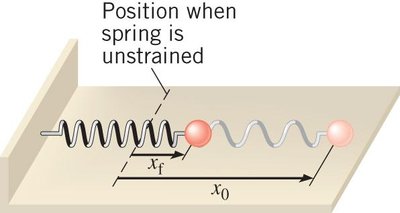
The work done by a spring and the energy stored in it are important for understanding energy conservation in SHM.
Work Done by Spring:
Average Force:
Elastic Potential Energy:
Total Mechanical Energy:
Additional info: The above equations assume ideal springs and no energy loss due to friction or air resistance. In real systems, damping effects may reduce the amplitude over time.
