 Back
BackSolid State Physics: X-ray Diffraction and Crystal Structure Study Guide
Study Guide - Smart Notes
 Tailored notes based on your materials, expanded with key definitions, examples, and context.
Q1. For which set of crystallographic planes (hkl) will a first-order diffraction peak occur at a diffraction angle of 2θ = 46.21° for BCC iron (Fe) (radius = 0.1241 nm) when monochromatic radiation with a wavelength of 0.0711 nm is used?
Background
Topic: X-ray Diffraction, Bragg's Law, and Miller Indices
This question tests your understanding of how to use Bragg's Law to determine which crystallographic planes (hkl) produce a diffraction peak at a given angle for a body-centered cubic (BCC) structure.
Key Terms and Formulas
Bragg's Law:
Interplanar spacing for cubic crystals:
Relationship between atomic radius and lattice parameter for BCC:
Step-by-Step Guidance
Calculate the lattice parameter for BCC iron using the atomic radius .
Determine the Bragg angle from the given value.
Use Bragg's Law to solve for the interplanar spacing .
Relate to the Miller indices using the cubic crystal formula.
Set up the equation to solve for and identify possible (hkl) values for BCC (remembering BCC reflection rules).
Try solving on your own before revealing the answer!
Final Answer:
The set of planes is (211). Explanation: Calculating nm. . Using Bragg's Law and the cubic spacing formula, , which corresponds to (211) for BCC (since only planes with even/odd all even or all odd indices diffract in BCC).
Q2. A sample of BCC metal with lattice parameter nm is placed in an X-ray diffractometer using incoming X-rays with nm. Using Bragg's law (assume first order diffraction, ), predict positions of the diffraction peaks (in ) corresponding to {110}, {210}, {230}, {321}, and {431} planes. Which of these peaks will be observable? Also, calculate the angle at which peaks are observed or not observed.
Background
Topic: X-ray Diffraction in BCC Structures, Bragg's Law, and Selection Rules
This question tests your ability to apply Bragg's Law to predict diffraction peak positions and to use BCC selection rules to determine which planes will produce observable peaks.
Key Terms and Formulas
Bragg's Law:
Interplanar spacing:
BCC Reflection Rule: Only planes where is even will diffract.
Step-by-Step Guidance
For each set of Miller indices, calculate .
Compute for each plane using the lattice parameter .
Apply Bragg's Law to solve for for each plane.
Double to get for each peak.
Check the BCC selection rule to determine which peaks are observable.
Try solving on your own before revealing the answer!
Final Answer:
Observable peaks: {110}, {230}, {321}. Not observable: {210}, {431} (since is odd). Calculated values: {110}: {230}: {321}: (Values rounded; see detailed calculations for each step.)
Q3. A sample of chromium (Cr) is analyzed by X-ray diffraction using copper Kα radiation for which Å. Calculate the Miller indices of the plane from which the angle of reflection, , is 31.4°. The lattice constant of Cr, , is 2.96 Å. Report your answer in the form (hkl).
Background
Topic: X-ray Diffraction, Bragg's Law, Miller Indices
This question tests your ability to use Bragg's Law and the cubic crystal formula to determine the Miller indices of a diffracting plane.
Key Terms and Formulas
Bragg's Law:
Interplanar spacing:
Step-by-Step Guidance
Use Bragg's Law to solve for using the given and .
Plug and into the cubic crystal formula to solve for .
Find the integer values of (hkl) that satisfy this equation.
Try solving on your own before revealing the answer!
Final Answer:
The Miller indices are (110). Explanation: Calculating from Bragg's Law and substituting into the cubic formula gives , which corresponds to (110).
Q4. AgBr and AgCl have the NaCl structure, and their lattice parameters are 5.7748 and 5.5501 Å, respectively. An X-ray diffractometer using incoming X-rays with Å. Calculate the following: (a) values of the first 4 diffracted peaks. (b) The atomic scattering factors (using the positions of NaCl in your notes).
Background
Topic: X-ray Diffraction in Ionic Crystals, NaCl Structure, Bragg's Law, Atomic Scattering Factors
This question tests your ability to calculate diffraction peak positions for NaCl-type structures and understand the concept of atomic scattering factors.
Key Terms and Formulas
Bragg's Law:
Interplanar spacing:
NaCl Reflection Rule: Only planes where are all even or all odd will diffract.
Atomic Scattering Factor:
Step-by-Step Guidance
List the first four allowed (hkl) planes for NaCl structure.
Calculate for each plane using the given lattice parameters.
Apply Bragg's Law to solve for and then for each peak.
For part (b), recall the formula for the structure factor and how atomic positions affect it in NaCl.
Try solving on your own before revealing the answer!
Final Answer:
(a) The first four values for AgBr are approximately: 13.7°, 28.0°, 33.7°, 41.0° (rounded). For AgCl: 14.3°, 29.2°, 35.2°, 42.8° (rounded). (b) The atomic scattering factors depend on the positions of Ag and Br/Cl in the NaCl structure; for allowed reflections, for all even/odd indices, and for mixed indices (which are forbidden).
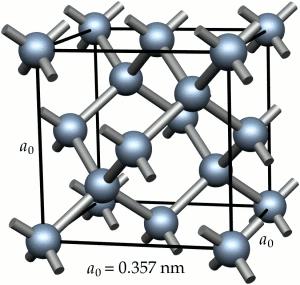
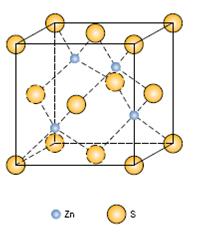
Q5. Calculate the structure factor for the conventional diamond or cubic ZnS structure. Atomic Positions for Diamond are: C: (0,0,0), (0,1/2,1/2), (1/2,0,1/2), (1/2,1/2,0), (1/4,1/4,1/4), (1/4,3/4,3/4), (3/4,1/4,3/4), (3/4,3/4,1/4).
Background
Topic: Structure Factor Calculation, Diamond and Zinc Blende (ZnS) Structures
This question tests your ability to calculate the structure factor for complex cubic structures using atomic positions.
Key Terms and Formulas
Structure Factor:
Atomic positions for diamond and ZnS structures (as given).
Step-by-Step Guidance
Write out the general formula for the structure factor for all atoms in the unit cell.
Substitute the atomic positions into the formula for .
Group terms and simplify using symmetry and properties of exponents.
Identify the conditions under which is nonzero (reflection conditions for diamond/ZnS).
Try solving on your own before revealing the answer!
Final Answer:
The structure factor for diamond (or cubic ZnS) is: Nonzero only when are all even or all odd and (for diamond). For ZnS, use and for the two atom types.
