 Back
BackSound Intensity and Standing Sound Waves: Study Notes
Study Guide - Smart Notes
 Tailored notes based on your materials, expanded with key definitions, examples, and context.
Sound Intensity and Standing Sound Waves
Energy Transfer in a Sound Wave
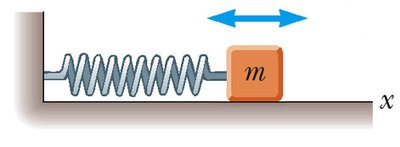
Sound waves transfer energy through the oscillatory motion of particles in a medium. Each small fluid element undergoes simple harmonic motion, described by the displacement function:
Displacement function:
Energy of a harmonic oscillator:
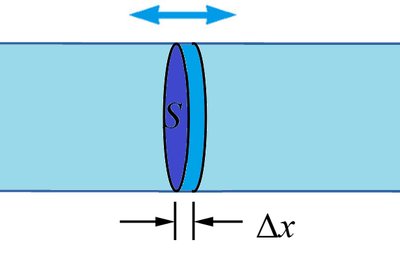
Mass of element:
Energy transfer rate (intensity): , where
Intensity in terms of amplitude:
Example: The energy carried by a sound wave is proportional to the square of its amplitude and frequency.
Pressure Oscillations in a Sound Wave
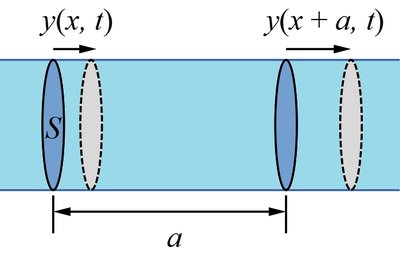
Sound waves cause oscillations in pressure as well as displacement. The excess pressure in a small fluid element is derived from the change in volume due to the wave:
Volume change:
For small :
Excess pressure:
Pressure amplitude:
Example: The pressure oscillations are out of phase with displacement oscillations.
Intensity of a Sound Wave
The intensity of a sound wave can be expressed in terms of both displacement amplitude and pressure amplitude. The speed of sound relates these quantities:
Intensity (displacement):
Pressure amplitude:
Speed of sound:
Intensity (pressure):
Intensity in decibels: ,
Human hearing range: 20 Hz to 20 kHz
Threshold of hearing:
Pain threshold:
Example: A sound wave with higher amplitude or frequency carries more energy and is perceived as louder.
Pressure and Displacement in a Sound Wave
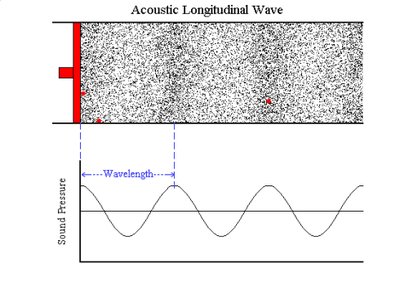
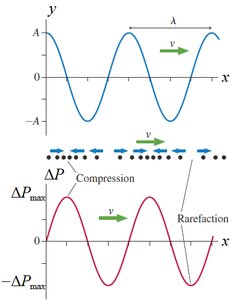
Pressure and displacement oscillations in a sound wave are related but occur out of phase. Displacement maxima correspond to pressure minima and vice versa:
Displacement:
Excess pressure:
Pressure amplitude:
Pressure maxima/minima: Zero displacement
Displacement maxima/minima: Zero excess pressure
Boundary Conditions in Sound Waves
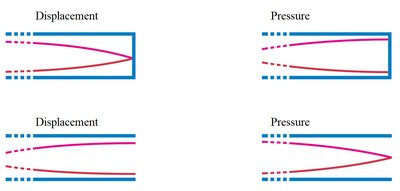
Standing waves form in tubes due to reflections at boundaries. The nature of the boundary (open or closed) determines the location of nodes and antinodes:
Displacement nodes: Pressure antinodes
Closed end: Displacement node, pressure antinode
Open end: Displacement antinode, pressure node
Normal Modes in a Tube with Both Ends Open
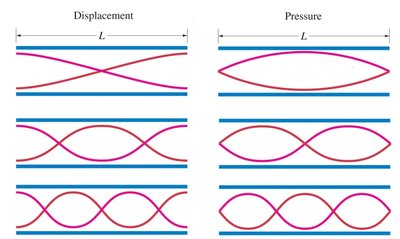
In a tube open at both ends, standing waves have pressure nodes at the ends. The allowed wavelengths and frequencies are determined by the tube length:
Excess pressure:
Displacement:
Pressure nodes:
Allowed wavelengths: , ,
Frequency in nth mode:
Fundamental frequency:
Normal Modes in a Tube with One End Open, One End Closed
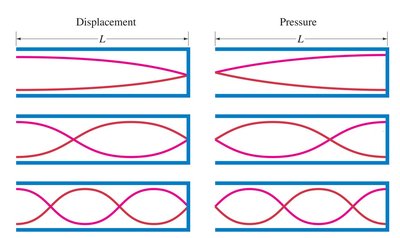
For a tube with one open and one closed end, the boundary conditions change, resulting in different allowed wavelengths and frequencies:
Excess pressure:
Displacement:
Pressure node at : Displacement node at
Allowed wavelengths: , ,
Frequencies: with odd
Fundamental frequency:
Exercises
Exercise 1: What is the amplitude of pressure oscillations in a sound wave of intensity 50 dB under normal conditions?
Exercise 2: The intensity of sound is 20 dB at a 15 m distance from the source. How close should you move to the source for the sound level to be 60 dB?
Exercise 3: A standing wave in a pipe has a frequency of 440 Hz. The next higher harmonic has a frequency of 660 Hz. The speed of sound = 340 m/s. Determine the fundamental frequency and the length of the pipe (a) if its both ends are open; (b) if its one end is open and the other closed.
Exercise 4: At what frequency does a 3-meter long chimney moan?
Additional info: These exercises reinforce the concepts of sound intensity, decibel scale, and standing wave modes in tubes.
