 Back
BackSound Waves: Properties, Sources, Interference, and Applications
Study Guide - Smart Notes
 Tailored notes based on your materials, expanded with key definitions, examples, and context.
Sound Waves
Introduction to Sound Waves
Sound waves are a type of mechanical wave that propagate as longitudinal waves through a medium such as air, water, or solids. They require a material medium to travel and cannot propagate through a vacuum. The speed of sound varies depending on the medium and its properties, such as temperature and density.
Longitudinal Wave: Particles of the medium vibrate parallel to the direction of wave propagation.
Speed of Sound: Fastest in solids, slower in liquids, and slowest in gases.
Temperature Effect: Higher temperatures generally increase the speed of sound in gases.
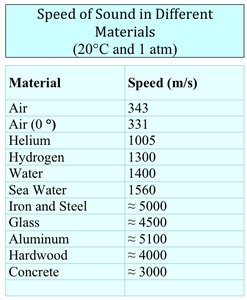
Example Table: Speed of sound in air at 20°C is approximately 343 m/s, while in water it is about 1400 m/s.
Wave Properties: Frequency, Wavelength, and Pitch
Sound waves are characterized by their frequency, wavelength, and amplitude. The frequency determines the pitch of the sound, while the amplitude relates to its loudness.
Frequency (f): Number of vibrations per second, measured in Hertz (Hz).
Wavelength (λ): Distance between successive compressions or rarefactions.
Pitch: Perceived frequency of a sound; higher frequency means higher pitch.
Audible Range: Human hearing typically ranges from 20 Hz to 20,000 Hz.
Ultrasound: Frequencies above 20,000 Hz.
Infrasound: Frequencies below 20 Hz.
Key Equation:
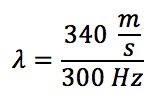
Example: For a sound wave with frequency 300 Hz in air (v = 340 m/s):
Echoes and Applications
Echoes occur when sound waves reflect off surfaces and return to the listener. The time delay can be used to calculate distances.
Echo Calculation: The total travel time is twice the distance to the reflecting surface.
Application: Used in sonar, measuring building distances, and understanding thunder and lightning delays.
Loudness and Intensity
Sound Intensity and the Decibel Scale
Intensity is the power per unit area carried by a wave. Loudness is the human perception of intensity, measured in decibels (dB).
Intensity (I): , where P is power and A is area.
Inverse Square Law: Intensity decreases with the square of the distance from the source.
Decibel Scale: , where is the threshold of hearing.
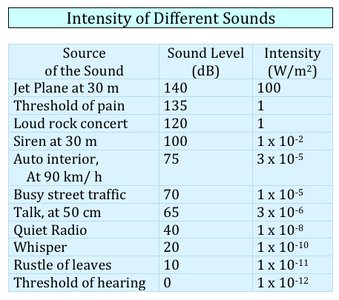
Example Table: Jet plane at 30 m: 140 dB; Whisper: 20 dB; Threshold of hearing: 0 dB.
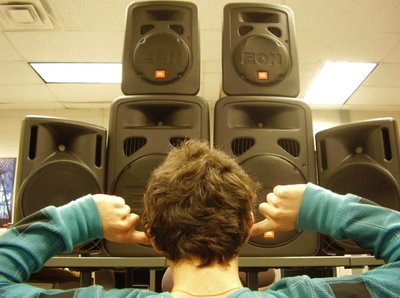
The Human Ear and Perception of Sound
The ear detects sound through a series of mechanical and neural processes. The outer ear collects sound, the middle ear amplifies it, and the inner ear converts it to electrical signals for the brain.
Outer Ear: Collects sound waves and directs them to the eardrum.
Middle Ear: Contains the hammer, anvil, and stirrup bones that transmit vibrations.
Inner Ear: The cochlea transforms vibrations into nerve impulses.

Sources of Sound: Vibrating Strings and Air Columns
Stringed Instruments
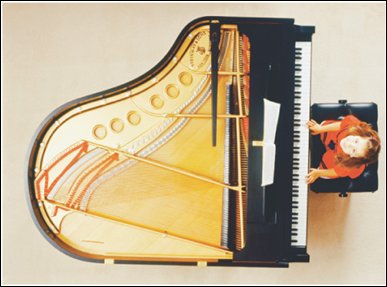
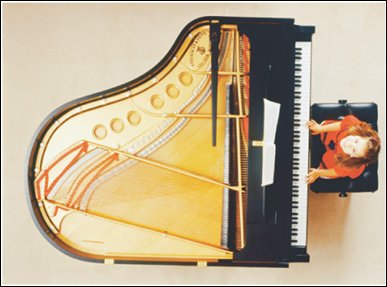
Stringed instruments produce sound by vibrating strings. The pitch depends on the string's length, tension, and mass per unit length.
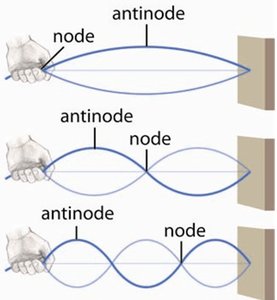
Fundamental Frequency: The lowest frequency produced by a vibrating string, with wavelength twice the string length.
Harmonics: Higher frequencies that are integer multiples of the fundamental.
Pitch Adjustment: Shortening the string or increasing tension raises the pitch.
Wind Instruments: Open and Closed Tubes
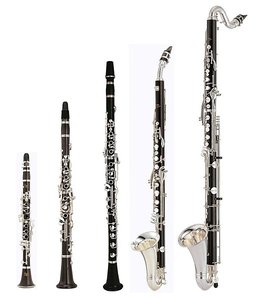
Wind instruments create sound through standing waves in air columns. The boundary conditions (open or closed ends) determine the harmonic series.
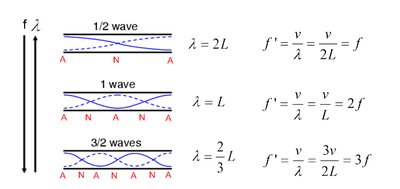
Open Tube: Both ends open; supports all harmonics. Fundamental wavelength is twice the tube length ().
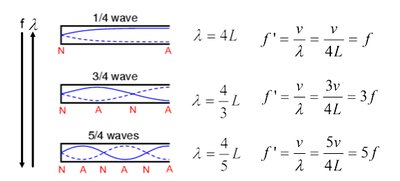
Closed Tube: One end closed; supports only odd harmonics. Fundamental wavelength is four times the tube length ().
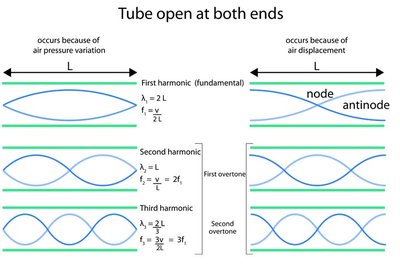
Equations for Resonance in Tubes
Open Tube: , ,
Closed Tube: , ,
Harmonics and Timbre
The unique sound quality (timbre) of an instrument is determined by the relative strengths of its harmonics.

Interference of Sound Waves
Principle of Superposition
When two or more sound waves meet, they superpose to form a resultant wave. The type of interference depends on the phase relationship between the waves.
Constructive Interference: Occurs when waves are in phase, resulting in increased amplitude (louder sound).
Destructive Interference: Occurs when waves are out of phase by half a wavelength, resulting in reduced or zero amplitude (quiet or no sound).
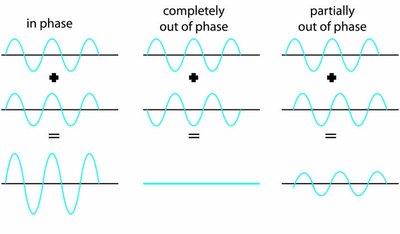
Interference Patterns and Applications
When two coherent sound sources emit waves of the same frequency, interference patterns of loud and quiet spots are formed. The positions of maxima and minima can be calculated using geometry and the wavelength.
Maxima (Constructive): Path difference is an integer multiple of wavelength ().
Minima (Destructive): Path difference is an odd multiple of half-wavelength ().
Beats
Beats occur when two sound waves of slightly different frequencies interfere, producing a periodic variation in loudness at the beat frequency.
Beat Frequency:
Application: Used in tuning musical instruments.
Doppler Effect and Sonic Booms
Doppler Effect
The Doppler effect is the change in frequency (and wavelength) of a wave as observed by someone moving relative to the source of the wave.
Approaching Source: Observed frequency increases (higher pitch).
Receding Source: Observed frequency decreases (lower pitch).
Applications: Used in radar, medical imaging, and astronomy.
Shock Waves and Sonic Booms
When a source moves faster than the speed of sound in a medium, it generates shock waves, resulting in a sonic boom. This is analogous to the bow wave created by a boat moving faster than water waves.
Sonic Boom: The sharp sound heard when an object exceeds the speed of sound.
Summary Table: Speed of Sound in Different Materials
Material | Speed (m/s) |
|---|---|
Air | 343 |
Air (0°C) | 331 |
Helium | 1005 |
Hydrogen | 1300 |
Water | 1400 |
Sea Water | 1560 |
Iron and Steel | ≈ 5000 |
Glass | ≈ 4500 |
Aluminum | ≈ 5100 |
Hardwood | ≈ 4000 |
Concrete | ≈ 3000 |
Summary Table: Intensity of Different Sounds
Source of the Sound | Sound Level (dB) | Intensity (W/m2) |
|---|---|---|
Jet Plane at 30 m | 140 | 100 |
Threshold of pain | 135 | 1 |
Loud rock concert | 120 | 1 |
Siren at 30 m | 100 | 1 × 10⁻² |
Auto interior, At 90 km/h | 75 | 3 × 10⁻⁵ |
Busy street traffic | 70 | 1 × 10⁻⁵ |
Talk, at 50 cm | 65 | 3 × 10⁻⁶ |
Quiet Radio | 40 | 1 × 10⁻⁸ |
Whisper | 20 | 1 × 10⁻¹⁰ |
Rustle of leaves | 10 | 1 × 10-11 |
Threshold of hearing | 0 | 1 × 10-12 |
Additional info: This guide covers the main concepts of sound waves, their properties, sources, resonance in tubes, interference, beats, and the Doppler effect, as relevant to a college-level physics course.
