 Back
BackSources of Magnetic Field: Biot-Savart Law, Magnetic Fields from Currents, and Applications
Study Guide - Smart Notes
 Tailored notes based on your materials, expanded with key definitions, examples, and context.
Ch. 28: Sources of Magnetic Field
Magnetic Field of a Moving Charge
Magnetic fields are produced by moving electric charges. The field at a point in space due to a charge q moving with velocity v is given by:
Magnetic Field Formula:
Where:
q: Electric charge
\vec{v}: Velocity of the charge
\hat{r}: Unit vector from the charge to the field point
r: Distance from the charge to the field point
\mu_0: Permeability of free space ()
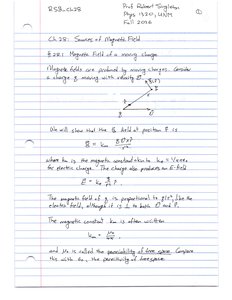
Additional info: The direction of \vec{B} is given by the right-hand rule for the cross product \vec{v} \times \hat{r}.
Magnetic Field of a Current Element: The Biot-Savart Law
The Biot-Savart Law gives the magnetic field produced at a point by a small segment of current-carrying wire. For a current I flowing through a wire element d\vec{l}:
Biot-Savart Law:
Where:
I: Current
d\vec{l}: Vector length element of the wire
\hat{r}: Unit vector from the element to the field point
r: Distance from the element to the field point
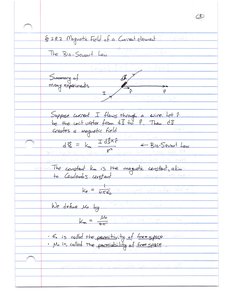
Additional info: The Biot-Savart Law is fundamental for calculating magnetic fields from arbitrary current distributions.
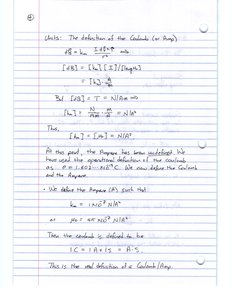
Units: The Definition of the Coulomb (or Ampere)
The SI unit of current is the ampere (A), defined via the force between parallel currents. The relationship between the units is established as follows:
Magnetic Field Units:
(Tesla)
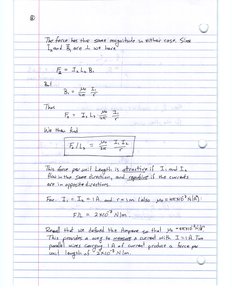
Definition of the Ampere: The ampere is defined such that:
Additional info: The ampere is defined operationally by the force per unit length between two parallel conductors.
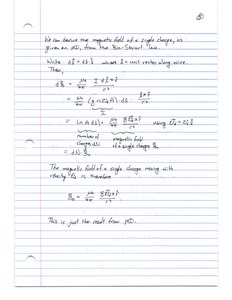
Derivation: Magnetic Field of a Moving Charge from Biot-Savart Law
The Biot-Savart Law can be used to derive the magnetic field of a single moving charge. For a charge moving along a path, the field at a point is:
This matches the direct formula for the field of a moving charge.
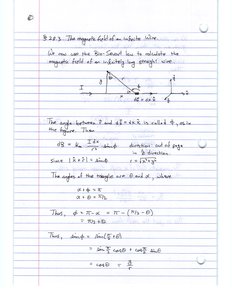
Magnetic Field from an Infinite Straight Wire
The Biot-Savart Law can be applied to calculate the magnetic field at a distance a from an infinitely long, straight wire carrying current I:
Result:
The direction of \vec{B} is given by the right-hand rule (circulating around the wire).
Force Between Two Parallel Wires
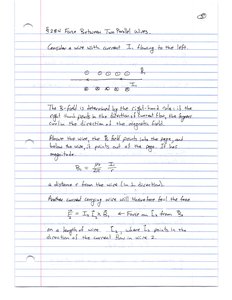
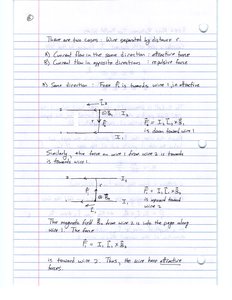
Two parallel wires carrying currents exert forces on each other due to their magnetic fields. The force per unit length between two wires separated by distance r is:
Force per Unit Length:
If currents are in the same direction, the force is attractive; if opposite, the force is repulsive.
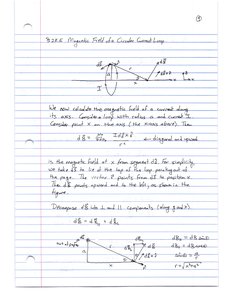
Magnetic Field on the Axis of a Circular Current Loop
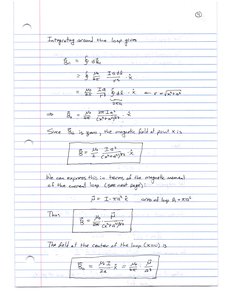
The magnetic field at a point on the axis of a circular loop of radius R carrying current I is:
Field at Distance x on Axis:
Field at Center of Loop (x = 0):
The Dipole Field
A current loop with current I and radius R forms a magnetic dipole moment:
Magnetic Dipole Moment:
The direction of \vec{\mu} is given by the right-hand rule (curl fingers in direction of current, thumb points in direction of \vec{\mu}).
The magnetic field along the axis at distance x (for x \gg R):
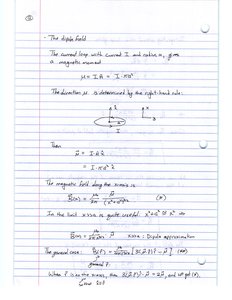
Additional info: This is the far-field (dipole) approximation for the field of a current loop.
