 Back
BackSources of Magnetic Field – Study Notes
Study Guide - Smart Notes
 Tailored notes based on your materials, expanded with key definitions, examples, and context.
Sources of Magnetic Field
Introduction
This chapter explores the origins and properties of magnetic fields produced by moving charges and electric currents. It covers fundamental laws, calculation techniques, and applications relevant to college-level physics.
Magnetic Field of a Moving Charge
Basic Principle
A moving electric charge generates a magnetic field. The direction and magnitude of this field depend on the velocity of the charge and its position relative to the observation point.
Right-Hand Rule: Point your thumb in the direction of the velocity of a positive charge; your fingers curl in the direction of the magnetic field lines.
Field Direction: For a charge moving into the page, the magnetic field forms concentric circles around the path of the charge.
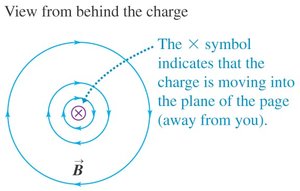
Formula:
where is the permeability of free space, is the charge, is the velocity, is the unit vector from the charge to the observation point, and is the distance.
Biot–Savart Law
Magnetic Field of a Current Element
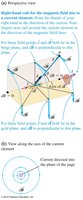
The Biot–Savart Law provides a quantitative method to calculate the magnetic field produced by a small segment of current-carrying conductor.
Law Statement: The magnetic field at a point due to a current element is:
Direction: Determined by the right-hand rule for the cross product.
Magnetic Field of a Straight Current-Carrying Conductor
Field Calculation
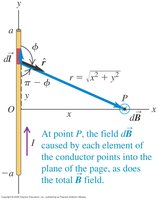
Applying the Biot–Savart Law to a long, straight wire yields the magnetic field at a distance from the wire:
Field Lines: The field forms concentric circles around the wire, with direction given by the right-hand rule.
Magnetic Field of a Circular Current Loop
Field on the Axis
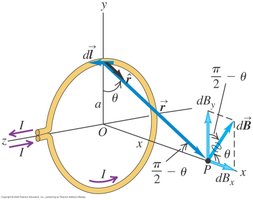
The Biot–Savart Law can be used to find the magnetic field at a point on the axis of a circular loop of radius carrying current :
At the Center: The field is strongest and points along the axis of the loop.
Right-Hand Rule: Curl your fingers in the direction of current; your thumb points in the direction of the field.
Force Between Parallel Conductors
Magnetic Interaction
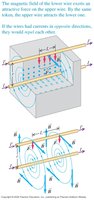
Parallel conductors carrying currents exert forces on each other due to their magnetic fields.
Force per Unit Length:
Attraction/Repulsion: Currents in the same direction attract; opposite directions repel.
Ampère’s Law
Integral Formulation
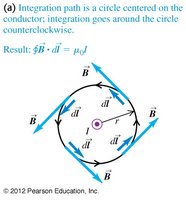
Ampère’s Law relates the integrated magnetic field around a closed loop to the total current passing through the loop:
Application: Useful for calculating fields in highly symmetric situations (e.g., straight wires, solenoids, toroids).
Direction: Use the right-hand rule to determine the positive direction for the loop integral.
Magnetic Field of a Solenoid
Field Inside a Solenoid
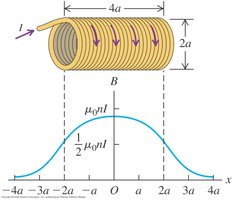
A solenoid is a coil of wire; inside, the magnetic field is nearly uniform and parallel to the axis:
n: Number of turns per unit length.
Field Distribution: The field is strong and uniform inside, weak outside.
Field of a Toroidal Solenoid
Magnetic Field in a Toroid
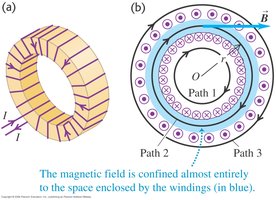
A toroidal solenoid is a coil shaped like a doughnut. The magnetic field inside is given by:
N: Total number of turns.
r: Distance from the center of the toroid.
Field Confinement: The field is largely confined within the core of the toroid.
Magnetic Materials
Orbital Magnetic Moment and Paramagnetism
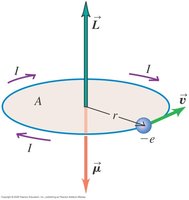
Electrons in atoms generate magnetic moments due to their orbital motion. The Bohr magneton is a fundamental unit of magnetic moment:
Paramagnetism: Materials with unpaired electrons align with external fields, enhancing the field.
Ferromagnetism and Hysteresis
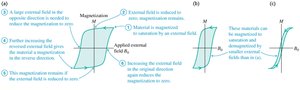
Ferromagnetic materials (e.g., iron) exhibit strong, permanent magnetization due to aligned domains. Hysteresis describes the lag between changes in magnetization and the external field.
Hysteresis Loop: Shows the relationship between magnetization and applied field, including remanence and coercivity.
Applications of Magnetic Fields
Electromagnets
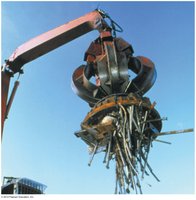
Electromagnets use current-carrying coils to generate strong, controllable magnetic fields for lifting heavy objects or in electric motors.
Magnetic Resonance Imaging (MRI)
MRI machines use strong, uniform magnetic fields to image the interior of the human body, exploiting the magnetic properties of atomic nuclei.

Summary Table: Key Magnetic Field Formulas
Configuration | Magnetic Field Formula |
|---|---|
Moving Point Charge | |
Long Straight Wire | |
Circular Loop (center) | |
Solenoid (inside) | |
Toroid (inside) | |
Force between Parallel Wires |
Practice Problems
Calculate the magnetic field at a point 5 cm from a long, straight wire carrying 10 A of current.
Find the force per unit length between two parallel wires 2 cm apart, each carrying 5 A in the same direction.
Determine the field at the center of a circular loop of radius 10 cm carrying 2 A of current.
Additional info: Some equations and context were inferred for completeness and clarity, following standard physics curriculum.
