Back
BackSources of Magnetic Field: Study Notes
Study Guide - Smart Notes
 Tailored notes based on your materials, expanded with key definitions, examples, and context.
Sources of Magnetic Field
Introduction to Magnetic Fields
Magnetic fields are fundamental to understanding the behavior of moving charges and currents in physics. They are generated by moving electric charges and are essential in many applications, from particle accelerators to everyday electronics.
Magnetic Field (\(\vec{B}\)): A vector field produced by moving charges or currents, influencing other moving charges in its vicinity.
Solenoid: A coil of wire that generates a nearly uniform magnetic field inside when carrying current.
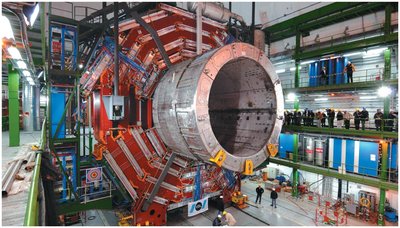
Applications: Used in MRI machines, particle accelerators, and electromagnets.
Magnetic Field of a Moving Charge
Right-Hand Rule and Field Direction
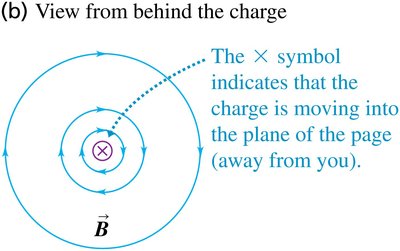
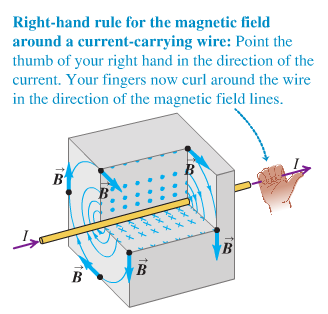
A moving charge creates a magnetic field whose direction can be determined by the right-hand rule. The field forms concentric circles around the path of the charge.
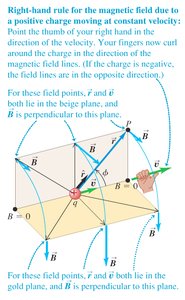
Right-Hand Rule: Point your thumb in the direction of the velocity of a positive charge; your fingers curl in the direction of the magnetic field lines.
Field Direction: For a charge moving into the page, the field circles clockwise.
Mathematical Expression
The magnitude of the magnetic field \(B\) at a distance \(r\) from a moving charge \(q\) with velocity \(v\) is given by:
\(\mu_0\): Permeability of free space
\(\phi\): Angle between velocity and position vector
Lorentz Force Law
Force on a Moving Charge
The total force on a charge in the presence of both electric and magnetic fields is given by the Lorentz force law:

Electric Force: \(q\vec{E}\)
Magnetic Force: \(q\vec{v} \times \vec{B}\)
The direction of the magnetic force is perpendicular to both the velocity and the magnetic field.
Magnetic Field of a Current Element
Biot-Savart Law
The Biot-Savart Law gives the magnetic field produced at a point by a small segment of current-carrying wire:
\(I\): Current
\(d\vec{l}\): Vector length element in the direction of current
\(\hat{r}\): Unit vector from the element to the point of interest
Magnetic Field Due to Straight and Parallel Conductors
Field of a Straight Conductor
A long, straight conductor carrying current produces a magnetic field that circles the wire. The field at a distance \(r\) is:
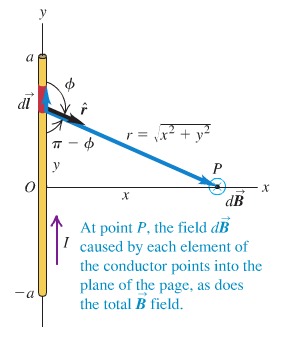
Direction is given by the right-hand rule: thumb in current direction, fingers curl in field direction.
Force Between Parallel Conductors
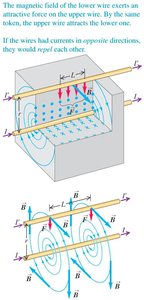
Two parallel wires carrying currents exert forces on each other. If currents are in the same direction, the force is attractive; if opposite, the force is repulsive.
Magnetic field produced by one wire at the location of the other:
Force per unit length:
Magnetic Field of a Circular Loop and Solenoid
Circular Current Loop
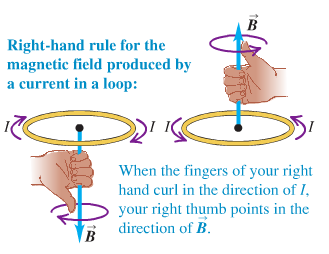
A current loop produces a magnetic field along its axis. The field at the center is:
\(R\): Radius of the loop
Direction: Right-hand rule for loops (curl fingers in current direction, thumb points in field direction).
Solenoids and Toroids
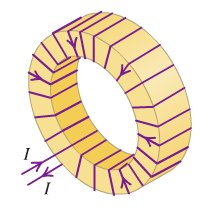
A solenoid is a coil of wire; a toroid is a solenoid bent into a circle. Both produce strong, uniform magnetic fields inside.
Field inside a long solenoid: (where \(n\) is turns per unit length)
Field inside a toroid: (where \(N\) is total turns, \(r\) is radius)
Ampère’s Law
Statement and Application
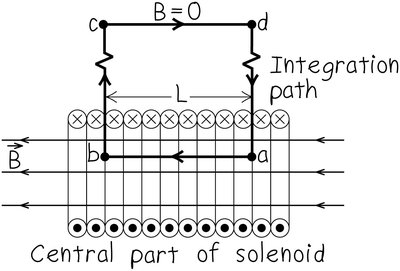
Ampère’s Law relates the integrated magnetic field around a closed loop to the current passing through the loop:
Useful for calculating fields in symmetric situations (e.g., solenoids, toroids, straight wires).
Analogous to Gauss’s Law for electric fields.
Magnetic Properties of Materials
Paramagnetism and Diamagnetism
Materials respond differently to external magnetic fields:
Paramagnetic: Field inside is greater than in vacuum; relative permeability \(K_m > 1\).
Diamagnetic: Field inside is slightly less than in vacuum; \(K_m < 1\).
Magnetic Susceptibility:
Ferromagnetism
Ferromagnetic materials (e.g., iron) have domains of aligned atomic magnetic moments. In an external field, these domains grow in the field direction, leading to strong magnetization.
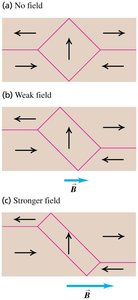
Domains are randomly oriented without an external field.
External field aligns domains, increasing net magnetization.
Atomic Magnetic Moments and the Bohr Magneton
Electron Orbits and Magnetic Dipole Moment
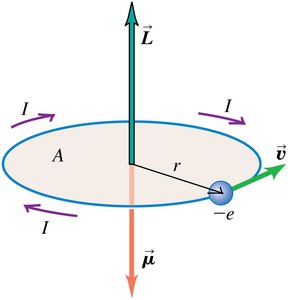
Electrons in atoms generate magnetic dipole moments due to their orbital and spin angular momentum. The Bohr magneton is the fundamental unit of magnetic moment.
Magnetic moment due to angular momentum:
Bohr magneton:
Electron spin also contributes a magnetic moment approximately equal to one Bohr magneton.