Back
BackSources of Magnetic Field: Study Notes
Study Guide - Smart Notes
 Tailored notes based on your materials, expanded with key definitions, examples, and context.
Sources of Magnetic Field
Introduction to Magnetic Fields
Magnetic fields are generated by moving electric charges and currents. Understanding the sources of magnetic fields is essential for explaining phenomena ranging from the Earth's magnetism to the operation of advanced scientific equipment such as MRI machines and particle accelerators.
Magnetic Field of a Moving Charge
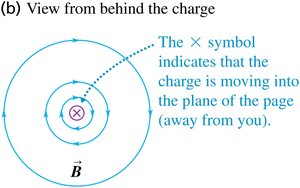
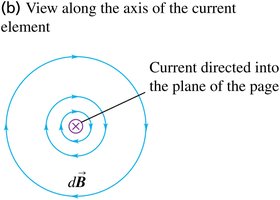
A single moving charge produces a magnetic field whose direction and magnitude depend on the velocity of the charge and the distance from the charge. The field lines form concentric circles around the path of the moving charge, with the direction given by the right-hand rule.
Direction: Determined by the right-hand rule; if the charge moves into the page, the field circles clockwise.
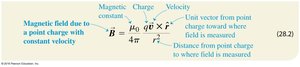
Magnitude: Decreases with the square of the distance from the charge.
The magnetic field at a point due to a moving charge is given by:
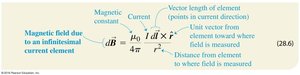
Biot-Savart Law: Magnetic Field of a Current Element
The Biot-Savart law provides a quantitative expression for the magnetic field produced by a small segment of current-carrying conductor. The total field is the vector sum of the contributions from all such elements.
Formula:
Direction: Given by the right-hand rule for the cross product.
Planetary Magnetism
Planetary magnetic fields, such as Earth's, are generated by circulating currents in their molten interiors. The strength and existence of a planet's magnetic field depend on its size, composition, and rotation rate.
Earth: Strong magnetic field due to rapid rotation and molten core.
Moon: Weak field due to slow rotation and solid interior.

Magnetic Field of a Straight Current-Carrying Conductor
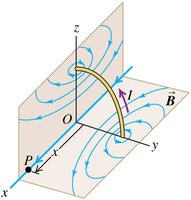
A straight conductor carrying current produces a magnetic field whose lines form concentric circles around the wire. The Biot-Savart law can be used to derive the field at a point on the perpendicular bisector of a finite wire.
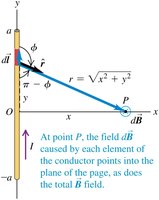
For a long, straight wire, the magnetic field at a distance r is:

For a finite wire of length 2a at distance x from the center:
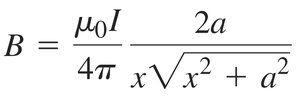
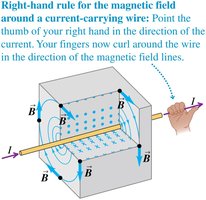
The direction of the field is given by the right-hand rule: thumb in the direction of current, fingers curl in the direction of the field lines.
Magnetic Fields in Cables
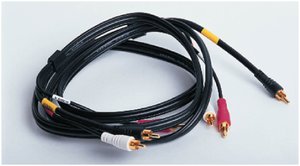
In cables with closely spaced wires carrying currents in opposite directions, the magnetic fields cancel, resulting in little or no net field outside the cable. This principle is used in audio-video and computer cables to minimize electromagnetic interference.
Force Between Parallel Conductors
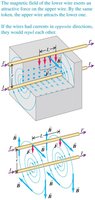
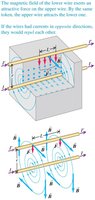
Parallel conductors carrying currents exert forces on each other due to their magnetic fields. Currents in the same direction attract; currents in opposite directions repel. This interaction forms the basis for the definition of the ampere.
Force per unit length:
Direction: Attractive for parallel currents, repulsive for antiparallel currents.

Magnetic Field of a Circular Current Loop
A current-carrying loop produces a magnetic field along its axis, with the direction given by the right-hand rule. The field at a point on the axis is calculated by integrating the Biot-Savart law around the loop.
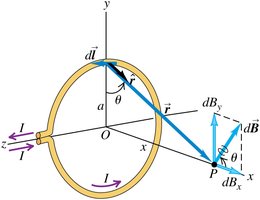
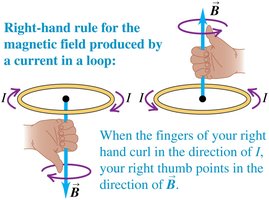
The field lines form closed curves around the loop, resembling those of a magnetic dipole.
Applications: MRI and Solenoids
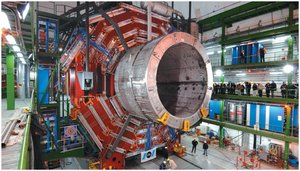
Magnetic resonance imaging (MRI) uses strong, uniform magnetic fields generated by solenoids. The high currents required are managed by cooling the coils with liquid helium to prevent overheating.

Ampere’s Law
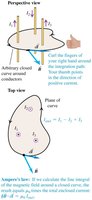
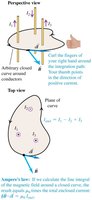
Ampere’s law relates the magnetic field around a closed path to the total current passing through the area enclosed by the path. It is especially useful for calculating fields in systems with high symmetry.
Special case (circular path around straight conductor):
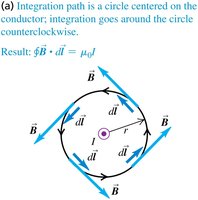

General statement: The integral is proportional to the algebraic sum of the enclosed currents, considering their directions.
Field of a Long Cylindrical Conductor
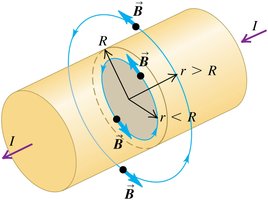
For a cylindrical conductor with uniform current distribution, the magnetic field inside and outside the conductor can be found using Ampere’s law:
Inside (r < R):
Outside (r > R):


Field of a Solenoid
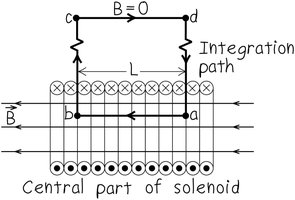
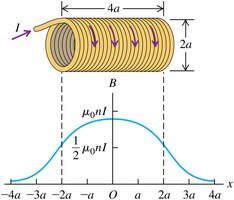
A solenoid is a coil of wire that produces a nearly uniform magnetic field inside when a current flows through it. The field strength depends on the number of turns per unit length and the current.
Field inside (ideal solenoid):
n: Number of turns per unit length
Microscopic Currents and Magnetic Properties of Materials
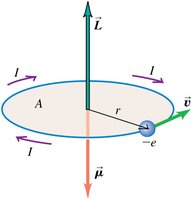
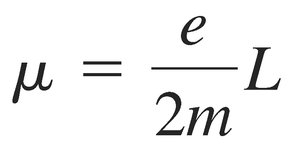
Electrons in atoms generate magnetic dipole moments due to their orbital and spin angular momentum. The Bohr magneton is the fundamental unit of magnetic dipole moment for electrons.
Bohr magneton:
Magnetic moment:
Paramagnetism, Diamagnetism, and Ferromagnetism
Materials respond differently to external magnetic fields based on their atomic structure:
Paramagnetic: Field inside is greater than in vacuum; relative permeability .
Diamagnetic: Field inside is slightly less than in vacuum; .
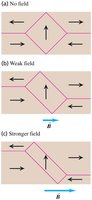
Ferromagnetic: Strong, spontaneous magnetization due to aligned domains (e.g., iron).
The magnetic susceptibility quantifies the response: .
Type | Relative Permeability () | Susceptibility () |
|---|---|---|
Paramagnetic | > 1 | Positive, small |
Diamagnetic | < 1 | Negative, small |
Ferromagnetic | >> 1 | Large, positive |