 Back
BackSources of Magnetic Field – Study Notes
Study Guide - Smart Notes
 Tailored notes based on your materials, expanded with key definitions, examples, and context.
Sources of Magnetic Field
Introduction to Magnetic Fields
Magnetic fields are generated by moving electric charges and currents. This chapter explores the fundamental sources of magnetic fields, including single moving charges, current-carrying wires, and coils. The principles discussed are foundational for understanding electromagnetism and its applications in technology and nature.
Magnetic Field of a Moving Charge
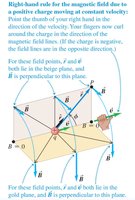
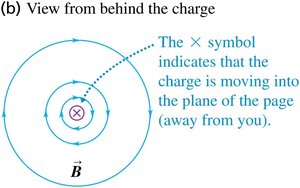
A single moving charge produces a magnetic field whose direction and magnitude depend on the velocity of the charge and the distance from the charge. The right-hand rule helps determine the direction of the magnetic field lines.
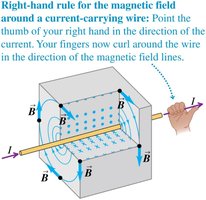
Right-Hand Rule: Point your thumb in the direction of the velocity of a positive charge; your fingers curl in the direction of the magnetic field lines.
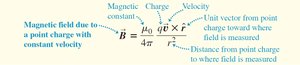
Magnetic Field Equation: The magnetic field at a point due to a moving charge is given by:
Variables: = charge, = velocity, = unit vector from charge to field point, = distance, = magnetic constant.
Biot–Savart Law: Magnetic Field of a Current Element
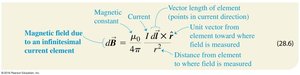
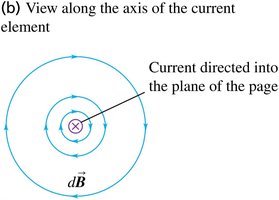
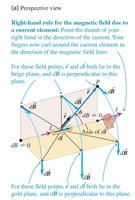
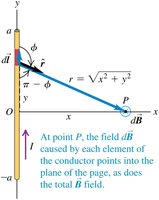
The Biot–Savart Law provides a quantitative method to calculate the magnetic field produced by a small segment of current-carrying wire. The total field is the vector sum of contributions from all such elements.
Biot–Savart Law:
= current, = vector length of element, = unit vector from element to field point, = distance.
Planetary Magnetism
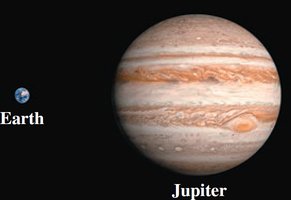
Planetary magnetic fields, such as those of Earth and Jupiter, are generated by circulating currents in their interiors. The strength of a planet's magnetic field depends on its size, composition, and rotation rate.
Earth's field is due to currents in its molten core.
Jupiter's field is much stronger due to its size, rapid rotation, and liquid hydrogen interior.
Magnetic Field of a Straight Current-Carrying Conductor
A straight wire carrying current produces a magnetic field whose magnitude at a distance from the wire is given by:
The direction of the field is given by the right-hand rule: thumb in the direction of current, fingers curl in the direction of .
Example: Magnetic Field from a Wire Segment
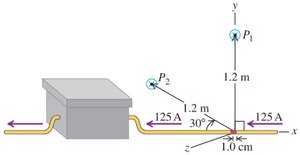
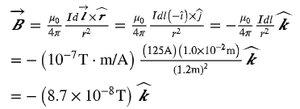
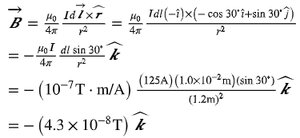
To find the magnetic field at specific points near a current-carrying wire, apply the Biot–Savart Law and vector analysis. For example, a 125 A current in a wire segment produces a field at points determined by their position relative to the wire.
Force Between Parallel Conductors
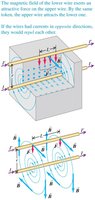
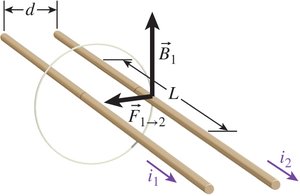
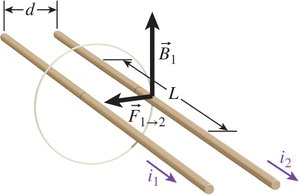
Parallel wires carrying currents exert forces on each other due to their magnetic fields. If currents are in the same direction, the wires attract; if opposite, they repel. The force per unit length between two long, straight, parallel conductors is:
= currents in the wires, = separation distance.
This interaction forms the basis for the SI definition of the ampere.

Magnetic Field from Multiple Wires
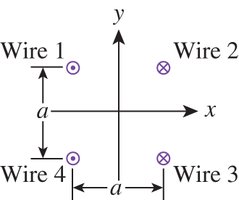
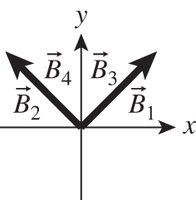
When several wires carry current, the net magnetic field at a point is the vector sum of the fields from each wire. For example, four wires at the corners of a square produce a field at the center that can be calculated using symmetry and the right-hand rule.
Magnetic Field of a Circular Current Loop
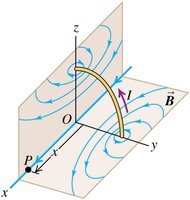
A current-carrying loop produces a magnetic field along its axis. The field at a distance from the center of a loop of radius is:
For loops, multiply by $N$.
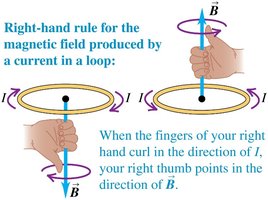
The direction is given by the right-hand rule: fingers curl in current direction, thumb points along .
Magnetic Field of a Solenoid
A solenoid is a coil of wire that produces a nearly uniform magnetic field inside when current flows. The field inside a long solenoid is:
= number of turns per unit length, = current.
Solenoids are used in devices like MRI machines, which require strong, uniform fields.

Magnetic Field of a Toroid
A toroid is a coil shaped like a doughnut. The magnetic field inside a toroid is confined within the core and is given by:
= total number of turns, = radius from the center of the toroid.
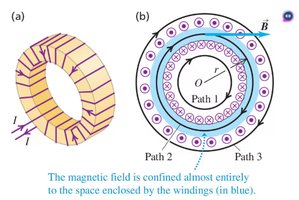
Ampère’s Law
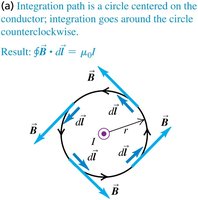
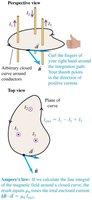
Ampère’s Law relates the integrated magnetic field around a closed loop to the total current passing through the loop. For a path enclosing current :
For multiple conductors, sum the enclosed currents algebraically.
This law is especially useful for calculating fields in symmetric situations (e.g., solenoids, toroids).
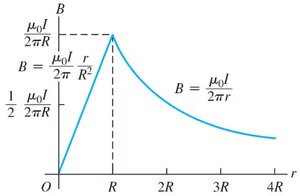
Field of a Long Cylindrical Conductor
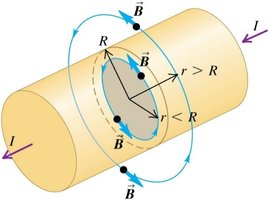
For a cylindrical conductor of radius carrying current uniformly, the magnetic field inside () and outside () is:
Inside (): Outside ():
Definition of the Ampere
The ampere is defined as the constant current which, if maintained in two straight parallel conductors of infinite length and negligible cross-section placed 1 meter apart in vacuum, would produce a force of newton per meter of length between the conductors. This definition leads to the value of the magnetic constant .
Summary Table: Key Magnetic Field Equations
Situation | Magnetic Field Equation |
|---|---|
Moving charge | |
Current element (Biot–Savart) | |
Straight wire | |
Circular loop (axis) | |
Solenoid (inside) | |
Toroid (inside) | |
Parallel wires (force/length) | |
Ampère’s Law |
