 Back
BackSources of the Magnetic Field: Biot–Savart Law, Ampère’s Law, and Applications
Study Guide - Smart Notes
 Tailored notes based on your materials, expanded with key definitions, examples, and context.
Sources of the Magnetic Field
Relationship Between Magnetism and Electricity
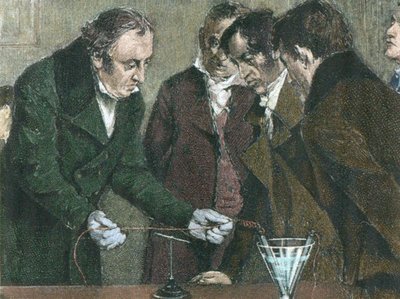
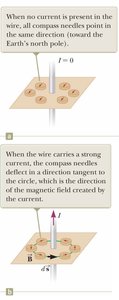
The connection between electricity and magnetism was first discovered in the early 19th century. Hans Christian Oersted observed that an electric current in a wire could deflect a nearby compass needle, revealing that electric currents produce magnetic fields. Later, Faraday and Henry demonstrated that a changing magnetic field can induce an electric current, and Maxwell's theoretical work showed that a changing electric field can also create a magnetic field. Thus, moving electric charges are the fundamental source of magnetic fields.
Key Point: Magnetic fields are produced by moving electric charges and intrinsic magnetic moments of elementary particles (spin).
Key Point: Magnetic and electric fields are both components of the electromagnetic force, one of the four fundamental forces of nature.
The Biot–Savart Law
Mathematical Formulation
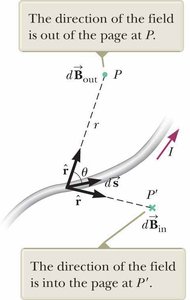
The Biot–Savart law quantitatively describes the magnetic field produced at a point by a small segment of current-carrying wire. The law is fundamental for calculating magnetic fields from arbitrary current distributions.
Formula (differential form):
Integral form (for total field):
Permeability of free space:
Right-Hand Rule for Cross Product
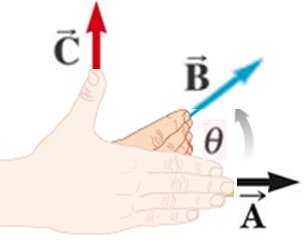
The direction of the magnetic field produced by a current element is determined by the right-hand rule for the cross product.
Fingers follow the direction of the first vector (, current element).
Palm faces the direction of the second vector (, position vector).
Thumb points in the direction of the resulting vector (, magnetic field).
Magnetic Field Due to Current-Carrying Wires
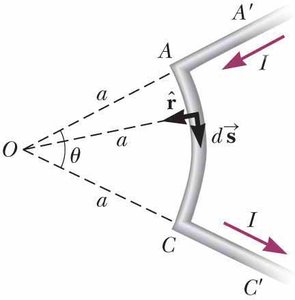
Curved Wire Segment
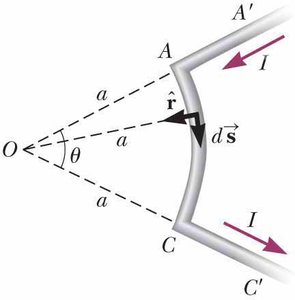
The magnetic field at the center of curvature of a wire segment forming an arc of radius and subtending an angle is:
(with in radians)
Circular Current Loop
For a full circular loop (), the magnetic field at the center is:
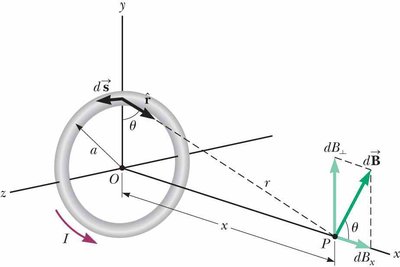
Magnetic Field on the Axis of a Circular Loop
At a point along the axis of a circular loop of radius carrying current :
At the center ():
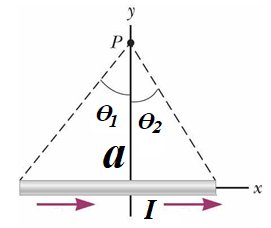
Magnetic Field Due to a Straight Conductor
The magnetic field at a perpendicular distance from a long, straight wire carrying current is:
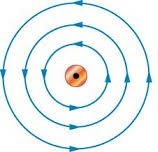
Direction of Magnetic Field Around a Wire
Use the right-hand rule: Thumb in the direction of current, fingers curl in the direction of the magnetic field lines (closed loops around the wire).
Magnetic Field Due to Multiple Wires
Superposition Principle
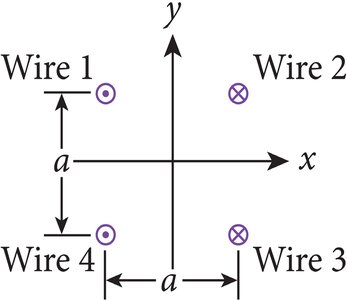
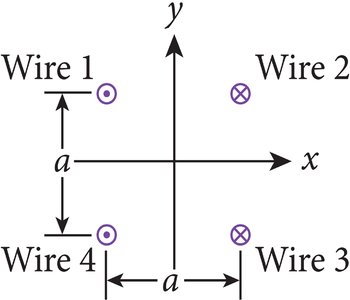
The net magnetic field at a point due to several wires is the vector sum of the fields produced by each wire individually.
Earth’s Magnetic Field
The Earth's magnetic field is likely generated by convection currents of charged particles in its liquid outer core. The field resembles that of a giant bar magnet tilted with respect to the planet's rotation axis.
Magnetic Force Between Parallel Conductors
Force Calculation
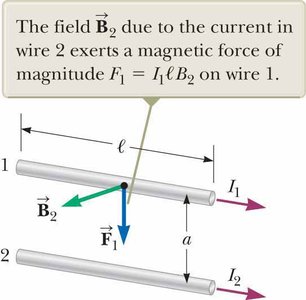
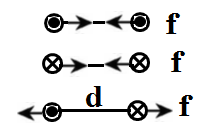
Two parallel current-carrying wires exert a force on each other due to their magnetic fields. The force per unit length between two long, parallel wires separated by distance is:
Same direction currents: wires attract; opposite direction: wires repel.
Ampère’s Law
Integral Formulation
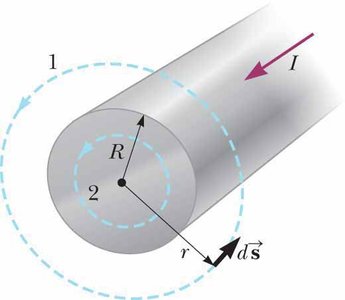
Ampère’s law relates the integrated magnetic field around a closed loop to the total current passing through the loop:
Application to a Long, Straight Wire
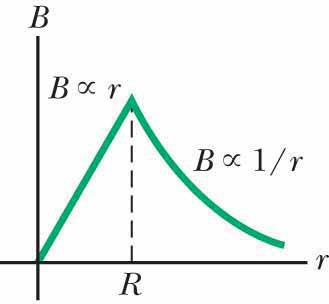
Outside the wire ():
Inside the wire ():
Magnetic Field of a Toroid
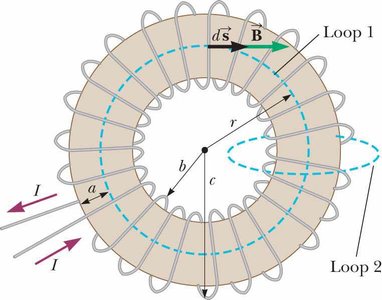
A toroid is a coil shaped like a doughnut. The magnetic field inside a toroid of turns, carrying current , at a distance from the center is:
Magnetic Field of a Solenoid
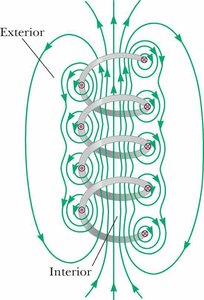
A solenoid is a long coil of wire. The magnetic field inside an ideal solenoid (closely spaced turns, length much greater than diameter) is:
Where is the number of turns per unit length.
Magnetic Flux
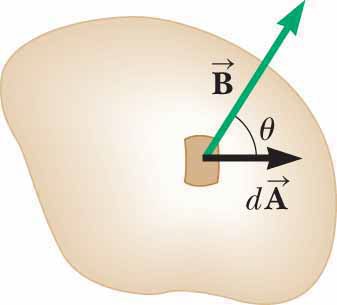
Magnetic flux through a surface is a measure of the number of magnetic field lines passing through that surface.
For a uniform field at angle to area :
Unit: Weber (Wb),
Gauss’s Law for Magnetism
Gauss’s law for magnetism states that the net magnetic flux through any closed surface is zero, reflecting the fact that magnetic field lines form closed loops and there are no magnetic monopoles.
Magnetic Properties of Materials
Ferromagnetism
Ferromagnetic materials (e.g., iron, cobalt, nickel) have permanent atomic magnetic moments that tend to align parallel to each other, resulting in strong magnetization even in weak external fields. Above the Curie temperature, thermal agitation disrupts this alignment, and the material becomes paramagnetic.
Substance | Curie Temperature (K) |
|---|---|
Iron | 1043 |
Cobalt | 1388 |
Nickel | 627 |
Gadolinium | 292 |
Dysprosium | 90 |
Additional info: Table inferred from context. |
Paramagnetism
Paramagnetic substances have atoms or ions with permanent magnetic moments that interact weakly and are randomly oriented without an external field. In an external field, these moments tend to align with the field, but thermal motion opposes this alignment.
Diamagnetism
Diamagnetic substances develop a weak magnetic moment in the direction opposite to an applied magnetic field, causing them to be weakly repelled by magnets. Diamagnetism is present in all matter but is usually masked by stronger effects unless the material is otherwise nonmagnetic. Superconductors exhibit perfect diamagnetism (Meissner effect), expelling all magnetic fields from their interior.
Summary Table: Key Magnetic Field Formulas
Configuration | Magnetic Field (B) |
|---|---|
Long straight wire | |
Circular loop (center) | |
Solenoid (interior) | |
Toroid (inside) | |
Parallel wires (force/length) |
Additional info: Table synthesized for quick reference.
