 Back
BackSpecial Relativity and Wave-Particle Duality: Structured Study Notes
Study Guide - Smart Notes
 Tailored notes based on your materials, expanded with key definitions, examples, and context.
Special Relativity
Einstein's Postulates
Special relativity is founded on two key postulates proposed by Albert Einstein:
Principle of Relativity: The laws of physics are the same in every inertial frame of reference.
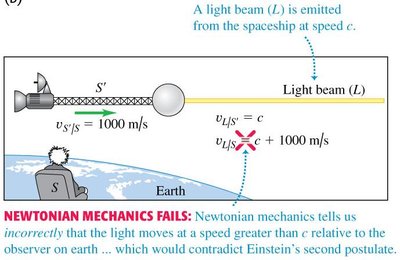
Constancy of the Speed of Light: The speed of light in a vacuum is the same in all inertial frames of reference and is independent of the motion of the source.
These postulates challenge classical mechanics, especially at speeds approaching the speed of light.
Reference Frames and Galilean Transformations
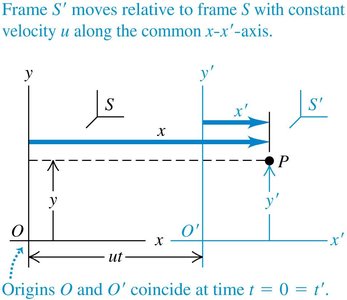
In classical physics, Galilean transformations relate coordinates and velocities between inertial frames moving at constant velocity relative to each other. However, they assume absolute time and do not account for the invariance of the speed of light.
Galilean Coordinate Transformation: , , ,
Galilean Velocity Transformation:
These transformations fail for light, as they predict , contradicting Einstein's second postulate.
Relativity of Simultaneity
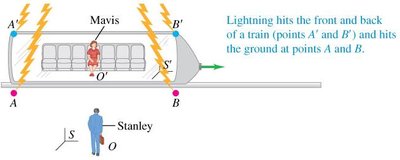
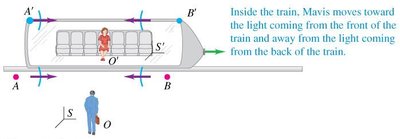
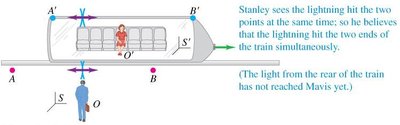
The concept of simultaneity is central to relativity. Two events that are simultaneous in one frame may not be simultaneous in another moving frame. This is illustrated by the train-and-lightning thought experiment.
Event: An occurrence at a definite position and time in a reference frame.
Simultaneity: In general, simultaneity is not preserved across moving inertial frames.
Time Dilation
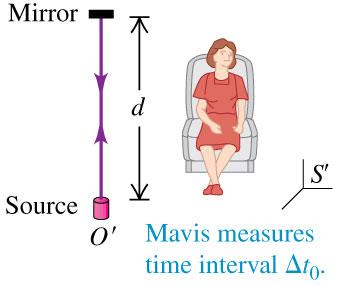
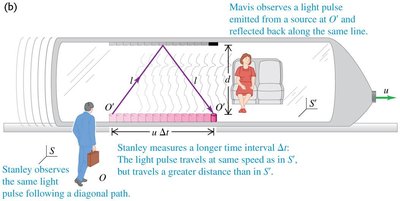
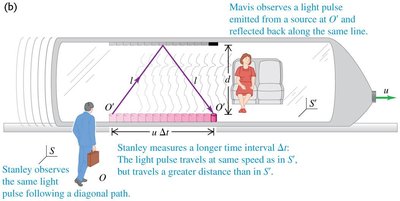
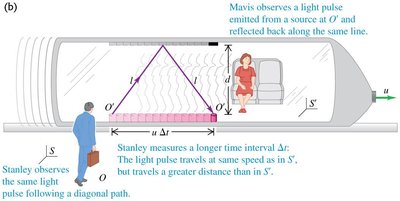
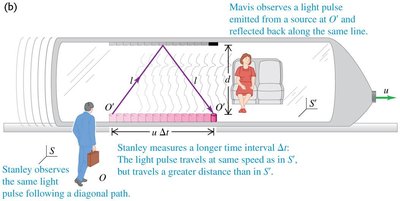
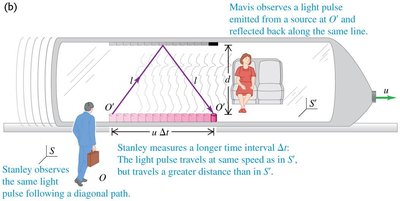
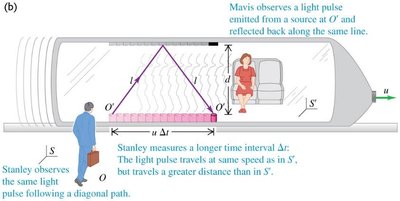
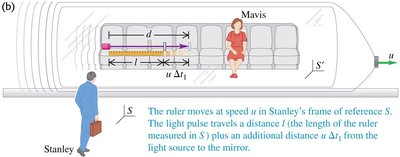
Time intervals measured in different inertial frames are related by the phenomenon of time dilation. A moving clock runs slower compared to a stationary observer's clock.
Proper Time (): The time interval between two events occurring at the same point in a particular frame.
Time Dilation Formula: , where
As approaches , increases rapidly, making much larger than .
Length Contraction
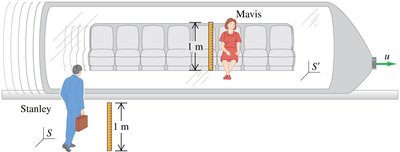
Objects moving relative to an observer appear contracted along the direction of motion. This effect is called length contraction.
Proper Length (): The length measured in the rest frame of the object.
Length Contraction Formula:
There is no contraction perpendicular to the direction of motion.
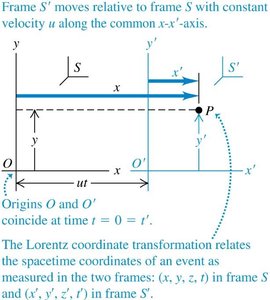
Lorentz Transformations
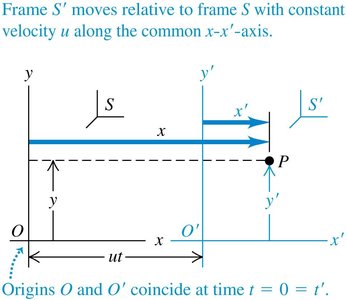
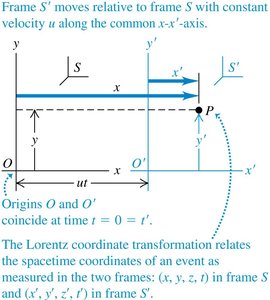
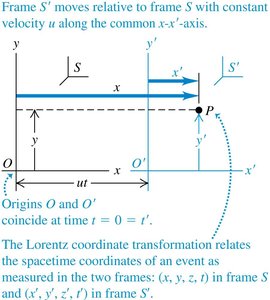
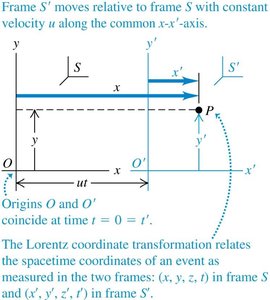
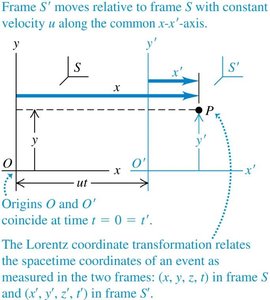
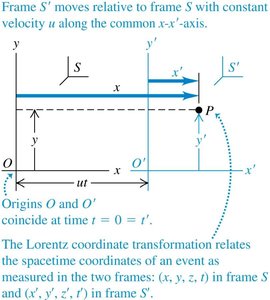
The Lorentz transformations replace the Galilean transformations for high-speed scenarios, ensuring the invariance of the speed of light and the correct relationship between space and time coordinates.
Coordinate Transformations:
,
Space and time are intertwined; absolute simultaneity and length are not preserved.
Relativistic Doppler Effect
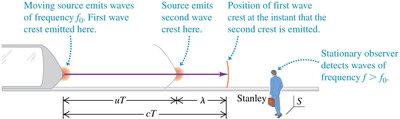
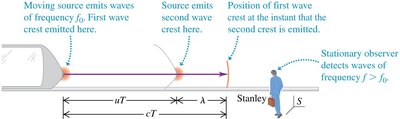
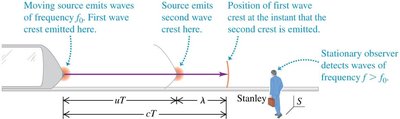
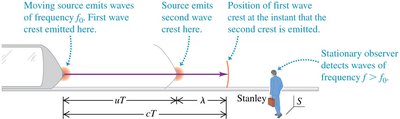
The Doppler effect for electromagnetic waves describes the change in frequency observed when the source and observer are in relative motion. In relativity, the formula accounts for time dilation and the invariance of the speed of light.
Frequency observed (): (source approaching observer)
Frequency observed (): (source receding from observer)
For , the classical Doppler effect is recovered.
Relativistic Momentum, Force, Work, and Energy
Relativistic Momentum
Momentum in relativity is modified to ensure conservation across all inertial frames and to account for the increase in mass with velocity.
Relativistic Momentum:
As approaches , increases, and momentum approaches infinity.
Relativistic Force and Newton's Second Law
Newton's second law is generalized in relativity. The relationship between force and acceleration depends on the orientation of the force relative to the velocity.
Generalized Law:
For force parallel to velocity:
For force perpendicular to velocity:
As speed increases, acceleration caused by a given force decreases.
Relativistic Work and Energy
Work and kinetic energy are also modified in relativity. The kinetic energy formula accounts for the increase in mass with velocity.
Relativistic Kinetic Energy:
Total Energy:
Rest Energy:
Energy-Momentum Relation:
Wave-Particle Duality and Quantum Effects
Photoelectric Effect
The photoelectric effect demonstrates the particle nature of light. When light shines on a metal, electrons are emitted if the frequency exceeds a threshold.
Energy of a photon:
Maximum kinetic energy: (where is the work function)
Emission depends on frequency, not intensity.
Compton Scattering
Compton scattering is the interaction of photons with electrons, resulting in a change in wavelength of the scattered photon. This effect confirms the particle nature of light.
Compton Shift Formula:
Energy and momentum are conserved in the collision.
Pair Production
Pair production occurs when a high-energy photon creates an electron-positron pair. The process requires the photon to have energy at least equal to .
Minimum energy:
Charge and energy are conserved.
Wave-Particle Duality, Probability, and Uncertainty
Light exhibits both wave and particle properties. The principle of complementarity states that both descriptions are necessary for a complete understanding of nature.
Diffraction and Interference: Explained by the wave nature of light.
Detection: Explained by the particle nature of light.
Probability: The pattern of photon detection is a statistical distribution.
Uncertainty: The position and momentum of photons cannot be simultaneously measured with arbitrary precision.
Summary Table: Classical vs Relativistic Transformations
Aspect | Galilean Transformation | Lorentz Transformation |
|---|---|---|
Coordinate | ||
Time | ||
Velocity | ||
Speed of Light | Not invariant | Invariant |
Additional info: The notes above expand on the original content, providing full academic context, definitions, and formulas for each topic. Images are included only where they directly reinforce the explanation.
