 Back
BackSpecial Theory of Relativity: Structured Study Notes
Study Guide - Smart Notes
 Tailored notes based on your materials, expanded with key definitions, examples, and context.
Special Theory of Relativity
Introduction
The Special Theory of Relativity, formulated by Albert Einstein in 1905, revolutionized our understanding of space, time, and motion. It describes how the laws of physics are the same in all inertial frames and how the speed of light is constant for all observers, regardless of their motion.
Motion Is Relative
Frames of Reference
Motion is always measured relative to a chosen frame of reference. An object's velocity can differ depending on the observer's frame. There is no absolute reference frame; all motion is relative.
Frame of Reference: The viewpoint from which motion is observed and measured.
Relative Velocity: The velocity of an object as measured from a particular frame.
Example: A passenger on a moving train measures the speed of another train differently than an observer standing on the platform.
Michelson-Morley Experiment
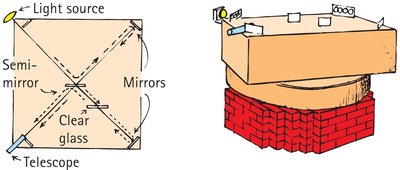
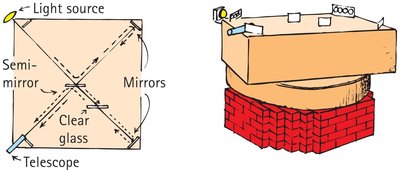
The Michelson-Morley experiment was designed to detect differences in the speed of light due to Earth's motion through space. It used an interferometer to compare light paths at right angles, expecting to find variations if light's speed depended on Earth's movement. No such variations were found, supporting the idea that the speed of light is constant.
Key Point: The experiment disproved the existence of a stationary 'ether' and supported relativity.
Postulates of Special Theory of Relativity
Einstein's Two Postulates
Einstein's theory is based on two fundamental postulates:
Postulate 1: All laws of nature are the same in all inertial (uniformly moving) frames of reference.
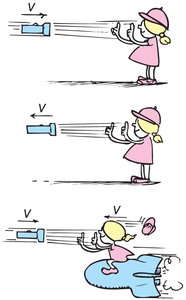
Postulate 2: The speed of light in free space is the same for all observers, regardless of the motion of the source or observer.
Simultaneity
Relativity of Simultaneity
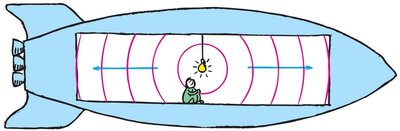
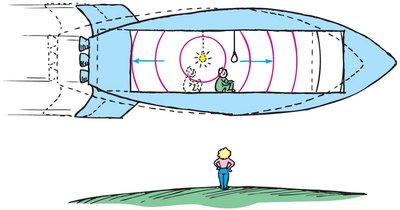
Events that are simultaneous in one frame of reference may not be simultaneous in another moving frame. This is a direct consequence of the constancy of the speed of light.
Key Point: Simultaneity is not absolute; it depends on the observer's frame.
Example: Lightning strikes at both ends of a moving train may appear simultaneous to a passenger but not to an observer on the platform.
Spacetime
Spacetime Continuum
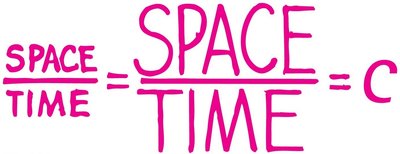
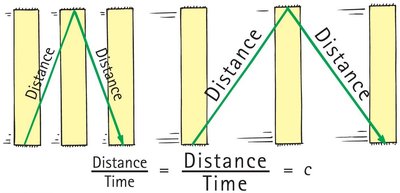
Space and time are not separate entities but are linked together in a four-dimensional continuum called spacetime. Measurements of space and time differ between observers, but the ratio of space to time for light remains constant.
Key Point: The speed of light is the fundamental link between space and time.
Time Dilation
Light Clock Thought Experiment
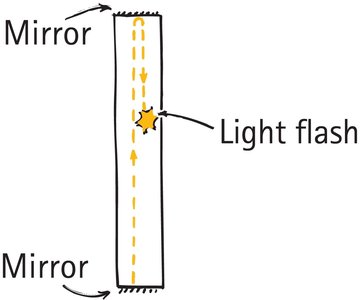
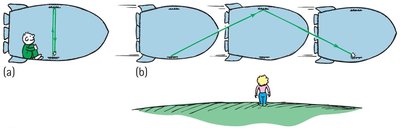
A light clock consists of a flash of light bouncing between two mirrors. For an observer moving with the clock, the light travels vertically. For an observer watching the moving clock, the light travels a longer, diagonal path, resulting in a longer time interval between ticks.
Key Point: Moving clocks run slower compared to stationary clocks.
Formula: Time dilation is given by , where is the proper time, is the relative velocity, and is the speed of light.
Lorentz Factor and Time Dilation
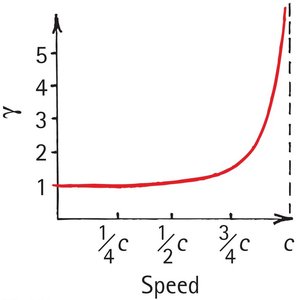
The Lorentz factor () quantifies the effects of relativity. As speed increases, increases, and time dilation becomes more pronounced.
Key Point: At speeds close to , time nearly stands still for the moving object.
Formula:

The Twin Trip
Relativistic Twin Paradox
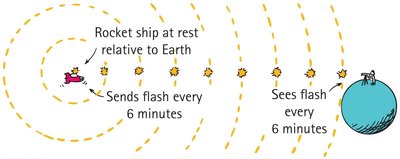
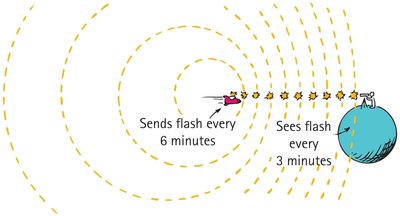
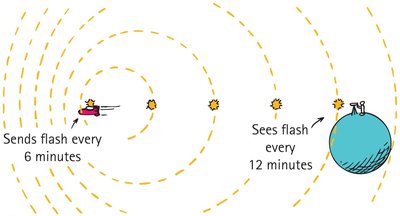
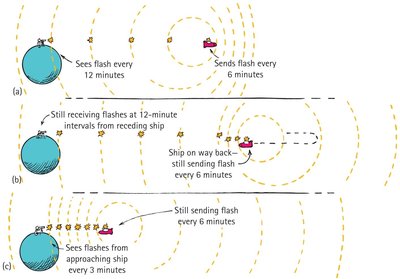
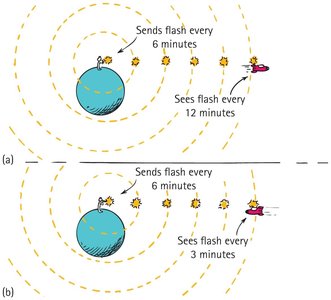
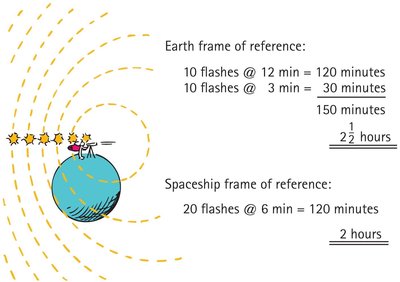
If one twin travels at high speed in space and returns, he will be younger than the twin who stayed on Earth. This is due to time dilation experienced by the traveling twin.
Key Point: The effect is not symmetric because the traveling twin undergoes acceleration.

Addition of Velocities
Relativistic Velocity Addition
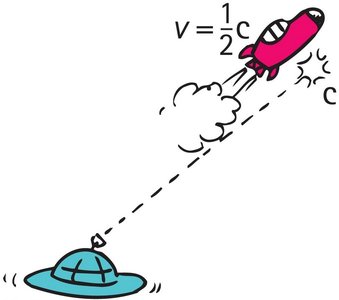
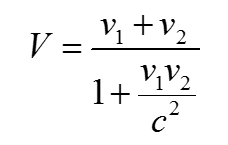
Velocities do not simply add together at relativistic speeds. The relativistic formula ensures that the speed of light is never exceeded.
Formula:
Key Point: No matter how fast you chase light, you can never catch it.
Length Contraction
Relativistic Length Contraction
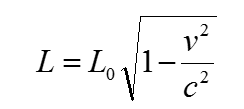
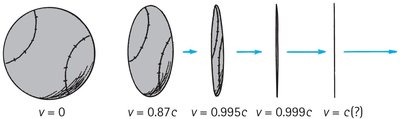
Objects moving at relativistic speeds appear shorter in the direction of motion. This effect is called length contraction and only occurs along the direction of travel.
Formula:
Key Point: No contraction occurs perpendicular to the direction of motion.
Relativistic Momentum
Momentum at High Speeds
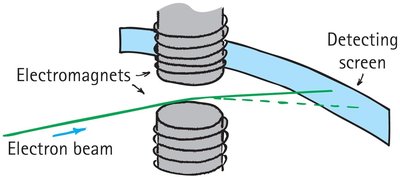
At speeds close to the speed of light, momentum increases more rapidly than predicted by classical physics. The relativistic momentum is given by .
Key Point: High-speed particles are harder to deflect due to increased momentum.
Mass, Energy, and E = mc2
Mass-Energy Equivalence
Einstein's equation shows that mass and energy are equivalent. Even a small amount of mass can be converted into a large amount of energy.
Key Point: Rest energy is the energy inherent in mass, even when not moving.
Example: Nuclear power plants and the Sun convert mass into energy.


The Correspondence Principle
Classical Limit of Relativity
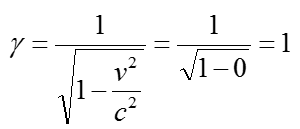
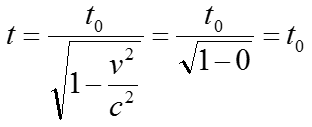
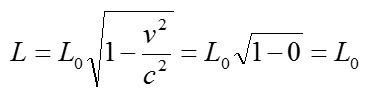
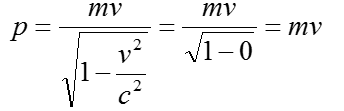
The correspondence principle states that new theories must agree with old ones in their domain of validity. Special relativity reduces to classical mechanics at low speeds.
Key Point: When , relativistic equations become classical equations.
Examples: Time, length, and momentum formulas reduce to their classical forms.
Conclusion
The Special Theory of Relativity challenges everyday experience but is mathematically consistent and experimentally verified. It emphasizes that measurements depend on the relative motion of observer and system, but physical reality is not open to interpretation.
