 Back
BackSprings, Hooke’s Law, and Series/Parallel Combinations
Study Guide - Smart Notes
 Tailored notes based on your materials, expanded with key definitions, examples, and context.
Periodic Motion
Simple Harmonic Motion and Springs
Springs are fundamental elements in physics for modeling oscillatory systems. The behavior of springs under force is described by Hooke's Law, which is foundational for understanding simple harmonic motion (SHM).
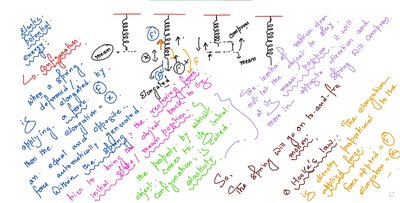
Elasticity: The property of a material to return to its original shape after deformation.
Restoring Force: The force exerted by a spring to return to equilibrium, always directed opposite to displacement.
Hooke's Law: For small deformations, the force exerted by a spring is proportional to its displacement from equilibrium.
Mathematical Formulation:
F: Restoring force (N)
k: Spring constant (N/m), a measure of stiffness
x: Displacement from equilibrium (m)
Work Done by a Spring and Potential Energy
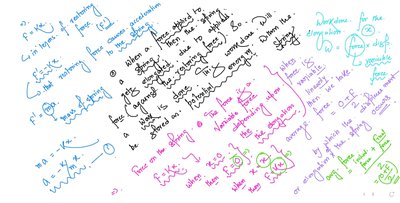
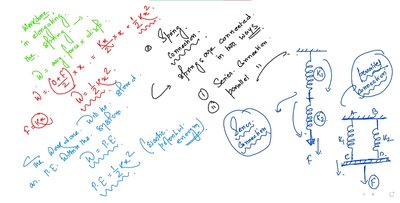
When a spring is stretched or compressed, work is done against the restoring force, which is stored as elastic potential energy.
Work Done by Spring: The work required to stretch or compress a spring by a distance x is given by:
Potential Energy (U): The energy stored in a stretched or compressed spring:
Spring Combinations
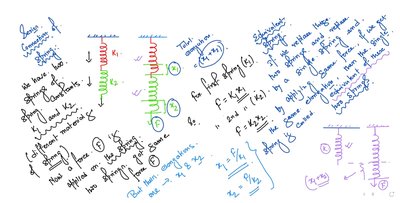
Springs in Series
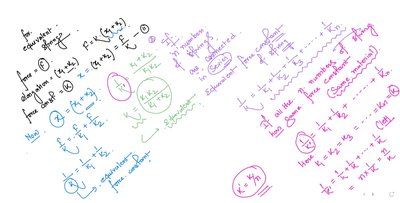
When springs are connected end-to-end (in series), the overall (equivalent) spring constant is reduced. The same force acts through each spring, but the total extension is the sum of individual extensions.
Formula for Series Combination:
Application: Used when a system requires greater flexibility or lower effective stiffness.
Springs in Parallel
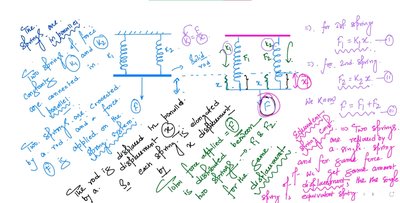
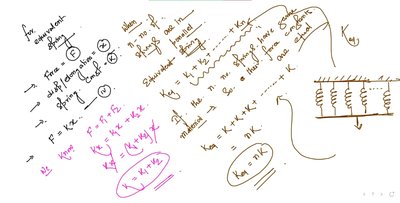
When springs are connected side-by-side (in parallel), the overall (equivalent) spring constant increases. The force is distributed among the springs, but the extension is the same for each.
Formula for Parallel Combination:
Application: Used when a system requires greater stiffness or support for larger loads.
Generalization and Problem Solving
For complex systems, springs may be arranged in combinations of series and parallel. The equivalent spring constant can be found by reducing the system stepwise using the above formulas.
Example: For two springs of constants and in series, the equivalent constant is:
For two springs in parallel:
Energy in Spring Systems
Potential Energy in Series and Parallel Arrangements
The total potential energy stored in a system of springs depends on the equivalent spring constant and the total displacement.
For equivalent spring constant and displacement :
Energy is distributed among the springs according to their individual constants and displacements.
Multiple Identical Springs in Parallel
If n identical springs (each with constant k) are connected in parallel, the equivalent spring constant is:
This increases the system's ability to resist deformation.
Additional info: These notes cover the essential physics of springs, including Hooke's Law, energy considerations, and the analysis of series and parallel combinations, which are foundational for understanding oscillatory motion and mechanical systems in introductory physics.
