Back
BackStars and Galaxies: Structure, Properties, and Evolution
Study Guide - Smart Notes
 Tailored notes based on your materials, expanded with key definitions, examples, and context.
Stars and Galaxies
Observing the Night Sky
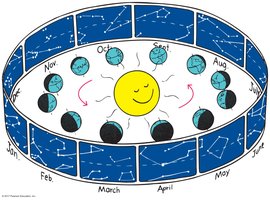
Observing the night sky has been a fundamental part of human culture and science. Constellations are groups of stars that form recognizable patterns, often named after mythological figures or animals. The positions of constellations change throughout the year as Earth orbits the Sun, providing a celestial calendar for observers.
Constellations: Patterns of stars named in antiquity, such as Ursa Major (the Great Bear) and the Big Dipper.
Seasonal Changes: The constellations visible in the night sky change monthly due to Earth's revolution around the Sun.
Solar Eclipses: During a solar eclipse, the daytime sky darkens, revealing constellations normally seen six months earlier or later.
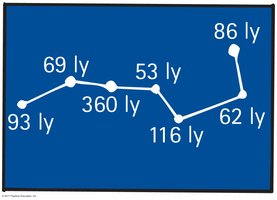
Star Distances: Stars in a constellation may appear close together but are often at vastly different distances from Earth.
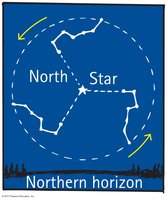
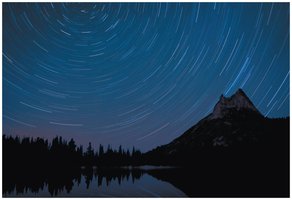
Earth's Rotation: Time-exposure photographs show star trails, illustrating Earth's rotation on its axis.

The Brightness and Colors of Stars
The color and brightness of a star provide important information about its physical properties. Color is directly related to surface temperature, while brightness can be measured in two ways: apparent brightness and luminosity.
Color and Temperature: Red stars are cooler, while blue stars are hotter. Blue light has nearly twice the frequency of red light.
Wavelength: Red stars emit light of the longest wavelength; blue and violet stars emit shorter wavelengths.
Apparent Brightness: How bright a star appears from Earth.
Luminosity: The intrinsic brightness of a star, independent of distance, often compared to the Sun's luminosity ().
Inverse-Square Law: Apparent brightness decreases with the square of the distance from the observer:
The Hertzsprung–Russell Diagram
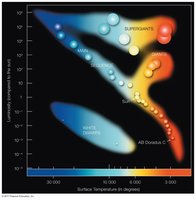
The Hertzsprung–Russell (H–R) diagram is a fundamental tool in stellar astronomy, plotting stars according to their luminosity and surface temperature. Most stars fall along the main sequence, with giants and white dwarfs occupying distinct regions.
Main Sequence: The continuous band where most stars, including the Sun, are found.
Giants and Supergiants: Luminous, cool stars above the main sequence.
White Dwarfs: Hot, dim stars below the main sequence.
Sun's Position: The Sun is an average, main-sequence star.
The Life Cycles of Stars
Stars are born, evolve, and die through a series of stages determined primarily by their mass. The life cycle includes formation from a nebula, main sequence burning, and eventual death as a white dwarf, neutron star, or black hole.
Nebula: A cloud of gas and dust where stars form.
Protostar: A contracting mass that heats up before nuclear fusion begins.
Main Sequence: Stable period of hydrogen fusion in the core.
Red Giant: Expansion and cooling as hydrogen is depleted.
White Dwarf: Remnant of low-mass stars, cooling over time.
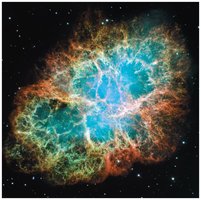
Supernova: Explosive death of massive stars, leaving behind neutron stars or black holes.
Star Sizes
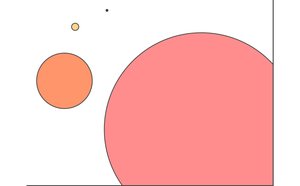
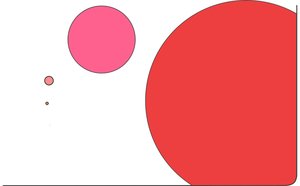
Stars vary greatly in size, from small white dwarfs to enormous supergiants and hypergiants. The Sun is a medium-sized star, while others like Betelgeuse and Cephei A are much larger.
White Dwarfs: Earth-sized remnants of low-mass stars.
Giants and Supergiants: Stars with radii tens to hundreds of times that of the Sun.
Hypergiants: Among the largest known stars, with radii over a thousand times that of the Sun.

Black Holes
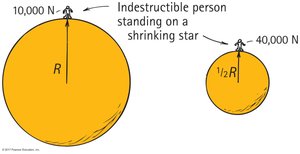
Black holes are the remnants of massive stars that have collapsed under their own gravity. Their gravitational pull is so strong that not even light can escape. The surface gravity increases dramatically as the star's radius decreases, following the inverse-square law.
Formation: Result from the collapse of supergiant stars after a supernova.
Surface Gravity: If a star's radius shrinks to half, surface gravity increases by a factor of four:
Effect on Orbits: If the Sun became a black hole, Earth's orbit would remain unchanged as long as the mass and distance remain the same.
Galaxies
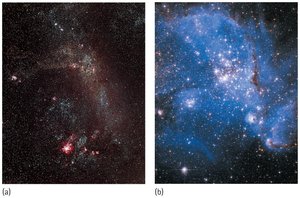
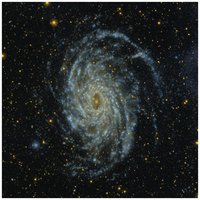
Galaxies are vast collections of stars, gas, and dust bound together by gravity. The Milky Way is our home galaxy, but there are billions of others in the universe, classified by their shapes and activity.
Types of Galaxies: Elliptical, spiral, and irregular.
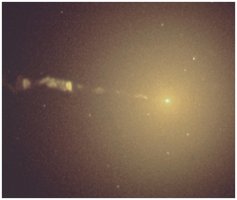
Active Galaxies: Emit enormous amounts of energy, often due to supermassive black holes at their centers.
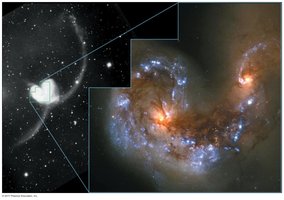
Starburst Galaxies: Undergo rapid star formation, often triggered by collisions.
Galactic Motion: Stars in galaxies typically follow elliptical orbits around the galactic center.
Clusters and Superclusters
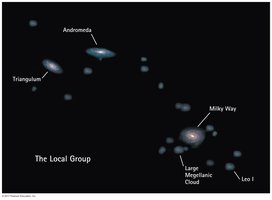
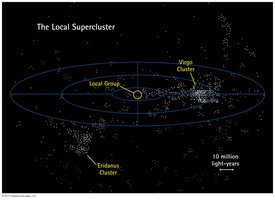
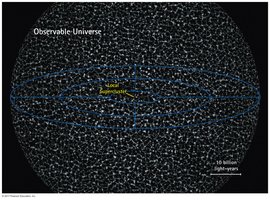
Galaxies are not isolated; they are grouped into clusters and superclusters, forming the largest known structures in the universe. Our Milky Way is part of the Local Group, which is itself part of the Local Supercluster.
Local Group: The Milky Way and its neighboring galaxies.
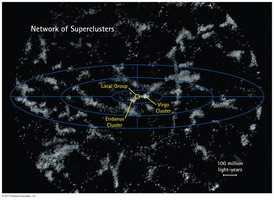
Superclusters: Collections of galaxy clusters, such as the Virgo and Eridanus clusters.
Cosmic Structure: Superclusters form a network with vast voids in between, resembling a cosmic foam.