 Back
BackStatic Equilibrium: Beam Supported by Cable and Hinge
Study Guide - Smart Notes
 Tailored notes based on your materials, expanded with key definitions, examples, and context.
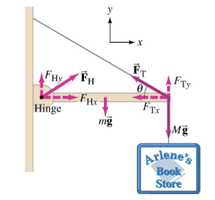
Q4. A uniform beam, 2.20m long with a mass m=25kg, is mounted by a small hinge on a wall as shown in the figure. The beam is held in a horizontal position by a cable that makes θ = 30°. The beam supports a sign of mass M = 28kg suspended from its end. Determine the components of the force FH and the tension, FT, in the supporting cable.
Background
Topic: Static Equilibrium and Forces
This question tests your understanding of static equilibrium, force decomposition, and torque. You must analyze the forces acting on a beam held by a hinge and a cable, and calculate the horizontal and vertical components of the hinge force, as well as the tension in the cable.
Key Terms and Formulas
Static Equilibrium: An object is in static equilibrium if the net force and net torque on it are both zero.
Torque ():
Force Decomposition: (tension) can be split into horizontal () and vertical () components.
Sum of Forces: ,
Sum of Torques:
Weight:
Step-by-Step Guidance
Draw a free-body diagram of the beam, labeling all forces: the weight of the beam () at its center, the weight of the sign () at the end, the tension in the cable () at the end, and the hinge force () at the wall.
Write the equilibrium equations for forces in the x and y directions:
Decompose the tension in the cable into components:
Set up the torque equilibrium equation about the hinge (choose the hinge as the axis to eliminate unknown hinge forces):
Include torques from the beam's weight, the sign's weight, and the cable's tension.
Try solving on your own before revealing the answer!
Final Answer:
components and tension calculated using:
,
Hinge force components found from force equilibrium equations.
The values are determined by plugging in the masses, length, angle, and .
