 Back
Statics and Tension: Finding the Tension in a Rope Holding a Ball
Study Guide - Smart Notes
 Tailored notes based on your materials, expanded with key definitions, examples, and context.
Q1. Find the tension in the horizontal rope holding a ball weighing 50 N, pulled back by a second rope at a 20° angle above the horizontal.
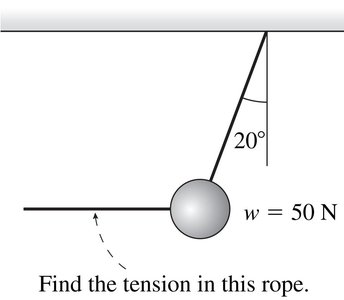
Background
Topic: Statics and Equilibrium
This question tests your understanding of equilibrium conditions and how to resolve forces in two dimensions. The ball is held stationary by two ropes, so the net force on the ball must be zero. You need to use Newton's 2nd Law and vector components to solve for the tension in the horizontal rope.
Key Terms and Formulas
Statics: The study of objects at rest and the forces acting on them.
Equilibrium: When the sum of all forces on an object is zero.
Newton's 2nd Law (for equilibrium):
Force components: For a force at angle , ,
Step-by-Step Guidance
Draw a free-body diagram for the ball, showing the weight ( downward), the tension in the horizontal rope (), and the tension in the angled rope ().
Write Newton's 2nd Law for equilibrium in both the (horizontal) and (vertical) directions:
and
Express the components of the angled tension () in terms of and :
(horizontal component)
(vertical component)
Set up the equilibrium equations:
Horizontal:
Vertical:
Use the vertical equation to solve for , then substitute into the horizontal equation to find .
Try solving on your own before revealing the answer!
Final Answer: 17 N
First, solve for using the vertical equilibrium:
Then, use the horizontal equilibrium to find :
The tension in the horizontal rope is approximately 17 N. This result comes from resolving the forces and ensuring equilibrium in both directions.
