 Back
BackStep-by-Step Guidance for College Physics: Circuits, Resistance, Magnetism, and Capacitance
Study Guide - Smart Notes
 Tailored notes based on your materials, expanded with key definitions, examples, and context.
Q1. Which option correctly ranks the resistances of five cylindrical resistors (made of the same material, with different diameters and lengths) from greatest to least?
Background
Topic: Electrical Resistance in Cylindrical Conductors
This question tests your understanding of how resistance depends on the physical dimensions (length and diameter) of a resistor, using the formula for resistance in terms of resistivity, length, and cross-sectional area.
Key formula:
Where:
= resistance
= resistivity of the material
= length of the resistor
= cross-sectional area ( for a cylinder)
= diameter of the resistor
Step-by-Step Guidance
Write the resistance formula for each resistor, substituting the given values for length and diameter.
Express the cross-sectional area in terms of diameter for each case.
Compare the resulting expressions to determine which resistor has the greatest resistance and which has the least.
Arrange the resistors in order from greatest to least resistance based on your calculations.
Try solving on your own before revealing the answer!
Final Answer: D.
Resistor (d) has the smallest diameter and longest length, so its resistance is greatest. Resistor (e) has the largest diameter and shortest length, so its resistance is least.
Q2. In a simple circuit with an ideal battery (emf ) and a lightbulb (resistance ), which statement is NOT true?
Background
Topic: Electric Circuits and Ohm's Law
This question tests your understanding of current direction, potential difference, Ohm's law, and power in a simple circuit.
Key formulas:
Step-by-Step Guidance
Recall that current flows from the positive terminal to the negative terminal of the battery.
Understand that the potential difference across the resistor equals the emf of the battery in an ideal circuit.
Apply Ohm's law to find the current: .
Calculate the power supplied by the battery and compare it to the options given.

Try solving on your own before revealing the answer!
Final Answer: D. The power supplied by the battery is , not .
Option D is incorrect because the correct formula for power is .
Q3. A battery is connected to four different light bulbs. If the electric currents are measured at points A, B, C, D, and E, what is the correct ranking of these currents from highest to lowest?
Background
Topic: Series and Parallel Circuits
This question tests your understanding of how current splits and recombines in circuits with series and parallel components.
Key concepts:
In a series circuit, current is the same at all points.
At a junction, current splits according to the resistance of each branch.
Current recombines at another junction.
Step-by-Step Guidance
Identify which points are in series and which are at junctions.
Determine how current splits at the junction and how it recombines.
Compare the current at each point based on the circuit diagram.
Rank the currents from highest to lowest.

Try solving on your own before revealing the answer!
Final Answer: C.
Current is the same at points A, B, C, and E, and less at D due to the split at the junction.
Q4. Which circuit results in the largest capacitance?
Background
Topic: Series and Parallel Capacitors
This question tests your ability to calculate equivalent capacitance for capacitors arranged in series and parallel.
Key formulas:
For capacitors in series:
For capacitors in parallel:
Step-by-Step Guidance
Identify which circuits have capacitors in series and which have them in parallel.
Apply the appropriate formula for each configuration.
Calculate the equivalent capacitance for each case.
Compare the values to determine which is largest.
Try solving on your own before revealing the answer!
Final Answer: B. The parallel circuit has the largest capacitance, .
Capacitors in parallel add directly, giving the largest possible equivalent capacitance.
Q5. If you cut a straight bar magnet in half, what happens to the right half?
Background
Topic: Magnetism and Magnetic Dipoles
This question tests your understanding of magnetic dipoles and the impossibility of magnetic monopoles.
Key concepts:
Magnets always have both a north and south pole.
Cutting a magnet creates two smaller dipoles, not monopoles.
Step-by-Step Guidance
Recall that a bar magnet is a dipole, with a north and south pole.
Understand that cutting the magnet does not isolate a single pole.
Each half becomes a smaller dipole, with a north and south pole.
Try solving on your own before revealing the answer!
Final Answer: B. The right half contains a north pole on the right and a south pole on the left.
Each piece remains a dipole, not a monopole.
Q6. A current-carrying wire moves in a static magnetic field. What is the correct explanation for the current in the red bar?
Background
Topic: Magnetic Force on a Current-Carrying Wire
This question tests your understanding of the right-hand rule and the direction of current in a magnetic field.
Key concepts:
Use the right-hand rule to determine the direction of force and current.
Current direction is determined by the orientation of the wire and the magnetic field.
Step-by-Step Guidance
Align your fingers with the direction of current.
Curl your fingers toward the direction of the magnetic field lines.
Your thumb points in the direction of the force.
Use this rule to determine the current direction in the red bar.
Try solving on your own before revealing the answer!
Final Answer: B. The current flows from right to left.
The right-hand rule confirms the direction of current in the red bar.
Q7. When switch S is turned on in a square-shaped wire and compass arrangement, what happens to the north pole of the compass needle?
Background
Topic: Magnetic Fields Generated by Current-Carrying Wires
This question tests your understanding of the right-hand rule and how magnetic fields affect a compass needle.
Key concepts:
Current in a wire generates a magnetic field.
The compass needle aligns with the local magnetic field direction.
Step-by-Step Guidance
Use the right-hand rule to determine the direction of the magnetic field generated by the current.
Observe the direction of the magnetic field lines near the compass.
The compass needle aligns with the magnetic field direction.
Try solving on your own before revealing the answer!
Final Answer: B. The needle rotates to align with the west.
The magnetic field lines near the compass point westward, so the needle points west.
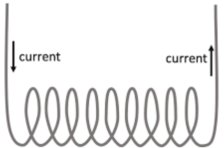
Q8. A lightweight solenoid is suspended from the ceiling, free to move, with an electric current flowing as illustrated. When switch S in the loop circuit is closed, what happens to the solenoid?
Background
Topic: Magnetic Fields and Forces Between Current-Carrying Coils
This question tests your understanding of the right-hand rule and the interaction between magnetic fields generated by a solenoid and a loop.
Key concepts:
The right-hand rule determines the direction of magnetic flux.
Opposing magnetic fields cause repulsion.
The solenoid is free to move, so it responds to the repulsive force.
Step-by-Step Guidance
Use the right-hand rule to determine the direction of magnetic flux in the solenoid and the loop.
Identify whether the fields are aligned or opposed.
Determine the direction of the force acting on the solenoid.
Predict the solenoid's motion based on the repulsion.
Try solving on your own before revealing the answer!
Final Answer: B. The solenoid moves in the –x direction.
The solenoid is repelled by the loop's magnetic field and moves away in the –x direction.
