 Back
BackStep-by-Step Guidance for EECE 210 Electric Circuits Quiz Problems
Study Guide - Smart Notes
 Tailored notes based on your materials, expanded with key definitions, examples, and context.
Q1. Calculate the power dissipated by the 6 Ω resistor for R = {2, 22, 32, 62} Ω.
Background
Topic: DC Circuit Analysis, Power Dissipation
This question tests your ability to analyze a circuit using Kirchhoff's Voltage Law (KVL) and calculate the power dissipated in a resistor.
Key Terms and Formulas
KVL (Kirchhoff's Voltage Law): The sum of voltages around a closed loop is zero.
Power dissipated in a resistor:
Current calculation: Use KVL to solve for .
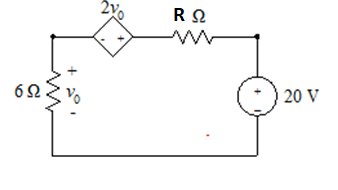
Step-by-Step Guidance
Write the KVL equation for the loop: .
Express in terms of : .
Substitute into the KVL equation: .
Simplify to get and solve for : .
Set up the power formula for the 6 Ω resistor: .
Try solving on your own before revealing the answer!
Final Answer: See below for each R value
Plug in each value of R into the formula to get the power dissipated for each case.
This approach uses KVL and the power formula to find the answer.
Q2. In the circuit shown, X = {16, 18, 20, 24} Volts. Determine .
Background
Topic: Series-Parallel Resistance, Ohm's Law
This question tests your ability to find the total current in a circuit by calculating the equivalent resistance and applying Ohm's Law.
Key Terms and Formulas
Equivalent resistance (): Combine resistors in series and parallel.
Ohm's Law:
Step-by-Step Guidance
Calculate the equivalent resistance: .
Use Ohm's Law to set up the current formula: .
Try solving on your own before revealing the answer!
Final Answer: A
Substitute each value of X to find the total current for each case.
Q3. Find the current in the circuit for R = {2, 4, 7, 12} kΩ.
Background
Topic: Mesh/Supermesh Analysis
This question tests your ability to use mesh analysis and dependent sources to solve for current in a circuit.
Key Terms and Formulas
Mesh analysis: Apply KVL to loops in the circuit.
Dependent source: A source whose value depends on a circuit variable.
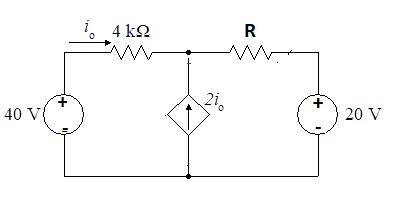
Step-by-Step Guidance
Write the KVL equation for the super-mesh: .
Simplify to get .
Solve for : mA.
Try solving on your own before revealing the answer!
Final Answer: mA
Substitute each value of R to find the current for each case.
Q4. Use KVL and KCL to determine the current in the circuit.
Background
Topic: Node and Loop Analysis, Dependent Sources
This question tests your ability to use Kirchhoff's Current Law (KCL) and Kirchhoff's Voltage Law (KVL) to solve for a current in a circuit with dependent sources.
Key Terms and Formulas
KCL: The sum of currents entering a node equals the sum leaving.
KVL: The sum of voltages around a loop is zero.
Dependent source: Source value depends on a circuit variable.
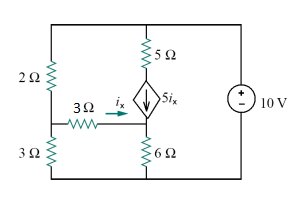
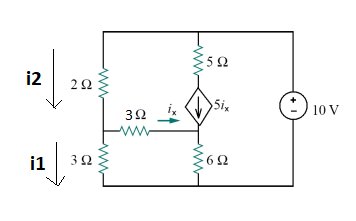
Step-by-Step Guidance
Assign currents: in the 3 Ω resistor, in the 2 Ω resistor, as shown.
Apply KCL: The current in the 6 Ω resistor is .
Write KVL for the left loop: so .
Use KCL to find : .
Write KVL for the big loop: .
Try solving on your own before revealing the answer!
Final Answer: A
Calculate using the final equation from the big loop.
Q5. Determine the equivalent resistor seen from terminals (a, b) for R = {4, 5.16, 8.31, 12} Ω.
Background
Topic: Series-Parallel Resistance, Equivalent Resistance
This question tests your ability to combine resistors in series and parallel to find the equivalent resistance between two terminals.
Key Terms and Formulas
Parallel resistance:
Series resistance:
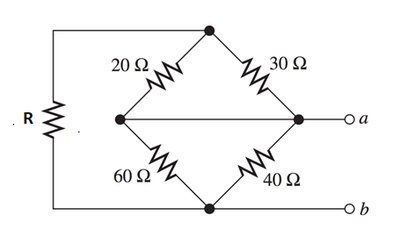
Step-by-Step Guidance
Combine 60 Ω and 40 Ω in parallel: .
Combine 20 Ω and 30 Ω in parallel: .
Add R to : .
Combine and in parallel: .
Simplify to .
Try solving on your own before revealing the answer!
Final Answer: Ω
Substitute each value of R to find the equivalent resistance for each case.
