 Back
Step-by-Step Guidance for Electric Current and Circuits (Physics with Calculus)
Study Guide - Smart Notes
 Tailored notes based on your materials, expanded with key definitions, examples, and context.
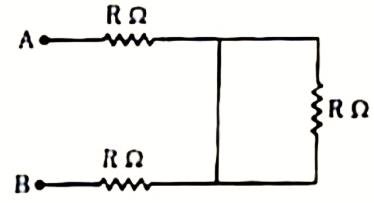
Q1. The equivalent resistance between A and B of the network shown in the figure is:
Background
Topic: Series and Parallel Resistor Combinations
This question tests your ability to analyze a resistor network and calculate the equivalent resistance using series and parallel rules.
Key Terms and Formulas:
Series combination:
Parallel combination:
Equivalent resistance: The single resistance that can replace the network without changing the current or voltage between A and B.
Step-by-Step Guidance
Observe the network: There are three resistors, each of resistance , arranged such that two are in series from A to B, and the third is connected between their midpoints.
Identify the parallel and series parts: The two resistors on the top and bottom are in series, but the middle resistor connects between them, forming a parallel path.
Redraw the circuit (mentally or on paper) to clarify the connections. Notice that the middle resistor is parallel to the path formed by the two outer resistors.
Set up the formula for equivalent resistance using the series and parallel rules. Express the equivalent resistance in terms of .
Try solving on your own before revealing the answer!
Final Answer:
Using the series and parallel combination rules, the equivalent resistance between A and B is .
This is because the middle resistor forms a parallel path, and the calculation simplifies to for this configuration.
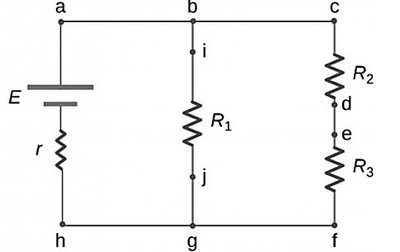
Q2. Case Study: An experiment was set up with the circuit diagram shown in figure. Given that , , and
Background
Topic: Circuit Analysis, Series and Parallel Resistors, Potential Difference, Power Dissipation
This question tests your ability to analyze a multi-branch circuit, identify points of equal potential, calculate current in branches, and determine power and potential difference across resistors.
Key Terms and Formulas:
Ohm's Law:
Power dissipated: or
Series and parallel resistor rules (see above)
Kirchhoff's Rules: Conservation of current at junctions, conservation of energy in loops
Step-by-Step Guidance
Identify the configuration: is in one branch, and are in series in another branch, both connected in parallel across the battery.
Calculate the total resistance in each branch: branch has , the other branch has .
Find the equivalent resistance of the parallel combination: Use .
Calculate the total current supplied by the battery using Ohm's Law.
Determine the current in each branch using the current divider rule.
Use the calculated currents to find power dissipated in and potential difference across .
Try solving on your own before revealing the answer!
Final Answers:
(i) Points with same potential: (b) f, h, j
(ii) Current through branch bg: (a) 1 A
(iii) Power dissipated in : (b) 2.5 W
(iv) Potential difference across : (a) 1.5 V
Each answer is obtained by applying Ohm's Law, parallel and series resistor rules, and careful circuit analysis.
