 Back
BackStep-by-Step Guidance for Magnetism and Wave Optics Practice Test
Study Guide - Smart Notes
 Tailored notes based on your materials, expanded with key definitions, examples, and context.
Q1. Three loops of wire are shown in the figure, all subject to the same uniform magnetic field. If the field does not vary with time, Loop 1 oscillates back and forth, Loop 2 rotates about a vertical axis, and Loop 3 oscillates up and down at the end of a spring. Which loop(s) will have an induced emf?
Background
Topic: Electromagnetic Induction (Faraday's Law)
This question tests your understanding of how changing magnetic flux through a loop induces an emf, according to Faraday's Law.
Key Terms and Formulas:
Magnetic flux ():
Induced emf ():
Faraday's Law: The emf is induced when the magnetic flux through the loop changes with time.
Step-by-Step Guidance
Analyze each loop's motion to determine if the magnetic flux through the loop changes with time.
Recall that flux changes if either the area, the orientation (angle), or the magnetic field changes.
For Loop 1, consider if oscillating back and forth changes the angle or area exposed to the field.
For Loop 2, rotating about a vertical axis may change the angle between the loop and the field.
For Loop 3, oscillating up and down may change the area or position relative to the field.
Try solving on your own before revealing the answer!
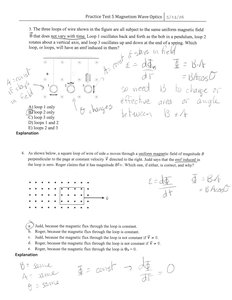
Final Answer: Loop 2 only
Only Loop 2 changes the angle between the loop and the magnetic field, thus changing the flux and inducing an emf.
Q2. A square loop of wire sits in a uniform magnetic field. If the magnetic field increases, what happens to the magnetic flux through the loop?
Background
Topic: Magnetic Flux and Faraday's Law
This question tests your understanding of how magnetic flux changes when the magnetic field changes.
Key Terms and Formulas:
Magnetic flux (): (for perpendicular orientation)
Faraday's Law:
Step-by-Step Guidance
Identify the area () of the loop and the direction of the magnetic field ().
Determine how the flux changes as increases, keeping constant.
Recall that an increase in leads to an increase in if the loop is perpendicular to the field.
Try solving on your own before revealing the answer!
Final Answer: The magnetic flux increases
Since is constant and increases, increases proportionally.
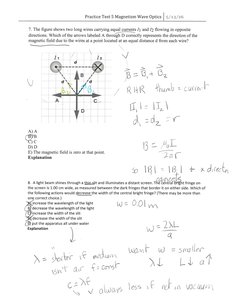
Q3. The figure shows two long wires carrying equal currents in opposite directions. Which direction does the magnetic field point at a point located a set distance from each wire?
Background
Topic: Magnetic Field from Current-Carrying Wires
This question tests your ability to use the right-hand rule to determine the direction of the magnetic field created by currents.
Key Terms and Formulas:
Right-Hand Rule: Thumb points in direction of current, fingers curl in direction of magnetic field.
Magnetic field from a long straight wire:
Step-by-Step Guidance
Identify the direction of current in each wire.
Apply the right-hand rule to each wire to determine the direction of the magnetic field at the specified point.
Combine the contributions from both wires to find the net magnetic field direction.
Try solving on your own before revealing the answer!
Final Answer: The magnetic field points in the x-direction
Using the right-hand rule, the net field is along the x-axis.
Q4. An electron is moving parallel to a wire carrying a current. The electron is moving at a velocity of 1,000,000 m/s and is 0.01 m away from the wire with a current of 2 A. What is the acceleration of the electron at this point?
Background
Topic: Magnetic Force on a Moving Charge
This question tests your ability to calculate the force and resulting acceleration on a charged particle moving in a magnetic field created by a current-carrying wire.
Key Terms and Formulas:
Magnetic field from a wire:
Magnetic force:
Acceleration:
Step-by-Step Guidance
Calculate the magnetic field at the location of the electron using the wire formula.
Determine the force on the electron using .
Find the acceleration by dividing the force by the mass of the electron.
Try solving on your own before revealing the answer!
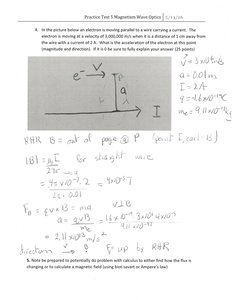
Final Answer:
Using the formulas above, you can calculate the acceleration step by step.
Q5. A diffraction grating is placed 1.0 m from a viewing screen. Light from a halogen lamp is passed through the grating, and the distance between the central maximum and the first-order maximum is measured. How do you determine the wavelength of the light?
Background
Topic: Diffraction and Interference
This question tests your ability to use the diffraction grating equation to relate the observed pattern to the wavelength of light.
Key Terms and Formulas:
Diffraction grating equation:
Small angle approximation:
= grating spacing, = order, = wavelength, = distance from central maximum, = distance to screen
Step-by-Step Guidance
Measure the distance from the central maximum to the first-order maximum on the screen.
Use the small angle approximation to relate to and .
Plug these values into the diffraction grating equation to solve for .
Try solving on your own before revealing the answer!
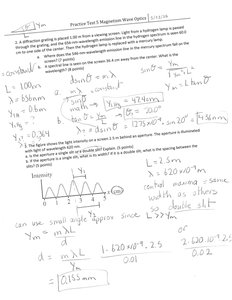
Final Answer:
By substituting the measured values into the equation, you can solve for the wavelength.
