 Back
BackStep-by-Step Guidance for Oscillations and Simple Harmonic Motion (Ch14)
Study Guide - Smart Notes
 Tailored notes based on your materials, expanded with key definitions, examples, and context.
Q14.8. Mass Hanging from a Spring: Simple Harmonic Motion
Background
Topic: Simple Harmonic Motion (SHM) and Forces in Oscillating Systems
This question tests your understanding of the forces, velocity, and acceleration at different points in the oscillation of a mass-spring system.
Key Terms and Formulas:
Equilibrium Point: The position where the net force on the mass is zero.
Amplitude: The maximum displacement from equilibrium.
Velocity: Rate of change of position; zero at turning points.
Acceleration: Rate of change of velocity; maximum at extreme positions.
Spring Force:
Net Force:
Step-by-Step Guidance
Consider the equilibrium position: This is where the spring is stretched just enough to balance the weight of the mass (). At this point, the net force is zero.
Think about the turning points (highest and lowest positions): At these points, the mass changes direction, so its velocity is momentarily zero.
Recall that acceleration is greatest where the restoring force is largest. This occurs at the maximum displacement from equilibrium (the highest and lowest points).
For the spring force to be zero, the spring must be at its natural (unstretched) length. Consider whether the oscillation ever reaches this point, given the equilibrium position is already stretched by the mass.
Try solving on your own before revealing the answer!
Q14.10. Determining Frequency and Amplitude from a Graph
Background
Topic: Analyzing Oscillation Graphs
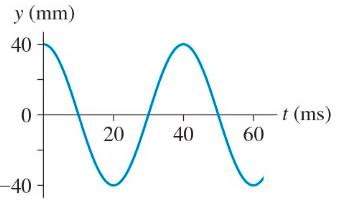
This question asks you to extract the frequency and amplitude of an oscillator from a position vs. time graph.
Key Terms and Formulas:
Period (): Time for one complete cycle.
Frequency (): Number of cycles per second,
Amplitude (): Maximum displacement from equilibrium.
Maximum Speed ():
Step-by-Step Guidance
Examine the graph and identify the period () by measuring the time between two consecutive peaks or troughs.
Calculate the frequency using .
Determine the amplitude by measuring the maximum displacement from the equilibrium position (the highest or lowest point on the graph).
If maximum speed is given, use to check your amplitude calculation.
Try solving on your own before revealing the answer!
P14.7. Air-Track Glider Oscillation
Background
Topic: Simple Harmonic Motion (SHM) of a Mass-Spring System
This question tests your ability to relate maximum speed, period, and amplitude, and to use the position function for SHM.
Key Terms and Formulas:
Maximum Speed:
Position as a function of time:
Period (): Time for one complete oscillation.
Amplitude (): Maximum displacement from equilibrium.
Step-by-Step Guidance
Identify the known values: s, m/s.
Use the formula to solve for amplitude .
For position at s, use and substitute the values for , , and .
Calculate the cosine argument and set up the expression for .
Try solving on your own before revealing the answer!
P14.18. Maximum Acceleration of Hummingbird Wing Tips
Background
Topic: Maximum Acceleration in Simple Harmonic Motion
This question asks you to find the maximum acceleration of an oscillating system using amplitude and frequency.
Key Terms and Formulas:
Maximum Acceleration:
Frequency (): Number of cycles per second.
Amplitude (): Maximum displacement.
Acceleration in units of :
Step-by-Step Guidance
Read the amplitude () and period () from the graph. Convert units if necessary (e.g., mm to m, ms to s).
Calculate the frequency: .
Plug the values into the formula .
Set up the calculation for and for .
Try solving on your own before revealing the answer!
Q14.7. Maximum Kinetic Energy and Amplitude
Background
Topic: Energy in Simple Harmonic Motion
This question tests your understanding of how the maximum kinetic energy (total mechanical energy) depends on amplitude.
Key Terms and Formulas:
Total Energy:
Maximum Kinetic Energy: Equal to total energy in SHM.
Amplitude (): Maximum displacement.
Step-by-Step Guidance
Recall that maximum kinetic energy is given by .
Notice that energy is proportional to the square of the amplitude.
If amplitude is doubled, substitute for in the energy formula and compare to the original energy.
Try solving on your own before revealing the answer!
P14.23. Oscillating Mass: Position Function Analysis
Background
Topic: Simple Harmonic Motion (SHM) Analysis
This question asks you to analyze the position function of an oscillating mass and determine amplitude, period, spring constant, maximum speed, total energy, and velocity at a specific time.
Key Terms and Formulas:
Position Function:
Angular Frequency:
Period:
Spring Constant:
Maximum Speed:
Total Energy:
Velocity at time :
Step-by-Step Guidance
Compare the given position function to to identify amplitude () and angular frequency ().
Calculate the period using .
Find the spring constant using .
Set up the expressions for maximum speed, total energy, and velocity at s using the formulas above.
Try solving on your own before revealing the answer!
P14.30. Pendulum Period on the Moon vs. Earth
Background
Topic: Pendulum Period and Gravitational Acceleration
This question tests your understanding of how the period of a pendulum depends on its length and the local gravitational acceleration.
Key Terms and Formulas:
Pendulum Period:
Length (): Length of the pendulum.
Gravitational Acceleration (): m/s, m/s
Step-by-Step Guidance
Write the period formula for both the Earth and the Moon: , .
Set the periods equal to each other since the question asks for matching periods.
Solve for in terms of , , and .
Set up the calculation for using the given values.
Try solving on your own before revealing the answer!
P14.33. Moment of Inertia of a Lower Leg (Physical Pendulum)
Background
Topic: Physical Pendulum and Moment of Inertia
This question tests your ability to use the oscillation frequency of a physical pendulum to determine its moment of inertia.
Key Terms and Formulas:
Frequency of Physical Pendulum:
Moment of Inertia (): Resistance to rotational acceleration.
Distance to Center of Mass (): Distance from pivot to center of gravity.
Step-by-Step Guidance
Write the formula for frequency in terms of moment of inertia: .
Rearrange the formula to solve for .
Set up the calculation for using the given values for mass, , , and .
Try solving on your own before revealing the answer!
P14.50. Spring Constant, Period, and Position-Time Graph for a Hanging Ball
Background
Topic: Hooke's Law and Simple Harmonic Motion
This question tests your ability to use Hooke's law to find the spring constant, calculate the period of oscillation, and draw a position-time graph.
Key Terms and Formulas:
Hooke's Law:
Spring Constant ():
Period:
Position-Time Graph:
Step-by-Step Guidance
Use Hooke's law to solve for the spring constant: , where is the stretch due to the mass.
Calculate the period using .
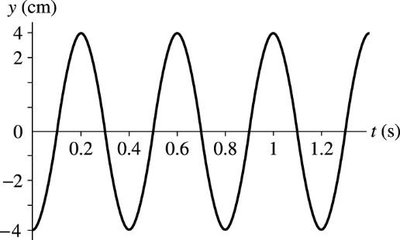
Set up the position-time function for the oscillation, using the amplitude and period found above.
Sketch or describe the graph for three cycles, labeling axes with appropriate units and values.
Try solving on your own before revealing the answer!
