 Back
BackStep-by-Step Guidance for PHY156 Circuit Analysis Worksheet
Study Guide - Smart Notes
 Tailored notes based on your materials, expanded with key definitions, examples, and context.
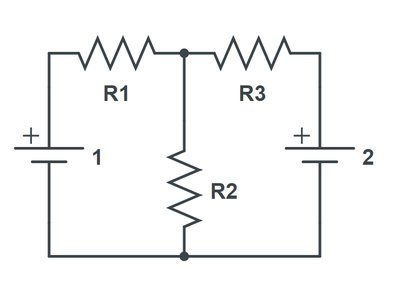
Q1a. Considering R1 = B Ω, R2 = 2B Ω, and R3 = A Ω, ℰ1 = 12 V, ℰ2 = 9 V:
Background
Topic: Circuit Analysis with Multiple Batteries and Resistors
This question tests your understanding of how to analyze a circuit with two batteries and three resistors using Kirchhoff's rules and Ohm's law.
Key Terms and Formulas:
Kirchhoff's Loop Rule: The sum of the potential differences around any closed loop is zero.
Kirchhoff's Junction Rule: The sum of currents entering a junction equals the sum leaving.
Ohm's Law:
Step-by-Step Guidance
Draw the circuit diagram and label the currents through each branch (e.g., I1 through R1, I2 through R3, and I3 through R2).
Apply Kirchhoff's loop rule to the left loop (containing ℰ1, R1, and R2) and write the equation for the sum of voltage changes.
Apply Kirchhoff's loop rule to the right loop (containing ℰ2, R3, and R2) and write the equation for the sum of voltage changes.
Use Kirchhoff's junction rule at the node where the three branches meet to relate the currents.
Try solving on your own before revealing the answer!
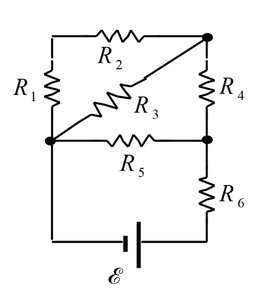
Q1b. Considering ℰ = 12 V and R1 = R2 = R4 = B Ω, R3 = R5 = 2B Ω, and R6 = A Ω:
Background
Topic: Complex Circuit Analysis, Equivalent Resistance, and Kirchhoff's Rules
This question tests your ability to find equivalent resistance, calculate current, and apply Kirchhoff's rules in a multi-loop circuit.
Key Terms and Formulas:
Equivalent Resistance: Combine resistors in series and parallel using (series) and (parallel).
Ohm's Law:
Kirchhoff's Rules: Loop and Junction rules as above.
Step-by-Step Guidance
Draw the circuit and identify which resistors are in series and which are in parallel. Label all currents and emf directions.
Combine resistors step-by-step to find the equivalent resistance of the circuit. Start with parallel and series combinations as appropriate.
Once you have , use Ohm's law to set up the equation for the total current from the battery.
Apply Kirchhoff's loop rule to the bottom loop containing R5 and R6, and write the equation for the loop.
Try solving on your own before revealing the answer!
Q2. For the circuit shown in image_1:
Background
Topic: Circuit Analysis with Multiple Batteries and Kirchhoff's Rules
This question tests your ability to analyze a circuit with two batteries and three resistors using Kirchhoff's rules, and to calculate current, voltage, and power.
Key Terms and Formulas:
Kirchhoff's Loop Rule: around a closed loop.
Kirchhoff's Junction Rule: at a junction.
Ohm's Law:
Power Dissipation:
Step-by-Step Guidance
Examine the circuit and determine if you can calculate the equivalent resistance. Consider the arrangement of batteries and resistors.
Label the currents: I1 for the left battery, I2 for the right battery, and I3 for the middle wire. Indicate the direction of each current.
Write the junction rule at the central node: (or similar, depending on current directions).
Apply Kirchhoff's loop rule to the left loop (containing ℰ1, R1, and R2) and the right loop (containing ℰ2, R3, and R2). Write the equations using only the given symbols.
Set up the system of equations to solve for I1, I2, and I3, but stop before plugging in numbers or solving.
Try solving on your own before revealing the answer!
