 Back
BackStep-by-Step Guidance for Physics 102: Electric Charges and Electric Fields Problems
Study Guide - Smart Notes
 Tailored notes based on your materials, expanded with key definitions, examples, and context.
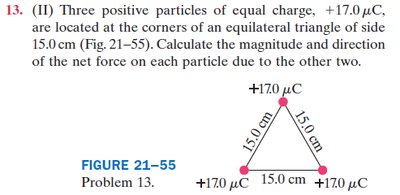
Q13. Three positive particles of equal charge, +17.0 μC, are located at the corners of an equilateral triangle of side 15.0 cm. Calculate the magnitude and direction of the net force on each particle due to the other two.
Background
Topic: Coulomb's Law and Vector Addition of Forces
This question tests your ability to apply Coulomb's Law to calculate the forces between point charges and to use vector addition to find the net force on a charge in a symmetric arrangement.
Key Terms and Formulas
Coulomb's Law:
Superposition Principle: The net force is the vector sum of the individual forces.
For an equilateral triangle, the angle between forces is 60°.
Step-by-Step Guidance
Calculate the magnitude of the force between any two charges using Coulomb's Law. Use and .
Draw a diagram showing the forces acting on one charge due to the other two. Each force acts along the line joining the charges.
Resolve the two forces into their x and y components. Remember, the angle between the forces is 60°.
Add the components vectorially to find the net force's magnitude and direction. (Stop here before the final calculation.)
Try solving on your own before revealing the answer!
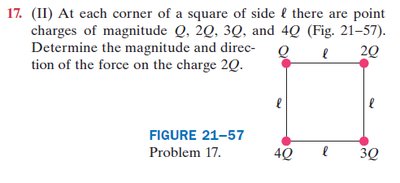
Q17. At each corner of a square of side there are point charges of magnitude , , , and . Determine the magnitude and direction of the force on the charge .
Background
Topic: Coulomb's Law and Vector Addition in Two Dimensions
This problem involves calculating the net force on one charge due to three others at the corners of a square, requiring vector addition of forces at different angles.
Key Terms and Formulas
Coulomb's Law:
Forces along the sides: ; along the diagonal:
Vector addition for forces at 90° and 45° angles
Step-by-Step Guidance
Identify the positions of all charges and label them. Place at a specific corner for clarity.
Calculate the force on due to each of the other three charges using Coulomb's Law, considering their distances.
Resolve each force into x and y components based on their directions (along sides and diagonals).
Sum the components to find the net force's magnitude and direction. (Stop here before the final calculation.)
Try solving on your own before revealing the answer!
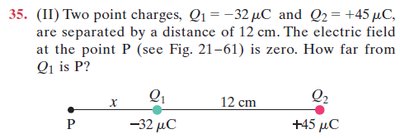
Q35. Two point charges, and , are separated by a distance of 12 cm. The electric field at point P is zero. How far from is P?
Background
Topic: Electric Field Due to Point Charges
This question tests your understanding of the electric field produced by multiple charges and how to find a point where the net field is zero.
Key Terms and Formulas
Electric field due to a point charge:
Superposition principle: The net field is the algebraic sum of the fields from each charge.
Step-by-Step Guidance
Let the distance from to point P be . The distance from to P is then .
Write expressions for the electric field at P due to each charge, considering their directions (fields due to positive and negative charges point in opposite directions).
Set the sum of the fields equal to zero and solve for . (Stop here before the final calculation.)
Try solving on your own before revealing the answer!
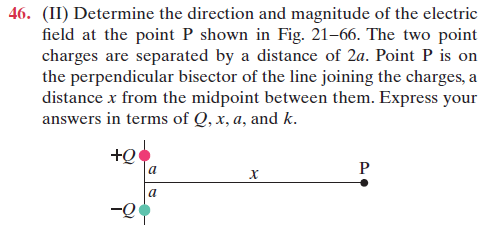
Q46. Determine the direction and magnitude of the electric field at point P, which is on the perpendicular bisector of the line joining two charges and separated by . Point P is a distance from the midpoint. Express your answers in terms of , , , and .
Background
Topic: Electric Field of a Dipole
This problem involves calculating the electric field at a point on the perpendicular bisector of a dipole, using vector addition and symmetry.
Key Terms and Formulas
Electric field due to a point charge:
Superposition principle: Add the fields from both charges vectorially.
Geometry: Use the Pythagorean theorem to find distances from each charge to P.
Step-by-Step Guidance
Calculate the distance from each charge to point P using the geometry of the setup.
Write the expression for the electric field at P due to each charge, considering both magnitude and direction.
Resolve the fields into components and add them to find the net field at P. (Stop here before the final calculation.)
Try solving on your own before revealing the answer!
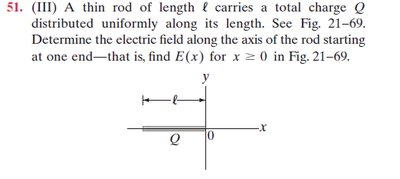
Q51. A thin rod of length carries a total charge distributed uniformly along its length. Determine the electric field along the axis of the rod starting at one end—that is, find for .
Background
Topic: Electric Field of a Continuous Charge Distribution
This question tests your ability to use integration to find the electric field due to a uniformly charged rod at a point along its axis.
Key Terms and Formulas
Linear charge density:
Electric field due to a small element:
Integration over the length of the rod
Step-by-Step Guidance
Express an infinitesimal charge element at position along the rod.
Write the distance from to the field point at as .
Set up the integral for the total electric field at by integrating from to . (Stop here before the final calculation.)
Try solving on your own before revealing the answer!
Q59. A dipole consists of charges and separated by 0.68 nm. It is in an electric field . (a) What is the value of the dipole moment? (b) What is the torque on the dipole when it is perpendicular to the field? (c) What is the torque on the dipole when it is at an angle of 45° to the field? (d) What is the work required to rotate the dipole from being oriented parallel to the field to being antiparallel to the field?
Background
Topic: Electric Dipoles in Electric Fields
This problem covers the concepts of dipole moment, torque on a dipole in an electric field, and work done in rotating a dipole.
Key Terms and Formulas
Dipole moment:
Torque:
Work to rotate dipole:
Elementary charge:
Step-by-Step Guidance
Calculate the dipole moment using .
Find the torque when the dipole is perpendicular to the field ().
Find the torque when the dipole is at to the field.
Set up the expression for the work required to rotate the dipole from parallel to antiparallel orientation. (Stop here before the final calculation.)
Try solving on your own before revealing the answer!
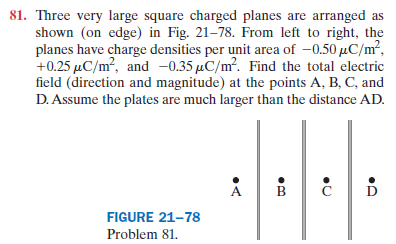
Q81. Three very large square charged planes are arranged as shown. The planes have charge densities per unit area of , , and . Find the total electric field (direction and magnitude) at the points A, B, C, and D. Assume the plates are much larger than the distance AD.
Background
Topic: Electric Field Due to Infinite Planes of Charge
This question tests your understanding of the electric field produced by infinite charged planes and the principle of superposition.
Key Terms and Formulas
Electric field due to an infinite plane:
Direction: Away from positive, toward negative charge
Superposition: Add the fields from each plane at each point
Step-by-Step Guidance
Determine the direction of the electric field produced by each plane at each point (A, B, C, D).
Calculate the magnitude of the field from each plane using .
Add the contributions from all planes at each point, considering their directions. (Stop here before the final calculation.)
Try solving on your own before revealing the answer!
