 Back
BackStep-by-Step Guidance for Selected Physics Problems (PHYS 1403)
Study Guide - Smart Notes
 Tailored notes based on your materials, expanded with key definitions, examples, and context.
Q1. Is the expression dimensionally correct, where is distance, is acceleration, is velocity, and is time?
Background
Topic: Dimensional Analysis
This question tests your ability to check the dimensional consistency of a physical equation by comparing the dimensions of each term.
Key Terms and Formulas:
Distance :
Velocity :
Acceleration :
Time :
Step-by-Step Guidance
Find the dimensions of : .
Simplify the dimensions to see if they match (distance).
Check the dimensions of and to ensure all terms are consistent.
Try solving on your own before revealing the answer!
Q2. Find the x-component of the velocity vector clockwise from the positive y-axis).
Background
Topic: Vectors and Components
This question tests your understanding of how to resolve a vector into its x- and y-components using trigonometry.
Key Terms and Formulas:
Vector magnitude:
Angle: (clockwise from positive y-axis)
X-component: (since angle is from y-axis)
Step-by-Step Guidance
Draw the vector and identify the angle relative to the axes.
Determine which trigonometric function to use for the x-component (since the angle is from the y-axis, use sine).
Set up the expression: .
Plug in the values: , .
Try solving on your own before revealing the answer!
Q3. Given vectors and , which is ?
Background
Topic: Vector Addition and Subtraction
This question tests your ability to perform vector operations, specifically subtraction and scalar multiplication.
Key Terms and Formulas:
Vector subtraction: means you double and subtract it from .
Step-by-Step Guidance
Draw vectors and (if provided) or imagine their directions and magnitudes.
Multiply by 2 to get .
Subtract from by reversing $2\vec{A}$ and adding it to $\vec{B}$.
Compare the resulting vector to the options given (A, B, C, D, None).
Try solving on your own before revealing the answer!
Q4. The motion diagram below tracks the position of Swimmer A. The swimmer begins at at and reaches at . Assuming constant velocity, calculate the position of Swimmer A at .
Background
Topic: Kinematics (Constant Velocity Motion)
This question tests your ability to use the equation for constant velocity motion to find position at a given time.
Key Terms and Formulas:
Constant velocity:
Position at time :
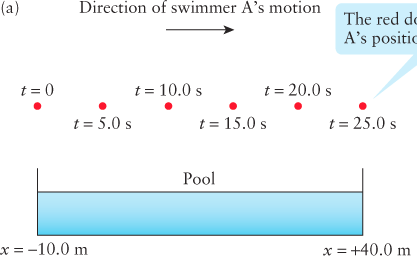
Step-by-Step Guidance
Calculate the swimmer's velocity: .
Plug in the values: , , , .
Use the velocity to find the position at : .
Plug in , (from previous step), and .
Try solving on your own before revealing the answer!
Q5. If the archerfish spits its water from the horizontal aiming at an insect above the surface of the water, how fast must the fish spit the water to hit its target? The insect is at the highest point of the trajectory of the spit water.
Background
Topic: Projectile Motion (Maximum Height)
This question tests your understanding of projectile motion, specifically how to relate the maximum height to the initial velocity and launch angle.
Key Terms and Formulas:
Maximum height:
Given: , ,
Step-by-Step Guidance
Write the formula for maximum height: .
Rearrange to solve for : .
Plug in the values for , , and .
Set up the calculation, but do not compute the final value yet.
Try solving on your own before revealing the answer!
Q6. An object is moving with constant velocity. Which of the following best describes the force(s) acting on the object?
Background
Topic: Newton's First Law (Inertia)
This question tests your understanding of the relationship between net force and constant velocity motion.
Key Terms and Formulas:
Newton's First Law: An object in motion remains in motion at constant velocity unless acted upon by a net external force.
Net force: for constant velocity.
Step-by-Step Guidance
Recall that constant velocity means zero acceleration.
Apply Newton's First Law to determine the net force.
Evaluate each answer choice in light of the law.
Try solving on your own before revealing the answer!
Q7. A 123.0 N carton is pulled up a frictionless baggage ramp inclined at above the horizontal by a rope exerting a 73.4 N pull parallel to the ramp's surface. The carton travels 6.20 m along the surface of the ramp. Calculate the work done on the carton by gravity.
Background
Topic: Work and Energy (Work by Gravity)
This question tests your ability to calculate the work done by gravity when an object moves along an inclined plane.
Key Terms and Formulas:
Work by gravity:
(weight), is distance along the ramp, is the angle between force and displacement.
Step-by-Step Guidance
Identify the force of gravity acting vertically downward ().
Find the angle between the direction of gravity and the displacement along the ramp ( or below horizontal).
Set up the work formula: where is the angle between force and displacement.
Plug in the values: , , (or its supplement, depending on your convention).
Try solving on your own before revealing the answer!
Q8. Two blocks of masses 2 kg and 3 kg are in contact on a horizontal frictionless surface. If a horizontal force of 15 N is applied to the 2 kg mass, what is the magnitude of the force on the block with mass 2 kg exerted by the block with mass 3 kg?
Background
Topic: Newton's Laws (Contact Forces)
This question tests your understanding of how forces are transmitted between objects in contact on a frictionless surface.
Key Terms and Formulas:
Newton's Second Law:
Contact force: The force that one block exerts on the other.
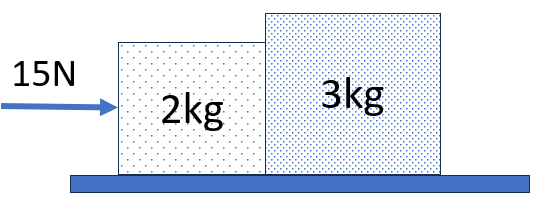
Step-by-Step Guidance
Calculate the total acceleration of the system: .
Draw a free-body diagram for the 2 kg block, showing the applied force and the contact force from the 3 kg block.
Write Newton's Second Law for the 2 kg block: .
Rearrange to solve for and substitute the values for , , and .
Try solving on your own before revealing the answer!
Q9. Two blocks of mass and () slide on a frictionless floor and have the same initial speed when they hit a long rough stretch (), which slows them to stop. Which one goes farther?
Background
Topic: Friction and Kinetic Energy
This question tests your understanding of how friction affects the stopping distance of objects with different masses but the same initial speed.
Key Terms and Formulas:
Kinetic friction force:
Work-energy principle:
Stopping distance:
Step-by-Step Guidance
Write the work-energy equation: .
Solve for in terms of , , and .
Notice whether mass cancels out or not, and compare the stopping distances for and .
Try solving on your own before revealing the answer!
Q10. A 62 kg person sits on a 4.0 kg chair with four legs. Each leg of the chair makes contact with the floor in a circle that is 1.5 cm in diameter. Find the pressure exerted on the floor by each leg of the chair, assuming the weight is evenly distributed.
Background
Topic: Pressure and Force
This question tests your ability to calculate pressure as force per unit area, considering the distribution of weight and the contact area.
Key Terms and Formulas:
Pressure:
Force:
Area per leg: , where
Step-by-Step Guidance
Calculate the total weight: .
Divide the total weight by 4 to get the force per leg.
Find the radius of the contact area: .
Calculate the area per leg: .
Set up the pressure formula: .
Try solving on your own before revealing the answer!
Q11. An object with a mass of 20 kg is initially at rest at the top of a frictionless inclined plane that rises at above the horizontal. At the top, the object is initially 8.0 m from the bottom of the incline. When the object is released, it eventually stops at a distance from the bottom of the inclined plane along a horizontal surface. The coefficient of kinetic friction between the horizontal surface and the object is 0.40. Find the distance $d$.
Background
Topic: Work-Energy Principle (Friction and Inclined Planes)
This question tests your ability to apply energy conservation and work done by friction to find the stopping distance on a horizontal surface after sliding down an incline.
Key Terms and Formulas:
Potential energy at top:
Work done by friction:
Energy conservation:
Step-by-Step Guidance
Calculate the height of the incline: .
Find the initial potential energy: .
Set up the work-energy equation: .
Solve for in terms of the given values.
Try solving on your own before revealing the answer!
Q12. We can roughly model a gymnastic tumbler as a uniform solid cylinder of mass 68.0 kg and diameter 1.20 m. If this tumbler rolls forward at 0.550 rev/s, how much total kinetic energy does he have? (, rad)
Background
Topic: Rotational Kinetic Energy
This question tests your ability to calculate the total kinetic energy (translational + rotational) of a rolling object.
Key Terms and Formulas:
Translational KE:
Rotational KE:
Moment of inertia for solid cylinder:
Relationship:
Convert rev/s to rad/s:
Step-by-Step Guidance
Calculate the radius: .
Convert angular speed to rad/s: .
Find the linear speed: .
Calculate and using the formulas above.
Add both kinetic energies for the total.
Try solving on your own before revealing the answer!
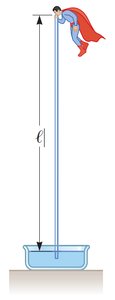
Q13. Superman attempts to drink cold water through a straw of length . The walls of the straw are very strong and do not collapse. What is the water pressure at the top of the straw (assuming fluid is at rest)? (, )
Background
Topic: Fluid Statics (Hydrostatic Pressure)
This question tests your understanding of how to calculate the pressure at a certain height in a fluid column.
Key Terms and Formulas:
Hydrostatic pressure:
is atmospheric pressure, is density, is gravity, is height (length of straw)
Step-by-Step Guidance
Write the hydrostatic pressure equation: .
Plug in , , , .
Set up the calculation for at the top of the straw.
Try solving on your own before revealing the answer!
