 Back
BackStep-by-Step Physics Study Guidance for Midterm Exam 1
Study Guide - Smart Notes
 Tailored notes based on your materials, expanded with key definitions, examples, and context.
Q1. Two concentric spheres: Find the total excess charge on the inner and outer surfaces of the conducting sphere.
Background
Topic: Electrostatics, Conductors, and Charge Distribution
This question tests your understanding of how charges distribute themselves on conductors and the application of Gauss's Law to spherical geometries.
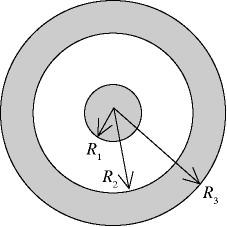
Key Terms and Formulas:
Gauss's Law:
Conductors in electrostatic equilibrium: Excess charge resides on the surface.
Charge conservation: The net charge on the shell is the sum of charges on its inner and outer surfaces.
Step-by-Step Guidance
Identify the charges: The inner sphere has , and the outer shell has .
Recall that the inner surface of the conducting shell must have a charge that cancels the field from the inner sphere inside the conductor.
Use charge conservation: The total charge on the shell is the sum of the charges on its inner and outer surfaces.
Set up equations for the inner and outer surface charges based on the above principles.
Try solving on your own before revealing the answer!
Final Answer:
Inner surface charge: Outer surface charge:
The inner surface must have to cancel the field from the inner sphere, and the outer surface has the remainder to make the total shell charge .
Q2. Find the magnitude and direction of the electric field at the center (r = 0 cm) of the inner sphere.
Background
Topic: Electric Field Inside a Charged Sphere
This question tests your understanding of electric fields inside conductors and nonconductors, especially at the center.
Key Terms and Formulas:
Gauss's Law:
Electric field inside a solid nonconducting sphere with surface charge: at the center.
Step-by-Step Guidance
Consider the symmetry: At the center, all contributions from surface charge cancel out.
Recall that for a solid nonconducting sphere with surface charge, the electric field inside is zero.
Use Gauss's Law to confirm the result.
Try solving on your own before revealing the answer!
Final Answer:
The electric field at the center is $0$ N/C.
By symmetry and Gauss's Law, the field at the center of a sphere with surface charge is zero.
Q3. Find the magnitude and direction of the electric field at r = 15.0 cm from the center of the inner sphere.
Background
Topic: Electric Field Between Spherical Shells
This question tests your ability to use Gauss's Law to find the electric field at a point between two concentric spheres.
Key Terms and Formulas:
Gauss's Law:
For between and , only the inner sphere's charge is enclosed.
Step-by-Step Guidance
Identify the region: cm is between and .
Apply Gauss's Law for a spherical surface at cm.
Enclosed charge is only the inner sphere's charge: .
Set up the formula: .
Try solving on your own before revealing the answer!
Final Answer:
N/C, directed radially outward.
The field is due to the inner sphere's charge only, since is between and .
Q4. Find the magnitude and direction of the electric field at r = 27.0 cm from the center of the inner sphere.
Background
Topic: Electric Field Outside a Spherical Shell
This question tests your understanding of how to use Gauss's Law to find the electric field outside the inner sphere but inside the outer shell.
Key Terms and Formulas:
Gauss's Law:
For between and , the enclosed charge includes the inner sphere and the inner surface of the shell.
Step-by-Step Guidance
Identify the region: cm is between and .
Determine the total enclosed charge: sum the inner sphere's charge and the inner surface charge of the shell.
Apply Gauss's Law for a spherical surface at cm.
Set up the formula: .
Try solving on your own before revealing the answer!
Final Answer:
N/C
The field is zero because the total enclosed charge is zero (inner sphere and shell's inner surface charges cancel).
Q5. Find the magnitude and direction of the electric field at r = 35.0 cm from the center of the inner sphere.
Background
Topic: Electric Field Outside Both Spheres
This question tests your ability to use Gauss's Law to find the electric field outside the entire system.
Key Terms and Formulas:
Gauss's Law:
For , the enclosed charge is the sum of all charges.
Step-by-Step Guidance
Identify the region: cm is outside both spheres.
Sum all charges: inner sphere and shell.
Apply Gauss's Law for a spherical surface at cm.
Set up the formula: .
Try solving on your own before revealing the answer!
Final Answer:
N/C, directed radially inward.
The field is due to the net charge of the system, which is .
