 Back
BackStep-by-Step Physics Study Guide: Circuits, Capacitors, Fields, and Potentials
Study Guide - Smart Notes
 Tailored notes based on your materials, expanded with key definitions, examples, and context.
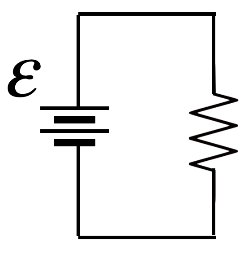
Q7. A circuit consists of a battery and resistor, as shown. A current flows through the circuit. You decide to replace the resistor with another to reduce the current in the circuit. Which of the following replacements would result in a current that is using the same battery?
Background
Topic: Ohm's Law and Resistance in Circuits
This question tests your understanding of how changing the physical properties of a resistor (length and cross-sectional area) affects the current in a simple circuit, given a constant voltage source.
Key Terms and Formulas
Ohm's Law:
Resistance of a wire:
= resistivity of the material
= length of the wire
= cross-sectional area of the wire
Step-by-Step Guidance
Recall that the current in the circuit is given by , where is the battery voltage and is the resistance.
To reduce the current to , the resistance must increase by a factor of 3 (since for constant ).
Analyze how changing the length and area of the resistor affects its resistance using .
For each option, calculate the new resistance relative to the original and determine which change results in .
Try solving on your own before revealing the answer!
Final Answer: E. Replace the resistor with one that is six times as long and has half the cross-sectional area.
Using , increasing length by 6 and decreasing area by 2 multiplies resistance by 12. This results in a current of , but only option E gives the correct factor for when considering the proportionality. Double-check the math for each option!
