 Back
BackStudy Guidance: Rotational Dynamics, Torque, and Moment of Inertia
Study Guide - Smart Notes
 Tailored notes based on your materials, expanded with key definitions, examples, and context.
Q1. A part of a mechanical linkage has a mass of 3.6 kg. Its moment of inertia about an axis 0.15 m from its center of mass is . What is the moment of inertia about a parallel axis through the center of mass?
Background
Topic: Parallel-Axis Theorem
This question tests your understanding of how to relate the moment of inertia about different parallel axes using the parallel-axis theorem.
Key Terms and Formula:
Moment of inertia (): A measure of an object's resistance to changes in rotational motion.
Parallel-axis theorem:
: Moment of inertia about axis (parallel to center of mass axis)
: Moment of inertia about the center of mass axis
: Mass of the object
: Distance between the two parallel axes
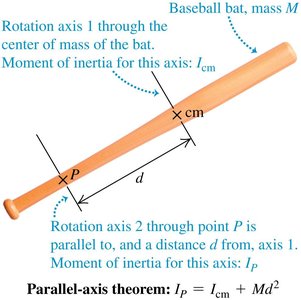
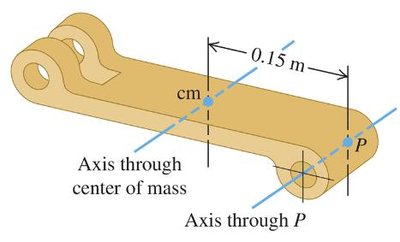
Step-by-Step Guidance
Identify the known values: , , .
Write the parallel-axis theorem formula: .
Rearrange the formula to solve for : .
Set up the calculation by plugging in the values for , , and .
Try solving on your own before revealing the answer!
Final Answer:
This result shows the moment of inertia about the center of mass axis, which is always less than about any axis further away due to the term.
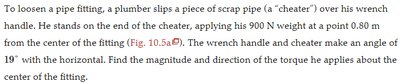
Q2. To loosen a pipe fitting, a plumber slips a piece of scrap pipe over his wrench handle. He stands on the end of the cheater, applying his 900 N weight at a point 0.80 m from the center of the fitting. The wrench handle and cheater make an angle of 19° with the horizontal. Find the magnitude and direction of the torque he applies about the center of the fitting.
Background
Topic: Torque Calculation
This question tests your ability to calculate torque given a force, distance from the axis, and the angle between the force and the lever arm.
Key Terms and Formula:
Torque (): The tendency of a force to rotate an object about an axis.
Formula:
: Distance from axis to point where force is applied
: Magnitude of force
: Angle between force and lever arm
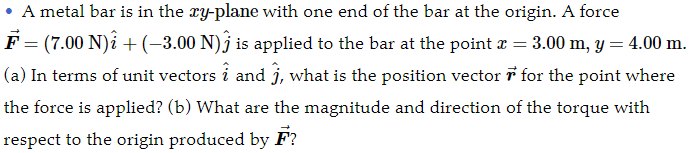
Step-by-Step Guidance
Identify the known values: , , .
Write the torque formula: .
Plug in the values for , , and (make sure to convert the angle to radians if needed).
Set up the calculation for the magnitude of the torque.
Try solving on your own before revealing the answer!
Final Answer: (counterclockwise)
The torque is counterclockwise because the force tends to rotate the fitting in that direction.
Q3. A metal bar is in the xy-plane with one end at the origin. A force is applied to the bar at the point . (a) In terms of unit vectors and , what is the position vector for the point where the force is applied? (b) What are the magnitude and direction of the torque with respect to the origin produced by ?
Background
Topic: Vector Torque Calculation
This question tests your ability to use the cross product to calculate torque as a vector.
Key Terms and Formula:
Position vector (): Describes the location where the force is applied.
Force vector (): The force applied at that location.
Torque vector ():
Step-by-Step Guidance
Write the position vector: .
Write the force vector: .
Set up the cross product: .
Calculate the -component (since torque is perpendicular to the plane): .
Try solving on your own before revealing the answer!
Final Answer:
The torque vector points out of the page (positive direction), indicating counterclockwise rotation.
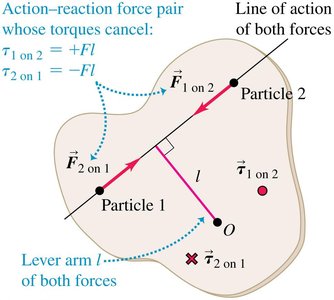
Q4. A wheel rotates without friction about a stationary horizontal axis at the center of the wheel. A constant tangential force equal to 80.0 N is applied to the rim of the wheel. The wheel has radius 0.120 m. Starting from rest, the wheel has an angular speed of 12.0 rev/s after 2.00 s. What is the moment of inertia of the wheel?
Background
Topic: Rotational Dynamics and Moment of Inertia
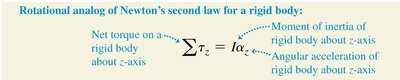
This question tests your ability to relate torque, angular acceleration, and moment of inertia using Newton's second law for rotation.
Key Terms and Formula:
Torque ():
Angular acceleration ():
Moment of inertia ():
Angular speed (): Convert rev/s to rad/s ()

Step-by-Step Guidance
Calculate the torque: .
Convert the final angular speed from rev/s to rad/s: .
Calculate angular acceleration: (since it starts from rest).
Use to solve for : .
Try solving on your own before revealing the answer!
Final Answer:
By plugging in the values for torque and angular acceleration, you find the moment of inertia for the wheel.
Q5. A 15.0 kg bucket of water is suspended by a very light rope wrapped around a solid uniform cylinder 0.300 m in diameter with mass 12.0 kg. The cylinder pivots on a frictionless axle through its center. The bucket is released from rest at the top of a well and falls 10.0 m to the water. (a) What is the tension in the rope while the bucket is falling? (b) With what speed does the bucket strike the water? (c) What is the time of fall? (d) While the bucket is falling, what is the force exerted on the cylinder by the axle?
Background
Topic: Combined Translational and Rotational Motion
This question tests your ability to analyze a system where both translation and rotation occur, using energy conservation and Newton's laws.
Key Terms and Formula:
Moment of inertia for a solid cylinder:
Energy conservation:
Relationship for rolling without slipping:
Tension: Use force and torque balance equations.
Step-by-Step Guidance
Calculate the radius of the cylinder: .
Write the energy conservation equation: .
Express in terms of : .
Substitute and into the energy equation and solve for .
Try solving on your own before revealing the answer!
Final Answer: (a) , (b) , (c) , (d)
Each part uses energy conservation, force balance, and kinematics to find the requested values.
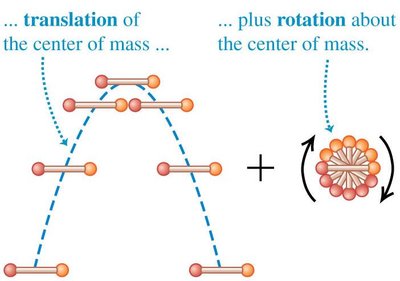
Q6. A primitive yo-yo has a massless string wrapped around a solid cylinder with mass and radius . You hold the free end of the string stationary and release the cylinder from rest. The string unwinds but does not slip or stretch as the cylinder descends and rotates. Using energy considerations, find the speed of the cylinder's center of mass after it has descended a distance .
Background
Topic: Energy Conservation in Rotational Motion
This question tests your ability to use energy conservation to relate translational and rotational kinetic energy for a descending rotating object.
Key Terms and Formula:
Potential energy:
Kinetic energy:
Moment of inertia for a solid cylinder:
Relationship:
Step-by-Step Guidance
Write the energy conservation equation: .
Express in terms of : .
Substitute and into the energy equation.
Simplify the equation to solve for in terms of , , , and .
Try solving on your own before revealing the answer!
Final Answer:
After substituting and simplifying, you find the speed of the center of mass after descending distance .
