 Back
Study Guide: 1-Dimensional Motion, Position-Time & Velocity-Time Graphs
Study Guide - Smart Notes
 Tailored notes based on your materials, expanded with key definitions, examples, and context.
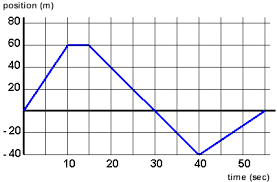
Q4. Use the graph to answer the following questions about an object's movements. Positive values are to the left of the object's reference position.
Background
Topic: Position vs. Time Graphs
This question tests your ability to interpret position-time graphs, determine direction of motion, periods of rest, total distance traveled, and displacement. These are foundational concepts in kinematics, a core topic in Physics with Calculus.
Key Terms and Formulas:
Position (): The location of an object relative to a reference point.
Displacement (): The change in position; .
Distance: The total length of the path traveled, regardless of direction.
Average Velocity (): .
Step-by-Step Guidance
Examine the graph to identify the object's position at each time interval. Note the direction of movement by observing whether the position increases or decreases.
For each segment (0–10 s, 10–15 s, 15–40 s, 40–50 s, 50–55 s), determine if the object is moving left, right, or is at rest by checking if the position changes or remains constant.
To find periods of rest, look for flat (horizontal) sections of the graph where position does not change with time.
Calculate the total distance traveled by summing the absolute values of each segment's movement, regardless of direction.
Compute the displacement by subtracting the initial position from the final position: .
For each question, set up the relevant calculation or reasoning based on the graph's data, but stop before plugging in the final values.
Try solving on your own before revealing the answer!
Final Answers:
a) The object is moving left (positive direction) between 0 and 10 seconds.
b) The object is moving right (negative direction) between 15 and 40 seconds.
c) The object is moving left (positive direction) between 40 and 50 seconds.
d) The object is at rest between 10 and 15 seconds.
e) The total distance traveled is 60 m (0–10 s) + 60 m (15–40 s) + 30 m (40–50 s) = 150 m.
f) The displacement from 0 to 55 seconds is -10 m (final position) minus 10 m (initial position) = -20 m (right).
Each answer is based on careful reading of the graph and applying the definitions of displacement and distance.
