 Back
BackStudy Guide: Electric Charge, Electric Field, Electric Potential, Capacitance, and Circuits (Chapters 17–19)
Study Guide - Smart Notes
 Tailored notes based on your materials, expanded with key definitions, examples, and context.
Chapter 17: Electric Charge and Electric Field
Basic Properties of Electric Charge
Electric charge is a fundamental property of matter that causes it to experience a force when placed in an electric or magnetic field. Charges come in two types: positive and negative. Like charges repel each other, while opposite charges attract. The elementary charge, denoted as e, is the magnitude of charge carried by a single proton or electron, with e = 1.60 \times 10^{-19} \text{ C}. Charge is quantized, meaning it only occurs in integer multiples of this elementary charge.
Conductors: Materials that allow easy movement of charge.
Insulators: Materials that do not allow easy movement of charge.
Coulomb's Law
Coulomb's law describes the force between two point charges:
where and .
The force acts along the line joining the two charges.
Repulsive for like charges; attractive for opposite charges.
Superposition Principle for Forces
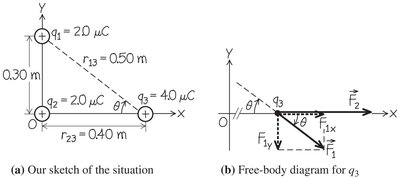
When multiple charges exert forces on a single charge, the total force is the vector sum of all individual forces.
For example, the force on due to and is calculated by summing the vector forces from each charge.
Electric Field
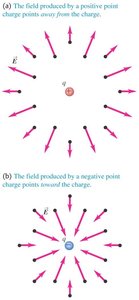
The electric field is a region around a charged object where other charges experience a force. It is defined as:
For a point charge:
The direction of the electric field is away from positive charges and toward negative charges.
Electric Field from Multiple Charges
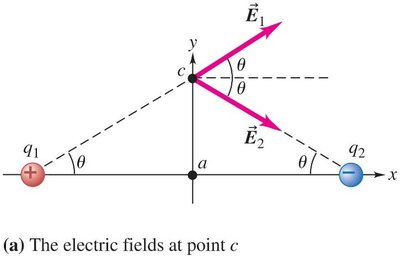
The total electric field at a point due to several charges is the vector sum of the fields from each charge:
Electric Field Lines
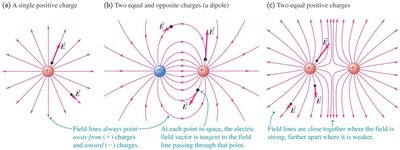
Electric field lines are a visual representation of the electric field. They indicate the direction and strength of the field:
Lines point away from positive charges and toward negative charges.
The density of lines indicates the strength of the field.
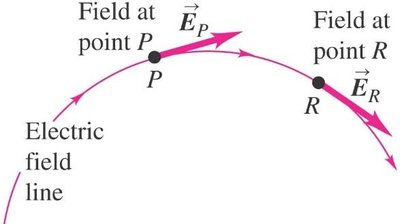
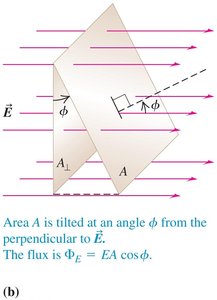
Electric Flux and Gauss's Law
Electric flux measures the number of electric field lines passing through a surface:
Gauss's law relates the electric flux through a closed surface to the charge enclosed:
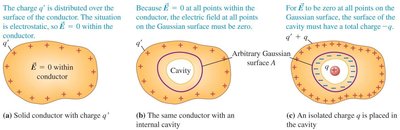
Charges Inside Conductors
In electrostatic equilibrium, the electric field inside a conductor is zero, and excess charge resides on the surface. If a cavity is present, the field inside the cavity depends on whether a charge is placed inside.
Chapter 18: Electric Potential and Capacitance
Electric Potential Energy and Work
When a charge moves in an electric field, the field does work on the charge, changing its potential energy:
For a uniform field:
For point charges:
For multiple charges:
Electric Potential
Electric potential is the potential energy per unit charge:
For a point charge:
For multiple point charges:
Equipotential Surfaces
Equipotential surfaces are regions where the electric potential is constant. They are always perpendicular to electric field lines.
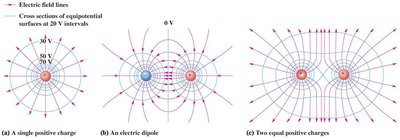
Capacitance
Capacitance is the ability of a system to store charge per unit voltage:
For a parallel-plate capacitor:
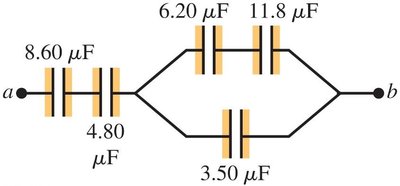
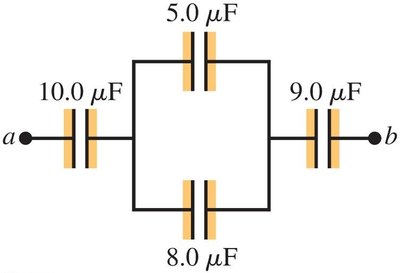
Capacitors in series:
Capacitors in parallel:
Energy stored in a capacitor:
Dielectric materials increase capacitance by a factor of :
Chapter 19: Current, Resistance, and Directed-Current Circuits
Electric Current
Electric current is the rate of flow of charge:
Ohm's Law and Resistance
Ohm's law relates voltage, current, and resistance:
Resistance depends on material properties:
For a source with emf and internal resistance :
Power in Electric Circuits
Power delivered in a circuit:
Resistors in Series and Parallel
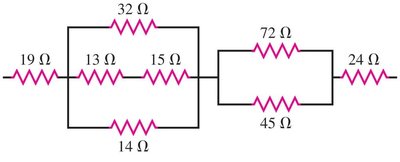
Series: (same current)
Parallel: (same voltage)
Kirchhoff’s Rules
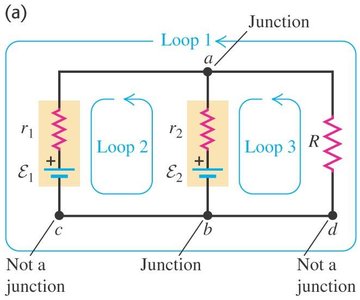
Kirchhoff’s rules are used to analyze complex circuits:
Junction Rule: The sum of currents entering a junction equals the sum leaving ().
Loop Rule: The sum of voltage changes around a closed loop is zero ().
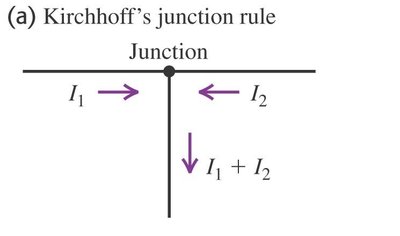
When calculating, choose a sign convention for current and stick with it (e.g., current into a junction is positive, out is negative).
