 Back
Study Guide: Forces and Newton’s Laws of Motion & Applying Newton’s Laws
Study Guide - Smart Notes
 Tailored notes based on your materials, expanded with key definitions, examples, and context.
Forces and Newton’s Laws of Motion
Newton’s First Law
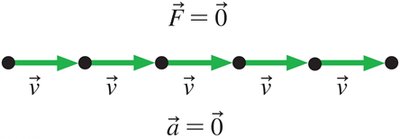
Newton’s First Law, also known as the law of inertia, states that an object at rest remains at rest, and an object in motion continues in a straight line at constant speed unless acted upon by a net external force.
Inertia: The tendency of an object to resist changes in its state of motion.
Acceleration: Occurs only when a net force acts on the object.
Equation:
Example: A hockey puck glides on ice until friction or another force acts upon it.
Newton’s Second Law
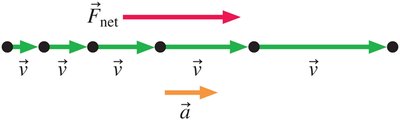
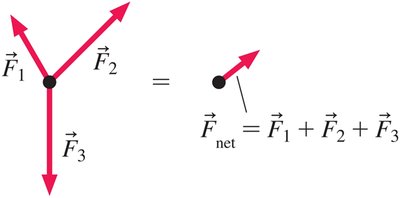
Newton’s Second Law establishes the relationship between force, mass, and acceleration. The net force acting on an object is equal to the product of its mass and acceleration.
Equation:
Vector Sum: The net force is the vector sum of all individual forces acting on the object.
SI Unit: Newton (N), where
Example: If two forces act on an object, their vector sum determines the acceleration.
Force: Definition and Types
A force is a push or pull exerted on an object, characterized by both magnitude and direction (vector quantity).
Contact Forces: Result from physical contact (e.g., friction, tension).
Long-Range Forces: Act over a distance (e.g., gravity, electromagnetic force).
Agent: The source of the force.
Common Forces: Weight, spring force, tension, normal force, static and kinetic friction, drag, thrust.
Force | Notation |
|---|---|
General force | |
Weight | |
Spring force | |
Tension | |
Normal force | |
Static friction | |
Kinetic friction | |
Drag | |
Thrust |
Mass and Acceleration
Mass is a measure of an object’s resistance to acceleration (inertia). The ratio of accelerations for two objects under the same force is inversely proportional to their masses.
Equation:
Application: Heavier objects accelerate less under the same force.
Free-Body Diagrams
Drawing Free-Body Diagrams
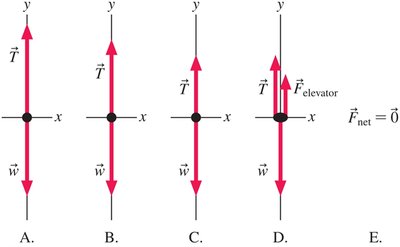
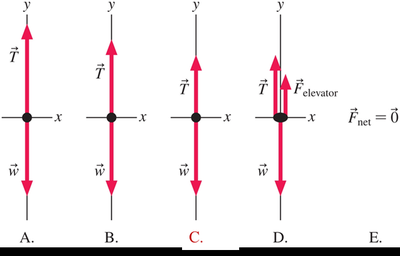
Free-body diagrams are essential tools for analyzing forces acting on an object. They represent the object as a particle and show all forces acting upon it.
Steps:
Identify all forces acting on the object.
Draw a coordinate system (axes may be tilted for inclined motion).
Represent the object as a dot at the origin.
Draw and label vectors for each force.
Draw and label the net force vector beside the diagram.
Purpose: Helps visualize and sum forces for problem-solving.
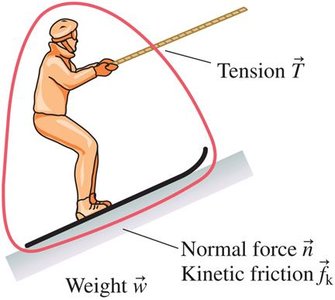
Example: Forces on a Towed Skier
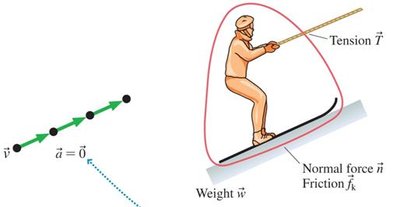
A skier is pulled up a hill at constant speed. The net force is zero, indicating dynamic equilibrium. Forces include tension (parallel to slope), kinetic friction (opposing motion), normal force (perpendicular to surface), and weight (vertically downward).
Key Point: Forces add to zero when acceleration is zero.
Application: Use tilted axes for inclined motion.
Newton’s Third Law
Action-Reaction Pairs
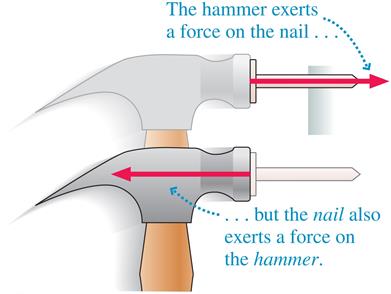
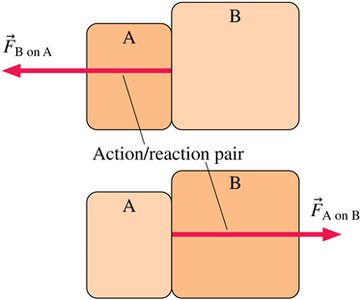
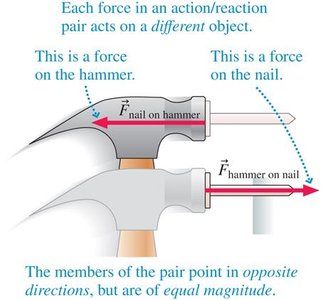
Newton’s Third Law states that for every action, there is an equal and opposite reaction. Forces always occur in pairs, acting on two different objects.
Action/Reaction Pair: If object A exerts a force on object B, then B exerts an equal and opposite force on A.
Equation:
Examples: Hammer and nail, bat and ball, foot and soccer ball.
Applications: Walking and Rockets
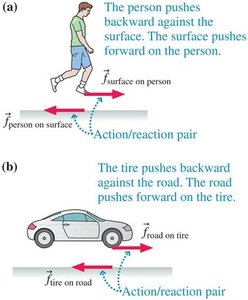
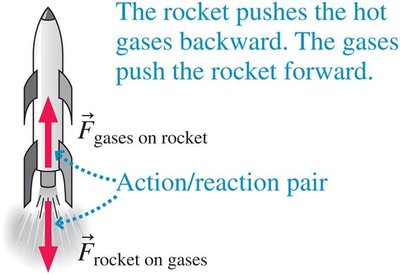
Static friction enables walking by providing a forward force. Rockets move forward by expelling gases backward, creating thrust.
Static Friction: Prevents slipping, points forward during walking.
Thrust: Forward force on rocket due to backward expulsion of gases.
Applying Newton’s Laws
Equilibrium
Equilibrium occurs when the net force on an object is zero. Static equilibrium refers to objects at rest, while dynamic equilibrium refers to objects moving at constant velocity.
Equation: ,
Application: Used to solve for unknown forces in equilibrium problems.
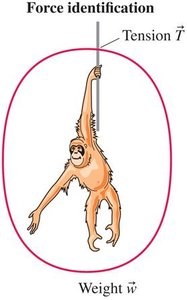
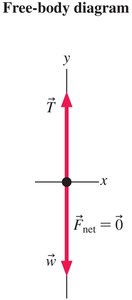
Example: Finding Forces on an Orangutan
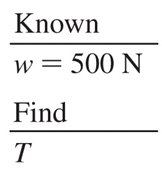
An orangutan hangs from a rope in static equilibrium. The tension in the rope equals the weight of the orangutan.
Equation:
Application: Tension is 500 N for a 500 N orangutan.
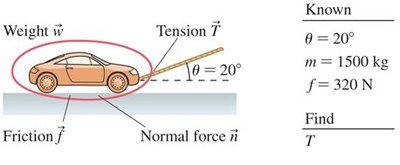
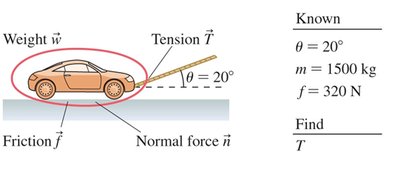
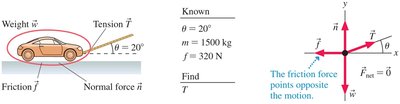
Example: Towing a Car at Constant Speed
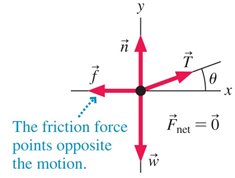
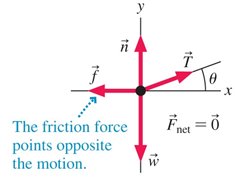
A car is towed at constant speed by a rope at an angle. The tension must balance the friction force and the vertical component must support part of the car’s weight.
Equation: (horizontal equilibrium)
Application: Tension is slightly greater than friction due to the angle.
Dynamics and Newton’s Second Law
Dynamics problems involve objects accelerating under the influence of forces. Newton’s second law connects forces to kinematics.
Equation:
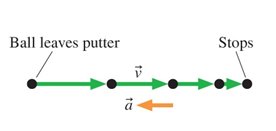
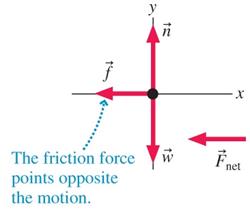
Approach: Use free-body diagrams to identify forces, then solve for acceleration or unknown forces.
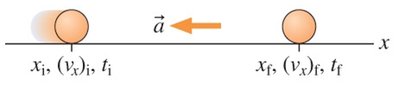
Example: Putting a Golf Ball
A golf ball slows due to friction. Use Newton’s second law to find acceleration, then kinematics to determine if it reaches the hole.
Equation:
Kinematics:
Mass, Weight, and Apparent Weight
Mass vs. Weight
Mass is a measure of inertia, while weight is the gravitational force exerted on an object. Weight depends on the local gravitational acceleration (), but mass is constant.
Equation:
Unit Conversion: ,
Apparent Weight
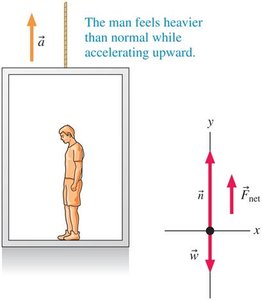
Apparent weight is the contact force supporting an object, such as the normal force from a scale. It differs from true weight when the object is accelerating vertically.
Equation:
Application: In an accelerating elevator, apparent weight increases or decreases depending on direction.
Weightlessness
Weightlessness occurs when the apparent weight is zero, such as during free fall. The object still has weight (gravitational force), but no contact force supports it.
Application: Astronauts in orbit experience weightlessness because they are in continuous free fall.

Summary and Problem-Solving Strategies
Equilibrium Problems
Check if object is at rest or moving at constant velocity.
Identify and draw all forces on a free-body diagram.
Use Newton’s second law in component form: ,
Assess if the result is reasonable.
Dynamics Problems
Sketch a pictorial representation and identify knowns.
Draw free-body diagram and motion diagram.
Use Newton’s second law:
Use kinematics as needed to find positions and velocities.
Assess if the result is reasonable.
Important Concepts
Newton’s laws are vector expressions; write them by components.
Apparent weight equals true weight only when vertical acceleration is zero.
*Additional info: Academic context and examples were expanded for clarity and completeness. Only images directly relevant to the explanation were included, as per instructions.*
